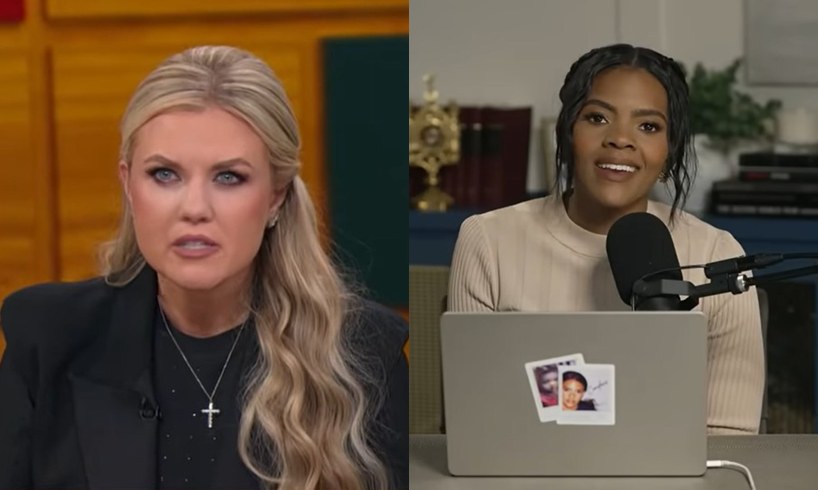
Erika Kirk and her nemesis, Candace Owens, finally faced off in their long-anticipated meeting.
What began as a deeply personal plea from a widow has evolved into a defining rupture within the modern conservative movement — one that is now forcing prominent right-wing figures to take sides.
Inside the Kirk–Owens Meeting That Exposed a Growing Rift on the Right
On Monday, Erika Kirk, the widow of slain conservative activist Charlie Kirk, met privately with Candace Owens after weeks of escalating tension over Owens’s promotion of conspiracy theories surrounding her husband’s assassination. The long-awaited meeting, held in person, lasted four and a half hours and was later described by both women as “productive,” though pointedly light on details.
The encounter came just days after Erika Kirk appeared in a CBS town hall moderated by Bari Weiss, where she delivered a blunt message to Owens when asked what she would say directly to her.
“Stop,” Kirk said. “That’s it. That’s all I have to say. Stop.”
A Meeting Years — and Grievances — in the Making
In the days leading up to Monday’s sit-down, both women signaled a pause in public escalation. Erika Kirk announced on X that she and Owens had agreed to suspend livestreams, tweets, and public commentary until after their private discussion. Owens echoed the sentiment, writing that she was “very much looking forward to this discussion.”
That restraint marked a sharp contrast to the months of public sparring that preceded it.
Owens, once a close friend of Charlie Kirk and a former Turning Point USA employee, initially urged restraint and respect following his assassination. But over time, she began amplifying increasingly fringe claims — suggesting involvement by everyone from the Israeli government to the U.S. military — while also leveling unsubstantiated allegations about the finances of Turning Point USA, which Erika Kirk now oversees.
Those claims were later undermined when the Treasury Department confirmed that none of the tax-exempt entities under Kirk’s leadership were under IRS investigation.
Still, the damage — both personal and political — had already been done.
“Nothing Was Held Back”
Following the meeting, Owens offered the most expansive account, describing an exhaustive and emotionally charged exchange.
“Erika and I had an extremely productive 4 1/2 hour meeting that I think we both feel should have taken place a lot earlier than it did,” Owens wrote. “We agreed much more than I had anticipated… Most importantly, we were able to share intel and clarify intent.”
She added that “nothing was held back” and that the immediate result was a thawing of tensions — a notable shift after months of public hostility.
Erika Kirk’s own post was shorter and more restrained.
“Had a very productive conversation with @RealCandaceO. More to come from both of us,” she wrote, before pivoting forward. “Looking forward to AmFest this week. Time to get back to work.”
The difference in tone between the two statements did not go unnoticed.
The Conservative Media Civil War
The dispute has never been just about two women. It has become a proxy battle for deeper ideological and ethical divides on the right — particularly over conspiracism, monetized outrage, and the boundaries of acceptable rhetoric.
That divide was laid bare when OutKick host and Fox News contributor Tomi Lahren publicly criticized the very idea of the meeting.
“I personally, if I were her, I wouldn’t do the meeting,” Lahren said, arguing that Owens thrives on controversy as content. “I wouldn’t give this other person any content… because when you have nothing else to talk about, you use other people for your content because you’re a vulture.”
Lahren went further, condemning what she described as the growing financial incentives behind extremism and conspiratorial rhetoric in the social media age — and explicitly calling out what she sees as rising antisemitism within right-wing circles.
Her comments made the divide impossible to ignore. Some on the right believe the moment calls for pushing back publicly and drawing clear lines. Others argue the smarter move is to starve provocateurs of attention altogether, especially when outrage has become a business model.
A Movement at a Crossroads
What is playing out between Kirk and Owens now reflects something larger than a personal dispute. It has come to represent the internal tug-of-war shaping conservative media more broadly. For Turning Point USA and to some extent other traditional conservative institutions, it is increasingly difficult not to clash with powerful influencers and internet personalities whose platforms reward provocation over policy. For Erika Kirk, the issue is deeply personal. It is rooted in grief, legacy, and the responsibility of protecting her late husband’s work. For Owens, it is framed as dissent, skepticism, and an insistence on questioning power structures, even when those questions drift into conspiracy.
The meeting may have cooled tensions between the two women, but it has not resolved the larger conflict it exposed.
As figures like Tomi Lahren openly pick sides and audiences fracture along trust lines, the right-wing movement appears increasingly divided over not just what it believes — but how it should behave.
Whether Monday’s conversation marks a turning point or merely a pause remains to be seen. What is clear is that the feud has already forced a reckoning — one that continues to reshape the conservative media landscape in real time.