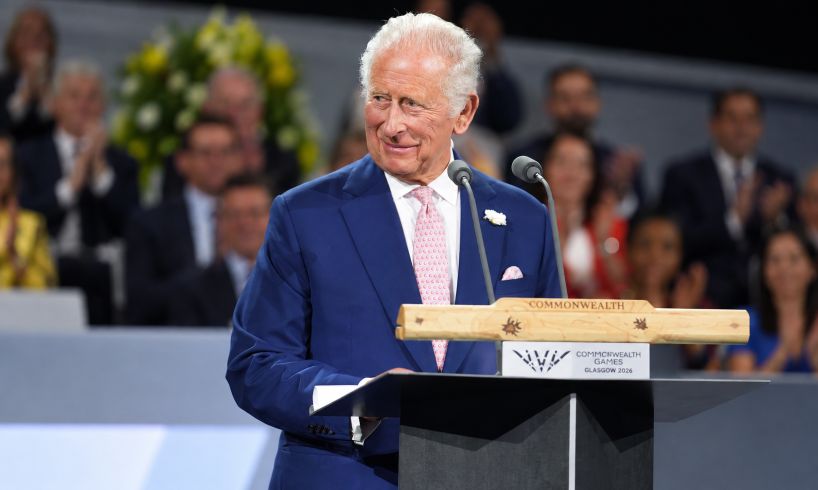
Something unusual is happening inside Britain’s most famous family. Everyone appears to agree on the basic facts. Prince Harry and Meghan Markle are not working members of the Royal Family. They do not represent King Charles III.
They are financially independent. Their charitable and commercial activities belong to them, not the monarchy.
And yet, after six years away, their return to Britain has created enough uncertainty that Buckingham Palace considered it necessary to put those facts in writing. That is where this story becomes much more interesting.
A letter authorized by King Charles and circulated by the Lord Chamberlain to senior government, military and other officials reaffirmed that Harry and Meghan remain non-working royals. They undertake their charitable activities privately, and their position was described as “akin to private citizens with commercial and charitable interests.”
Nothing in that language technically restored or removed a status Harry and Meghan did not already possess.And that may be the most revealing part of the entire episode.
The King was not announcing a new arrangement. He was making the existing arrangement impossible to misunderstand.
Why send a letter if nothing changed?
That is the first question worth asking. Harry and Meghan stopped being working royals in 2020. Six years later, the Palace did not suddenly discover that fact. What changed was their location.
The Duke and Duchess of Sussex returned to live in Britain with Prince Archie and Princess Lilibet after years based primarily in California. Their arrival placed them physically back inside the country where the distinction between member of the Royal Family and working representative of the monarchy carries real institutional consequences.
That distinction can blur quickly. Harry remains the King’s son. He remains a prince.
Harry and Meghan remain the Duke and Duchess of Sussex. Their children are Prince Archie and Princess Lilibet.
They can attend charities, appear at major events, attract international press and meet influential people.
To an ordinary observer watching photographs of Harry arriving at a high-profile event, the difference between Prince Harry doing something and Prince Harry doing something on behalf of the Crown may not always be obvious.
Institutionally, however, that difference is enormous. The King’s letter effectively erects a firewall between the two.
Harry can be prominent without serving in an official royal capacity. Meghan can conduct business without the Palace being involved.
They can support charities without those charities becoming royal patronages. They can live in Britain without becoming part-time working royals. That is a much bigger distinction than the phrase “private citizens” initially suggests.
The Sussex response is answering a different question
Sources close to Harry and Meghan subsequently pushed back on that description.
“They are public figures,” one source told People, arguing that their level of recognition makes a conventional private existence unrealistic.
On its face, that sounds like a direct contradiction of the Palace. It really isn’t. A person can be both a private citizen and a public figure.
One term describes the capacity in which someone operates. The other describes how visible that person is. Taylor Swift is a public figure but a private citizen.
A former president can remain a public figure after leaving office, even when no longer exercising presidential authority.
An internationally famous entrepreneur can command enormous attention without representing the state.
Harry and Meghan’s fame therefore does not automatically give them an institutional role within the monarchy. But the Sussex argument becomes more significant when security enters the equation.
Harry has spent years arguing that his fame, royal lineage and threat profile do not disappear simply because he stopped performing official duties.
That question became immediately relevant following the family’s return. Their children changed schools only days after beginning because their security team raised concerns surrounding transportation and the commute, while British authorities were reviewing the family’s security arrangements. Seen through that lens, the words start doing different jobs.
Buckingham Palace is talking about authority. Harry and Meghan’s side is talking about exposure.
Those are not the same thing. And neither automatically cancels the other.
The Palace is closing the door on the gray zone
One unresolved temptation has always hung over the Sussex story. The middle ground. Harry and Meghan originally wanted greater independence while retaining some relationship with royal duties. The arrangement ultimately adopted in 2020 produced a much cleaner separation.
Their return to Britain inevitably resurrects the question. Could something different emerge now? Could Harry perform occasional royal duties? Could Meghan appear at selected institutional events? Could charities associated with Harry regain some semi-official royal character? Could family reconciliation gradually become professional reintegration?
King Charles’s letter provides a remarkably straightforward answer to that last question: Not under the current arrangement.
The family’s physical return has not produced an institutional return. That may be the most consequential sentence beneath all the noise surrounding this story.
Harry can rebuild a relationship with his father without rebuilding a job inside the monarchy. Archie and Lilibet can develop relationships with their British relatives without their parents becoming working royals.
And Charles can act as a father and grandfather while maintaining entirely different boundaries as sovereign.
Those relationships can exist simultaneously. They may simply no longer be allowed to overlap.
Then there is Prince William
And this is where the story starts looking beyond King Charles. Harry’s relationship with his father and his relationship with his brother appear to be moving in very different directions.
Recent reporting indicates that Charles and Harry have been communicating as the Sussexes settle back in Britain. By contrast, People reported this week that Harry and Prince William remain deeply estranged, describing it through royal historian Amanda Foreman’s characterization as a “very, very cold war.”
That matters because Charles’s rules do not exist in a vacuum. William is the heir. Whatever informal flexibility Charles might eventually show his younger son personally, the monarchy Harry would encounter in the future would be William’s monarchy.
And William would inherit not merely the family dispute but the institutional precedent created around it. This is why the King’s clarification may ultimately matter more than the immediate media fight.
It establishes the baseline. Harry and Meghan can be family. They can be celebrities. They can be philanthropists.
They can be commercially successful. They can live in Britain. They can even become fixtures of British public life again.
None of those things, individually or together, makes them representatives of the Crown.
That boundary could survive Charles.
The Sussexes now face a peculiar reality
Leaving royal life gave Harry and Meghan something they said they wanted: independence. But independence carries an unavoidable consequence.
The institution no longer automatically comes with them. That means their successes are their own.
It also means their controversies belong to them. Their commercial ventures do not become Palace ventures.
Their charitable work does not automatically receive royal standing. Their public comments do not speak for the sovereign.
And when Harry enters a room, officials increasingly need to understand whether they are dealing with the King’s son or a representative of the King.
Those descriptions once overlapped. They no longer do. That may be precisely why the Palace wanted the distinction written down.
Why this matters beyond Harry and Meghan
People tend to treat every Sussex story as another installment of an endless family feud. That misses the institutional story underneath it.
The monarchy has spent centuries managing an unusual problem: its members are simultaneously relatives, celebrities and constitutional figures.
Harry and Meghan have added a fourth category. They are royal relatives with enormous global recognition, operating independently of the Crown.
No particularly neat historical template fits that. And Britain’s increasingly slimmed-down monarchy makes the distinction even more important.
When someone carrying a famous royal title appears at a charity gala, launches an initiative or meets an international dignitary, the public may reasonably ask: Is this royal?
Charles’s answer appears increasingly simple. Unless Harry and Meghan are specifically acting for the sovereign, the answer is no.
What happens next
The most important development to watch may not be another Palace statement. Watch behavior instead. Watch whether official organizations begin treating Sussex appearances more explicitly as private engagements.
Watch how charities describe Harry’s role. Watch whether Harry’s increasing presence in Britain produces pressure for some kind of quasi-royal accommodation.
Watch how security decisions distinguish between public prominence and official status. And, above all, watch William. Charles is managing his younger son’s immediate return. William represents what comes after it.
Something worth pointing out and following. If Charles’ letter becomes the permanent institutional framework rather than merely a clarification for this moment, then Harry and Meghan may have discovered the defining reality of their British return: They can come home without coming back to the Royal Family as an institution.
That distinction allows reconciliation. It allows family dinners. It allows grandchildren to know their grandfather. It allows Harry and Meghan to build lives in Britain. But it preserves something else too. A line.
And for the first time since the Sussexes returned, King Charles has made that line remarkably clear.
THE USDR READ
What happened: King Charles formally reaffirmed Harry and Meghan’s non-working royal status following their return to Britain.
What really matters: The argument over “private citizens” versus “public figures” mixes two different questions — institutional authority and public visibility.
Who is shaping the story: King Charles is setting the present boundary; Harry and Meghan are defining their post-royal public identities; Prince William may ultimately determine how durable that boundary becomes.
What changes now: Physical proximity to the Royal Family does not equal institutional reintegration.
What to watch: Security, official protocol surrounding Sussex appearances, Harry’s relationship with Charles and any change — or continued absence of change — between Harry and William.
USDR OUTLOOK: It seems the biggest story may no longer be whether Harry reconciles with his family. It may be whether reconciliation can occur while the Palace permanently separates family membership from royal function.


Comments (0)