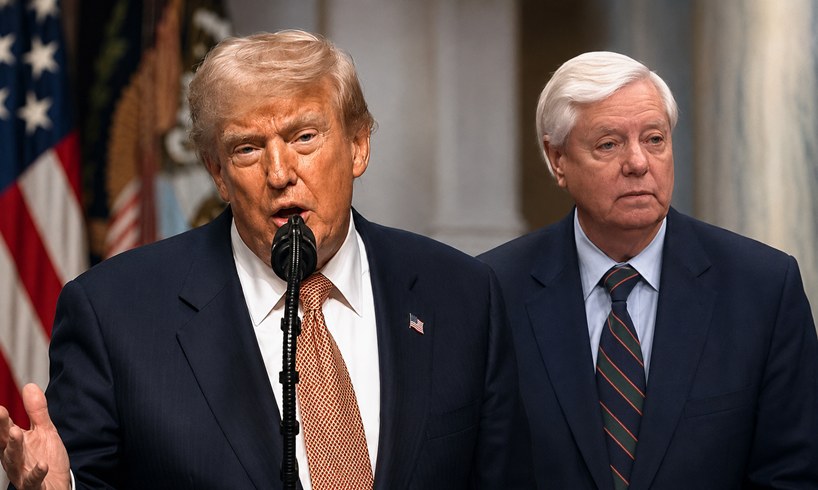
U.S. Senator Lindsey Graham, a longtime Republican from South Carolina who went from being one of Donald Trump’s strongest critics to one of his most loyal supporters in Congress, has died at 71.
Graham died Saturday evening after what his office called a “brief and sudden illness.” No further details about his illness or the exact cause of death were released right away. His family thanked people for their prayers and asked for privacy.
The senator’s sudden death ends a political career that spanned over thirty years. Still, Graham’s lasting effect on Republican history is likely to be remembered more for how he adapted to the Trump era than for any single law or committee role.
At first, he predicted that Trump would ruin the Republican Party. In the end, he became one of the most well-known figures in the party formed by Trump.
The Trump Critic Who Saw A Republican Earthquake Coming
During the bitter 2016 Republican presidential contest, few elected Republicans attacked Trump as aggressively or personally as Graham.
The South Carolina senator called his rival a “race-baiting, xenophobic, religious bigot,” accused him of selling fear and prejudice, and declared him unfit to occupy the Oval Office. Graham refused to vote for Trump in the general election, supporting independent conservative candidate Evan McMullin instead.
His most memorable warning came in May 2016.
“If we nominate Trump, we will get destroyed,” Graham wrote, adding that Republicans would “deserve it.”
Graham’s prediction about the election was wrong, but his bigger warning turned out to be right. Trump did not just win the nomination and the presidency — he changed the party’s leadership, language, priorities, and expectations of loyalty for good.
A few years later, Graham admitted that Trump had a rare ability to reshape the GOP. He said Trump could make the party bigger, stronger, and more diverse, but he also warned that Trump “also could destroy it.” Still, Graham decided that Republicans needed to move forward with Trump instead of trying to rebuild without him.
Graham had predicted a Republican transformation. What he could not have predicted was how completely he would become part of it.
From “Unfit For Office” To A Place Inside Trump’s World
The hostility between the two men had previously appeared intensely personal.
Trump publicly ridiculed Graham, branded him an idiot and disclosed his private cellphone number during a campaign rally. Graham responded by destroying the phone in a mocking campaign video and treating Trump as a dangerous embarrassment to the conservative movement.
After Trump entered the White House, however, the relationship changed rapidly. Meetings were followed by telephone conversations, golf outings and increasing cooperation on judicial nominations, taxes and foreign policy.
Graham later gave a very honest explanation for his change. When political writer Mark Leibovich asked what had changed, Graham said his goal was “to try to be relevant.” He believed that working with Trump gave him a chance to influence decisions and achieve results he thought were good.
Former Washington Post analyst Aaron Blake put it more simply, calling it “political expediency.” Graham’s connection to Trump helped him keep his influence in Washington and protected him from a Republican base that was very loyal to the president.
Graham once said that Trump had been good to him by letting him “in his world.” This access formed the basis of a unique political partnership: Trump got an experienced defender in the Senate, and Graham gained direct access to the center of presidential power.
The January 6 Break That Lasted Only Briefly
The alliance appeared to collapse after Trump supporters attacked the U.S. Capitol on January 6, 2021.
Speaking from the Senate floor, an emotional Graham announced that his journey with Trump was over. “Count me out,” he declared. “Enough is enough.” The separation did not last.
Graham declined to convict Trump during his second impeachment trial, resisted efforts to remove him permanently from Republican politics and eventually endorsed his campaign to return to the White House. By Trump’s second presidency, Graham had again become a frequent adviser and highly visible defender.
That cycle of condemnation, separation, and reconciliation showed the main contradiction in Graham’s relationship with Trump. He could see what he thought were Trump’s dangerous impulses and speak out against them, but he would return to the alliance because he believed the Republican Party could not function without the leader.
JD Vance And Marco Rubio Traveled The Same Political Road
Graham’s transformation initially looked exceptional. It eventually became a blueprint followed by other major Republican figures.
Vice President JD Vance was once a bitter Trump critic who wondered privately whether the future president might become “America’s Hitler.” Vance later apologized for his attacks, adopted Trump’s populist political movement and rose from Senate candidate to running mate and vice president.
Secretary of State Marco Rubio has experienced a similar conversion that may help his political future. During the 2016 campaign, Rubio called Trump a “con artist” and warned that he was dangerously unprepared for the presidency. Years later, Rubio became one of the most trusted and powerful officials in Trump’s administration, receiving responsibility for American diplomacy and national security.
The rise of Vance and Rubio showed that Graham was not exclusively a lone politician changing his views for convenience. He was one of the first examples of a much bigger shift in the Republican Party.
Former opponents discovered that opposing Trump could end their national careers, while accepting him could provide access to voters, endorsements and positions that the old Republican establishment could no longer deliver.
An Old-Guard Republican Who Survived The MAGA Revolution
Graham belonged to a Republican generation that existed long before the phrase “Make America Great Again” became the party’s defining slogan.
He was closely associated with Senators John McCain and Joe Lieberman, forming an influential foreign-policy trio frequently called the “three amigos.” Graham supported military intervention abroad, strong global coalitions and an aggressive American response to hostile governments.
He was also an institutional politician who understood Senate rules, committee negotiations and bipartisan dealmaking. That experience made him valuable to a president who frequently battled the traditional machinery of Washington.
Graham acted as a link between two parts of the Republican Party: the older national-security group led by McCain and the newer, personality-driven MAGA movement led by Trump.
The partnership was never simply about ideology. Graham was more willing to support military action than many “America First” conservatives, especially on issues like Iran, Israel, Russia, and Ukraine. Rather than give up those views, he used his relationship with Trump to keep traditional Republican hawkishness important in the new movement. Shortly before he died, he had just returned from Ukraine and was working with the administration on more sanctions against Russia.
The Centrist Positions Graham Left Behind
Graham had never been a political centrist in the conventional sense. He was a deeply conservative senator, especially on military affairs, judges and national security.
However, he once occupied a more moderate position inside the Republican Party because of his willingness to negotiate with Democrats.
He participated in major bipartisan immigration efforts and supported legislation that combined stronger border security with a long-term path to citizenship for millions of undocumented immigrants. The 2013 proposal passed the Senate with 68 votes before dying in the House.
Near the end of his career, Graham stood with Trump and called for ending sanctuary-city policies, supporting enforcement measures that matched the MAGA immigration agenda much more closely.
He also abandoned a highly publicized promise concerning Supreme Court vacancies. In 2016, Graham said voters should select the president who would fill an election-year opening and invited critics to use his words against him. In 2020, he helped push through Trump nominee Amy Coney Barrett shortly before the presidential election.
These changes strengthened the idea that keeping Trump in power, and Graham’s own ability to work within that power, had become more important to him than defending some of the principles he once supported.
Graham’s Transformation Turned Into His Political Legacy
Lindsey Graham spent the beginning of the Trump era warning Republicans that they were surrendering their party to a dangerous political force.
He spent the remainder of his career demonstrating how an experienced establishment Republican could survive that surrender.
His critics saw opportunism, inconsistency and a disposition to abandon principle for influence. His supporters saw pragmatism: a politician accepting that Trump controlled the Republican electorate and choosing to influence him from inside the alliance rather than protest from political exile. Both interpretations contain part of the truth.
Graham remained a consequential senator because he understood earlier than many of his colleagues that the Republican Party was not returning to its pre-Trump identity. Its old leaders could resist the transformation and risk becoming irrelevant, or they could negotiate a place within the new coalition.
Graham chose the second path. Vance, Rubio and much of the Republican establishment eventually followed him.
His death marks more than the end of a long Senate career. It closes the story of a politician who correctly predicted that Donald Trump would change the GOP forever, and then changed himself to make sure he still had a place in it.