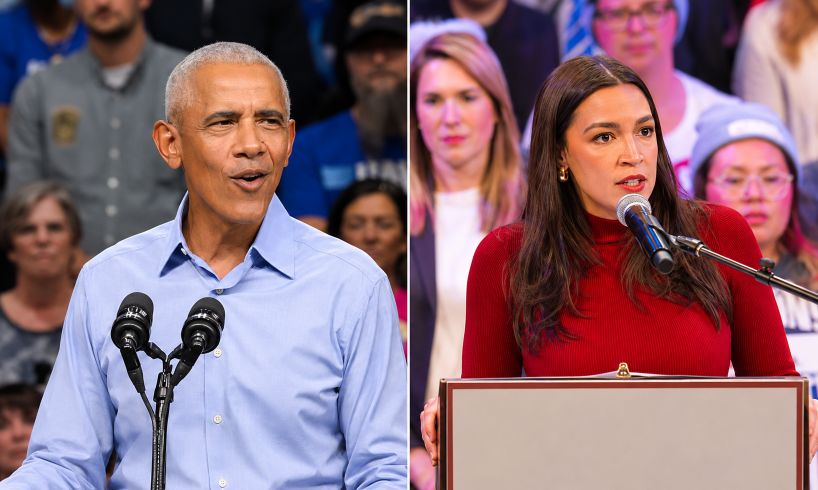
Michigan Democrats spent months trying to repair a bitter Senate primary. Former President Barack Obama made a personal call. Rep. Alexandria Ocasio-Cortez reportedly stepped in once tensions rose again. Senior lawmakers organized what was supposed to be a public show of agreement in Detroit.
Then, less than 48 hours before Election Day, Rep. Haley Stevens walked into a different Detroit church alongside Republican Senate nominee Mike Rogers and announced she was supporting him over Democrat Abdul El-Sayed.
The November 1 endorsement stunned party leaders not simply because Stevens had lost the August primary to El-Sayed, but because new accounts of the preceding weeks show how many prominent Democrats had tried to prevent precisely this outcome. Obama’s outreach came immediately after the primary, while Ocasio-Cortez’s reported phone call took place just days before the switch. Those are two distinct moments in a larger, failed effort to hold the party together.
Obama’s August Call Now Looks Very Different
On August 7, days after El-Sayed defeated Stevens, Obama spoke separately with both Democrats. According to an August Politico report, the former president praised their efforts to unite Michigan Democrats ahead of the general election.
A person familiar with the conversation said Obama appreciated Stevens’s focus on party unity. Stevens, who had served in the Obama administration’s auto-rescue effort, reportedly encouraged him to campaign in Michigan for Democrats. Obama’s separate conversation with El-Sayed was also described as an encouraging attempt to move past the primary.
Obama’s conversation with Stevens took place months before the election, not during the frantic final weekend. There is no indication that the former president personally intervened again as her endorsement of Rogers approached.
Obama subsequently appeared with El-Sayed at an October 24 rally in Detroit, stressing the importance of the Senate contest. By then, the former president had publicly joined the effort to elect the candidate who had beaten Stevens. Yet a campaign meant to project party unity was heading toward another rupture.
AOC’s Reported 25-Minute Intervention
The more immediate attempt to stop Stevens from breaking away came from Ocasio-Cortez, one of El-Sayed’s most prominent progressive allies.
According to Politico’s Playbook reporting, cited in subsequent accounts published November 2, Ocasio-Cortez called Stevens on Wednesday, October 28, amid concerns that Stevens might withdraw her support for El-Sayed. Their conversation reportedly lasted approximately 25 minutes.
For a moment, the conversation seemed to help. Stevens thanked Ocasio-Cortez for taking the time to hear her concerns, and the New York congresswoman responded cordially. Stevens also reportedly reassured her that she still intended to support the Democratic nominee.
However, an underlying grievance remained. Stevens had complained about being excluded from an Ocasio-Cortez campaign appearance in Pontiac, within Stevens’s congressional district. To Stevens, the exclusion illustrated a Democratic campaign that no longer seemed to have room for her. El-Sayed’s allies viewed the continuing dispute differently: as a distraction from the election itself.
The Final Weekend Unraveled
The breakdown accelerated after Stevens’s fiancé, attorney Jason Turkish, publicly endorsed Rogers. Stevens objected to an advertisement from an outside group that linked American support for Israel to rising grocery prices, arguing that its message was antisemitic. El-Sayed’s campaign did not produce the ad, and El-Sayed ultimately rejected its message.
But the argument did not end there. El-Sayed’s team asked Stevens to stay away from his remaining campaign appearances, saying the controversy had become a distraction. Stevens portrayed that exclusion as confirmation she no longer belonged in his campaign.
As late as Saturday night, Democratic colleagues still believed they could contain the crisis. The Washington Post reported that Stevens assured several leading Democrats she would not endorse Rogers. Rep. Jamie Raskin said he spoke with her for 25 minutes that evening and understood she would remain with the party. Former Michigan Gov. Jim Blanchard also expected her to join a Sunday church appearance with El-Sayed and Rep. James Clyburn.
Instead, on Sunday morning, Stevens was beside Rogers at Detroit’s Perfecting Church. She posted a video endorsing the Republican. The reversal reportedly surprised even Rogers’s campaign staff, who learned of the endorsement as it was announced.
Trump Celebrates; Democrats Revolt
President Donald Trump praised Stevens’s decision and said he would welcome her into the Republican Party. The image of a Democratic congresswoman backing the GOP nominee gave Rogers an extraordinary closing-weekend talking point in a race with possible implications for Senate control.
Democrats responded angrily. Senate Minority Leader Chuck Schumer called the endorsement a betrayal. Michigan Democratic Party chair Curtis Hertel said Stevens was no longer a member of the state party. Stevens’s chief of staff, Justin German, and other aides resigned in protest.
For all the anger Stevens’s endorsement generated, its impact on the election remains difficult to gauge. El-Sayed’s campaign said it raised $2.4 million on Sunday, suggesting the controversy also stirred a strong response among Democrats. Whether that reaction translates into votes, however, is another question.
A Bigger Warning for Democrats After Tuesday
The story is not simply that Obama and Ocasio-Cortez failed to persuade a colleague. Their outreach occurred at different stages, and no public evidence shows that either knew Stevens would ultimately endorse a Republican. The larger failure was a party’s inability to resolve profound disagreements over Israel, political identity and the obligations of a defeated primary candidate.
Stevens maintains that El-Sayed’s campaign left her feeling unwelcome, while his supporters believe she allowed a personal disagreement to overshadow a much bigger election. Rogers, meanwhile, has gained a high-profile endorsement. Voters still have to decide where the candidates stand on the issues that matter to them.
Whether the endorsement changes enough votes to matter will become clearer after November 3. What is already clear is that phone calls from a former president, outreach from a progressive star and assurances to party elders were not enough to keep Michigan’s Democrats united through Election Day.


Comments (0)