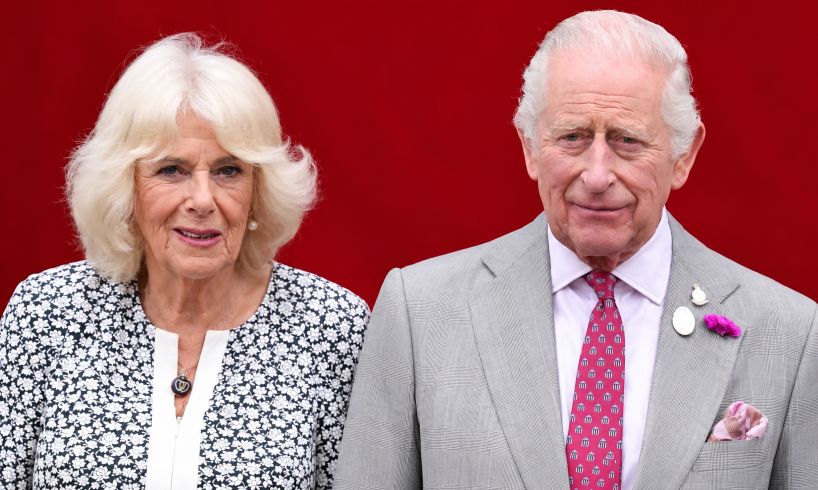
Queen Camilla is reportedly building an improbable alliance with Andrew Mountbatten-Windsor, assuming a sensitive role between the disgraced former prince and King Charles III as Buckingham Palace struggles to contain another chapter of the royal scandal.
The development is particularly surprising given Camilla’s historically strained relationship with her brother-in-law. For years, the two were hardly regarded as natural allies. Now, however, royal insiders claim the Queen has softened her attitude toward Andrew and increasingly finds herself handling communications that Charles would rather avoid.
According to reports carried by Wonderwall and Showbiz CheatSheet, Camilla’s apparent change of heart may have less to do with personal forgiveness than with protecting the monarchy from further embarrassment.
An unnamed source cited by the National Examiner, whose claims were subsequently reported by other outlets, described Camilla as increasingly acting as a “go-between” because Charles reportedly cannot bear dealing with his younger brother directly.
The source also claimed Andrew has become unusually respectful toward Camilla, creating an unexpected opening in a relationship once defined by mutual suspicion.
But the reported private arrangements have not been independently confirmed by Buckingham Palace, and the precise nature of Camilla’s involvement remains unclear.
What is considerably clearer is the difficult position facing the King.
Andrew’s Legal Victory Complicates an Already Delicate Situation
The reports of Camilla’s changing relationship with Andrew come against the backdrop of a major legal development.
Andrew suffered another legal twist on October 8, 2026, when the High Court in London confirmed that Thames Valley Police had used unlawful warrants to search two properties linked to him.
Officers had searched his home on the Sandringham estate and Royal Lodge, where he previously lived, as part of an investigation into suspected misconduct in public office.
Police acknowledged that the warrants had been obtained under an incorrect legal provision.
The decision represented a procedural victory for Andrew, whose lawyers had challenged the legality of the searches. However, it did not clear him of wrongdoing or terminate the criminal investigation.
The decision was a setback for police, but it did not bring their investigation to an end. Justice Nicholas Hilliard made that distinction clear, leaving another legal question unresolved: whether investigators can keep and use the evidence collected during the searches.
The case took a serious turn on February 19, 2026. Andrew was arrested amid allegations that he had provided Jeffrey Epstein with sensitive information while working as Britain’s trade envoy.
He was released under investigation and has not been charged. He denies wrongdoing.
For Buckingham Palace, the distinction between a procedural victory and an exoneration is important.
Yet even a limited courtroom success can alter the political and personal calculations surrounding an individual whose standing within the royal family has collapsed.
Andrew remains under investigation, but he has shown he can successfully challenge the authorities on an important legal issue.
That development could make efforts to handle his relationship with the family considerably more complicated.
Why Camilla May Believe Keeping Andrew Close Is Safer
On the surface, Camilla’s reported inclination to engage with Andrew looks like a remarkable reversal.
The Queen has previously been portrayed as deeply skeptical of her brother-in-law, with royal commentators tracing their tensions back to the years before her marriage to Charles in 2005.
Reports have suggested Andrew objected to the relationship and questioned whether Camilla was an appropriate future royal consort.
Their alleged disagreements were never fully documented publicly, but the long-running portrayal of their relationship makes the latest claims especially striking.
So why would Camilla now seek a more cooperative relationship?
One possible explanation is that she sees Andrew as a problem more easily managed through communication than complete isolation.
Showbiz CheatSheet, citing reporting from Heat, suggested that Camilla may regard maintaining contact with Andrew as a way to reduce the risk of further damaging disclosures about the royal family.
The prospect of a revealing memoir or public confrontation has been raised in speculative royal coverage, although there is no established evidence that Andrew has committed to either course.
Nevertheless, the potential for another damaging episode is difficult for the Palace to ignore.
An Andrew who feels abandoned by his family could become more difficult to deal with. An Andrew who believes he still has someone willing to listen may be less inclined toward confrontation.
That is the calculation apparently driving the reported change in Camilla’s approach.
It is not necessarily forgiveness. It may be an attempt at containment.
King Charles Faces a Problem He Cannot Simply Delegate
Charles has already taken extraordinary steps to distance the monarchy from his brother.
Charles had already drawn a firm line in October 2025. Buckingham Palace announced that Andrew would lose his remaining royal titles and honors, and that his time at Royal Lodge was coming to an end.
The message went beyond Andrew’s future in the royal family. By publicly expressing sympathy for victims and survivors of abuse, the Palace signaled that the monarchy was no longer prepared to let his personal troubles overshadow its responsibilities.
Following Andrew’s arrest in February, Charles publicly endorsed the investigation and declared that the law must take its course.
That statement established a clear position: the monarchy would cooperate with the authorities rather than intervene on Andrew’s behalf.
But distancing Andrew from royal duties and privileges does not eliminate his personal relationship with the King. He remains Charles’s younger brother.
And while the monarchy can remove titles, withdraw financial privileges and restrict public appearances, it cannot erase decades of family history.
This is where Camilla’s reported involvement becomes especially sensitive.
If Camilla is indeed relaying messages between the brothers, she could allow Charles to maintain private contact with Andrew without undermining the firm public stance he has taken against him.
At the same time, that arrangement carries risks of its own.
Any suggestion that Andrew is quietly regaining influence inside the royal household may undermine the message Charles has spent more than a year trying to establish.
The Palace would also need to distinguish ordinary family communication from any involvement in Andrew’s ongoing legal affairs.
Private contact is not evidence of improper interference. But the appearance of special treatment could generate fresh questions about the monarchy’s devotion to accountability.
The Bigger Danger Is Not Andrew’s Return — It Is Another Palace Crisis
For Charles, the central question may no longer be whether Andrew deserves a place in royal life.
The King has already made his institutional position unmistakably clear.
The more difficult question is how to prevent his brother’s continuing troubles from becoming a permanent distraction for the monarchy.
Camilla’s reported strategy offers one possible answer: keep communications open, reduce personal hostility, and avoid allowing family tensions to develop into another public confrontation.
But that approach has a fundamental weakness.
Andrew’s legal predicament cannot be resolved through family diplomacy, and maintaining cordial relations does nothing to determine the outcome of the police investigation.
Nor can the monarchy assume that keeping Andrew close will prevent future revelations or controversies.
Indeed, if the public comes to believe that Palace figures are privately protecting a disgraced family member while publicly maintaining their distance, the attempted damage control could become another scandal. That is the dilemma Charles now faces.
Cut Andrew off completely, and the family could face an increasingly bitter internal dispute. Maintain private contact, and the King risks accusations that the Palace is softening its position behind closed doors.
Camilla may believe she is able to navigate the narrow space between those outcomes.
Yet the arrangement, if accurately reported, would place her in an extraordinarily delicate position: trying to preserve family communication while not weakening the Crown’s institutional trustworthiness.
The irony is that Camilla’s greatest contribution to Charles may not be persuading Andrew to reconcile with his brother. It may be preventing their relationship from deteriorating into another crisis neither the King nor the monarchy can afford.
And for a sovereign who has already stripped his brother of royal privileges, that could prove a far more difficult task than removing a title.

Comments (0)