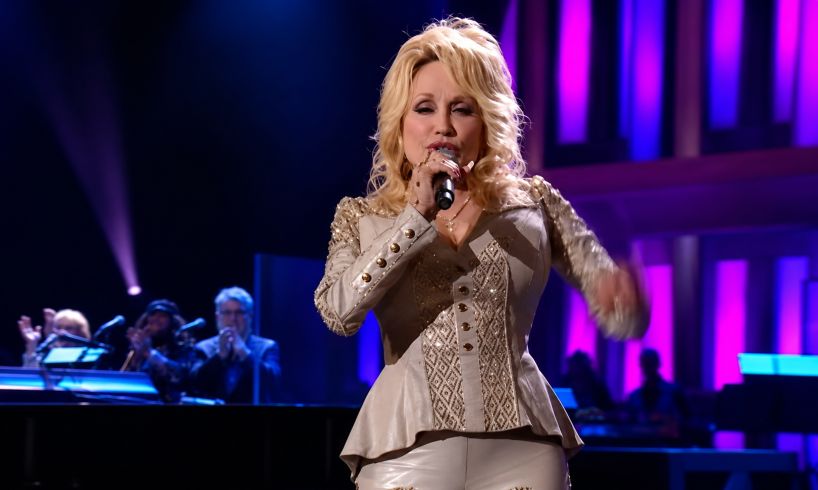
Dolly Parton spent a lifetime telling the world she would always love it. In the end, those were among the final words she left behind.
The legendary singer, songwriter, actress, entrepreneur and philanthropist died Tuesday, August 25, in Nashville at the age of 80, bringing to a close one of the most extraordinary careers in American entertainment.
Parton’s publicist confirmed that she died peacefully. A cause of death has not been made public. Almost immediately, the announcement triggered an extraordinary flood of grief across music, Hollywood and social media.
But perhaps nothing captured the moment more powerfully than the message shared by Parton’s own family. On her official social-media account, beneath news of her death, appeared five words instantly recognizable to generations of fans: “I will always love you.”
The phrase stood as both a farewell and a recall of the song Parton wrote decades ago that became one of the most enduring compositions in modern music.
For millions of people, it was difficult to imagine a more appropriate goodbye.
Dolly Parton Dies Peacefully in Nashville
Parton’s death was announced by her nephew Bryan Seaver, who said he was fulfilling a request the singer had made years earlier about how the news should eventually be shared.
Seaver described Parton not simply as an international superstar but as the woman her family knew privately—as a sister, aunt and beloved relative whose success created opportunities for generations around her.
Her family later said that Parton had led a life defined by love, compassion and fortitude and requested that, instead of flowers, those wishing to honor her support the Dolly Parton Imagination Library.
A private service is expected for immediate family. The announcement ended several months of growing concern about Parton’s health.
Only days earlier, the country icon had spoken publicly about the medical problems that had forced her to slow down.
But even then, Dolly sounded unmistakably like Dolly. She was still planning, creating, and looking forward.
Her Final Weeks Were Noted by Health Struggles
Parton had recently missed the August 14 opening of NightFlight Expedition, a major new attraction at Dollywood in Tennessee. Rather than appear in person, she addressed attendees through a recorded video from Nashville.
She explained that she had been experiencing dizziness and dehydration and that her doctor had advised her against traveling. The cancellation followed other health-related disruptions.
Earlier this year, Parton canceled a planned Las Vegas residency while undergoing medical treatment. She later explained that some of her health concerns had gone unattended while she focused on caring for her husband, Carl Dean, before his death in March 2025.
It was an enormously difficult period. Dean had spent nearly 60 years beside Parton while largely avoiding the extraordinary glare surrounding his famous wife.
Their relationship became legendary partly because of how fiercely they protected it. Dolly conquered Nashville, but Carl preferred home.
And somehow, for nearly six decades, it worked. His death at 82 left Parton facing a life she had rarely known without him.
Dolly Never Stopped Working
What made Parton’s final health reports so quintessentially Dolly was her refusal to speak as though her life had already entered its final chapter.
Even as she discussed medical treatment, she was talking about new ventures. She had been developing the Life of Many Colors Museum and the SongTeller Hotel in downtown Nashville, while also continuing work connected to her Broadway musical.
She was expanding into coffee and other business projects. Her health had slowed her down. It had not stopped her fantasy.
That determination had been one of the defining characteristics of her entire life. Parton was born into a family of 12 children in rural Tennessee.
She grew up with very little money but an abundance of music. By 13, she had performed at the Grand Ole Opry. Eventually, she arrived in Nashville as a young woman determined to become a songwriter.
What followed was almost impossible to replicate.
From the Tennessee Mountains to Global Stardom
Parton emerged first as a songwriter and then as a performer whose voice was impossible to confuse with anyone else’s.
Her partnership with Porter Wagoner helped introduce her to a national country audience. After came the records that turned Dolly Parton into Dolly Parton: “Coat of Many Colors,” “Jolene,” “9 to 5,” “Here You Come Again,” “Islands in the Stream,” and, of course, “I Will Always Love You.”
Over seven decades, Parton sold more than 100 million records worldwide and became one of the rare country artists capable of moving fluently between Nashville and mainstream popular culture.
She also proved herself to be much more than a singer.
Hollywood Discovered Dolly Too
In 1980, Parton made her film debut alongside Jane Fonda and Lily Tomlin in “9 to 5.” She did not merely act in the movie. She wrote and performed its instantly recognizable title song.
The film helped establish Parton as a genuine Hollywood personality whose comedic timing and enormous charisma translated naturally to the screen.
She later appeared in movies including “The Best Little Whorehouse in Texas” and “Steel Magnolias.” Her public identity became almost as famous as her music: he towering blonde hair, the rhinestones, the enormous nails, and the self-deprecating jokes.
Parton understood exactly what people saw when they looked at her—and often made the joke before anyone else could.
Behind that extravagant image was a remarkably disciplined songwriter and businesswoman.
‘There Will Never Ever Be Another You’
Within minutes of the announcement, tributes began flooding social media. Reba McEntire, one of Parton’s longtime friends and fellow country legends, remembered the woman she had known for decades.
Her tribute included a line that immediately resonated: “There will never ever be another you.”
McEntire thanked Dolly for the music, love and generosity she had given during her life.
Kacey Musgraves appeared nearly overwhelmed by the news. She wrote: “The world feels a lot less sparkly all of a sudden.”
She later expressed comfort in believing that Dolly had been reunited with Carl Dean.
Miley Cyrus, Parton’s honorary goddaughter, described the woman who had played such an important role in her life as: “the purest soul.”
Three very different generations of performers were saying essentially the same thing. This was not simply the death of another successful singer.
Something unusually beloved had disappeared.
Dolly Parton Was One of the Few Stars Almost Everyone Claimed
Celebrity usually creates division and success produces critics. Politics also splits audiences and generations move on.
Dolly Parton somehow spent decades escaping much of that. Country fans loved her. Pop audiences loved her. Actors loved her.
Songwriters revered her. Children knew her through books. Parents knew her because those books arrived in their mailboxes.
She managed to become a cultural person who appeal crossed regions, political identities and generations. That accomplishment may ultimately rank alongside her music.
Parton generally avoided turning herself into a political spokesperson, preferring instead to focus publicly on issues where she believed she could make a concrete difference.
One of the greatest examples became the Imagination Library.
Millions of Children Received Books Because of Dolly
Parton launched her Original Library in 1995 in her home county in Tennessee. The idea was remarkably simple. Children would receive free books.
Not once. Month after month. The initiative eventually expanded far beyond Tennessee and into an enormous international literacy program.
By the end of Parton’s life, millions of books were being distributed to children through the initiative.
The program was inspired in part by her father, Robert Lee Parton, who could not read or write.
Parton repeatedly described the literacy initiative as one of the accomplishments of which she was most proud.
Her family choosing the Imagination Library as the beneficiary for memorial donations therefore carries particular meaning.
For generations of children, Dolly Parton’s legacy literally arrived in the mailbox.
Her Generosity Went Far Beyond Music
The books were only part of it. After devastating wildfires struck communities around Gatlinburg, Tennessee, in 2016, Parton established assistance for families whose homes had been destroyed.
During the COVID-19 pandemic, she donated $1 million toward research that helped support development of the Moderna vaccine.
She repeatedly used her wealth, celebrity and business empire to support causes connected to education, disaster relief and her native Tennessee.
That generosity explains why so many tributes following her death have focused as much on the woman as the music.
People admired Dolly’s songs. They also believed she cared.
Carl Dean Was the Great Private Love of Her Life
For all the people who knew Dolly Parton as an international celebrity, the most important relationship in her personal life remained largely invisible.
She met Carl Dean outside a Nashville laundromat shortly after moving to the city at 18. They married in 1966.
Dean then spent much of the next 59 years doing something almost unimaginable for the husband of one of America’s most famous entertainers:
He stayed out of the spotlight. Parton frequently joked about the contrast between them. She loved performing. He wanted nothing to do with fame.
He rarely accompanied her to industry events. She respected it. Their marriage became a quiet constant beneath one of entertainment’s loudest careers.
Dean died in March 2025. Now, barely 18 months later, Dolly is gone too.
That reality gave Kacey Musgraves’s simple social-media reaction additional emotional weight when she wrote that she was glad Dolly was with Carl.
‘I Will Always Love You’ Has One Final Meaning
Parton originally wrote “I Will Always Love You” as a professional farewell to Porter Wagoner when she decided to leave his television program and pursue her own career.
Years later, Whitney Houston transformed it into one of the biggest recordings in music history. But the song always belonged to Dolly first.
Its genius was never merely in the famous chorus. It was the unusual tenderness of saying goodbye without anger. Leaving while still loving someone.
That message followed Parton throughout her career. And now, through her family’s final post, it has become attached permanently to the end of her life. “I will always love you.”
Five words. No elaborate statement could have sounded more like Dolly Parton.
An American Original
It would be easy to measure Parton’s life through numbers. The records sold. The Grammys. The hit songs. The films. The businesses. The millions of books. But numbers do not fully explain why her death has landed differently.
Dolly Parton spent decades carefully constructing one of the most recognizable images in show business while somehow persuading people that the woman beneath the wigs and rhinestones was completely genuine.
Maybe that was the trick. Perhaps there was never much difference between the public Dolly and the private one. The jokes were real. The ambition was real. The generosity was real. The songwriting certainly was.
The little girl from the Tennessee mountains became one of the most recognizable entertainers in the world without ever seeming embarrassed by where she came from.
She transformed poverty into songs. Songs into success. Success into businesses. And businesses into opportunities to help other people.
That is an extraordinary American story.
The World Is a Little Less Sparkly
Kacey Musgraves may ultimately have found the perfect words. The world does feel less sparkly. There will be another generation of singers.
Another country superstar. Another Hollywood personality. Another billionaire entrepreneur. But there probably will not be another person who combines all of those identities quite the way Dolly Parton did.
Reba McEntire understood that immediately. “There will never ever be another you.”
Dolly Parton died at 80 after spending virtually her entire life creating something—songs, movies, businesses, books, laughter, opportunities.
And even near the end, when her body finally demanded that she slow down, her mind remained fixed on what she wanted to build next.
The final irony is that the woman famous for working “9 to 5” never really seemed capable of stopping at five. Now the music remains.
The books will keep arriving. Dollywood will keep opening its gates. And somewhere, probably for generations, someone will hear the first notes of “Jolene,” “Coat of Many Colors” or “I Will Always Love You” and discover Dolly all over again.
Her family gave the world her final message. It hardly needed explanation: “I will always love you.”
And judging by the extraordinary reaction to her death, millions of people intend to return the favor.

Comments (0)