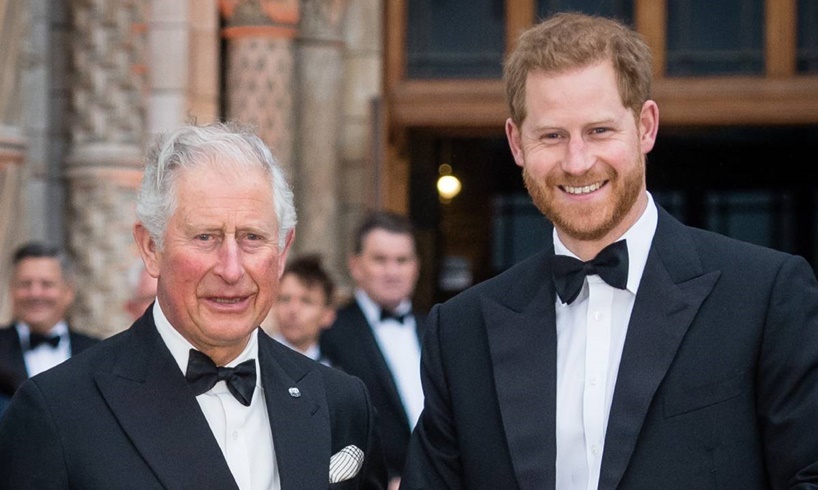
Give Prince Harry an inch, and critics will tell you he demands the entire arm. That is the standard narrative weaponized inside the House of Windsor whenever the tectonic plates of family and Crown begin to shift, but beneath the flashing camera lights, the royal briefings and the relentless tabloid churn, there is something much more fundamental—and much more human—at the heart of this story: expectation.
In an ordinary family, it is pretty straightforward. Fathers are expected to show up for their children, grandparents to make time for their grandchildren. And at some point families try to put old grievances aside, oftentimes for the sake of the next generation. When pride is not swallowed, those basic needs go unmet, people get hurt, arguments flare, resentment builds, and sometimes doors quietly close.
With all its protocols and traditions the monarchy has never really followed the usual family rules—and it may never do so.
Here, every private impulse has the potential to become a public consequence. A father and son picking up the phone after years of tension might be a quiet, personal step toward healing in another family, but when that father is the King of the United Kingdom, even a simple conversation can carry the weight of an institution that has existed for centuries. Every silence can become a headline, every gesture can be analyzed for meaning, and sometimes even the things nobody says become part of the larger and sometimes blown out of proportion story.
That is what makes the situation between King Charles III and Prince Harry so fascinating.
The moment King Charles agreed to open a line of dialogue, Harry’s internal strategy immediately expanded: if the sovereign acknowledges the son, the grandfather must answer to the children.
The moment a door opens between father and son, the conversation naturally becomes bigger than the two men themselves, because Harry is not only Charles’ estranged son—he is also the father of Archie and Lilibet. And that inevitably raises another question.
Can the relationship between a father and his son create an opportunity for the grandfather and his grandchildren to start finding their way back to one another as well?
That is the delicate tightrope the Crown is walking, because this is not simply about a family trying to heal old wounds. It is an ancient institution trying to manage the very modern, very human reality that families are messy, relationships change, and grandchildren don’t stay little forever.
For the past six years, the 5,400-mile distance between Britain and California provided an obvious explanation for why Charles and his American/British grandchildren had limited opportunities to have physical contact and spend time together. Whatever the deeper reasons may have been, geography was an easy and understandable part of the equation.
A reigning monarch has constitutional responsibilities, state engagements and an enormous schedule. He cannot simply clear the diary, board a plane from Britain to Los Angeles, battle the Southern California traffic and casually turn up in Montecito for afternoon tea.
For the king, the Pacific Ocean was, in that sense, the ultimate buffer. Distance gave everyone room and it provided a reasonable explanation.
And perhaps most importantly, distance made an otherwise painful family situation easier to explain to the public.
But what happens when the distance defense has completely disappeared from the equation?
That vanishing divide is where the story takes a very different turn. The new pages that Harry and Meghan have decided to write with their stunning Megxit redo put King Charles in a complicated position.
Harry and his family spend substantially more time in Britain; therefore, the question becomes less about geography and more about opportunity. The conversation shifts from “How can the King possibly travel thousands of miles to see his grandchildren?” to something much more personal: “If they’re closer now, will he make the effort to see them?”
And that is a much harder question to answer. Reports have suggested that Charles does not want his relationship with Archie and Lilibet to exist solely through occasional video calls. Royal commentator Ingrid Seward has previously said the King does not want a “FaceTime relationship” with Harry’s children, while other reports have portrayed Charles as wanting a warmer and more hands-on relationship with his grandchildren.
If the King truly wants this, then the situation may finally allow it to happen. But there is another important piece to this puzzle.
Harry’s supporters are likely to look at the relationship Charles has with Prince William’s children—Prince George, Princess Charlotte and Prince Louis—and naturally wonder whether Archie and Lilibet should have the same opportunity to know their grandfather.
That does not necessarily mean the relationships will ever look identical, because Prince William and Harry have very different relationships with their father, and the circumstances surrounding their children are very different.
Still, from a parent’s perspective, it is understandable to want your children to have a meaningful relationship with their grandparents.
And that is where emotion begins to collide with royal protocol. The King has a role to perform while setting an example. Harry has a family to protect.
The Palace has an institution to manage and shield. And somewhere in the middle are two young innocent children who did not choose or ask for any of this.
That is why the language coming from the Palace also matters. Through formal administrative guidance, the King has reinforced the distinction between Harry and Meghan’s private lives and the official duties performed by working members of the Royal Family. That boundary is important because royal status, royal duties and family relationships are not necessarily the same thing.
Two things can be true, Harry can be outside the working institution and still be Charles’ son.
Archie and Lilibet can live outside the official working Royal Family and still be the King’s grandchildren. the Those realities can exist side by side, even if the Palace has to be very careful about how that relationship is presented publicly.
And this is where Harry’s critics and supporters are likely to disagree.
Critics may see the Sussexes’ return to Britain as putting additional pressure on the King, effectively creating a new situation in which Charles has fewer practical obstacles to seeing his grandchildren.
Supporters may see it in a much simpler way: Harry has brought his children closer to their grandfather and, in doing so, created an opportunity for a relationship that was difficult to maintain while living continents apart. Either way, the circumstances have changed for the monarch.
When the Sussexes were living permanently in California, the Palace could point to the enormous practical difficulties involved in maintaining a conventional grandparent-grandchild relationship across the Atlantic.
But if Archie and Lilibet are now living in Britain, that explanation is tossed out the window. The question becomes much more uncomfortable.
If the children are close enough to visit, will the visits happen? If the King wants to be a loving, nurturing and hands-on grandfather, will he make the effort, will he find the time?
And if it does not, what explanation will the public give for the continued distance? This is why Harry’s critics may believe he has backed his father into a corner. While his supporters may argue that he has simply removed one of the biggest practical obstacles standing between his children and their grandfather.
Harry has not necessarily demanded anything publicly. He may not need to. Sometimes simply changing the circumstances can change the question.
And perhaps that is the most important development here. For years, everyone could point to the miles.
Now, if the reports about Harry’s family spending more time in Britain prove accurate, the miles may no longer be the central issue.
The real question becomes whether father, son, grandfather and grandchildren can find a way through everything that came before.
Because this was never really just about a plane ticket or a few hours on a calendar.
It is about years of hurt, competing loyalties, royal protocol, family dynamics and the uncomfortable reality that every private decision made by the Windsors can become public property.
And perhaps Harry’s biggest and most uncomfortable move was not bringing his family closer to Britain at all. What if it was Harry dragging the tough, complicated question closer to the King?
Because once the ocean is no longer standing between the grandfather and his youngest grandkids everyone is left staring at the same reality and the same question: Was the distance really about the miles—or were the miles simply making it easier to avoid the much harder conversation?

Comments (0)