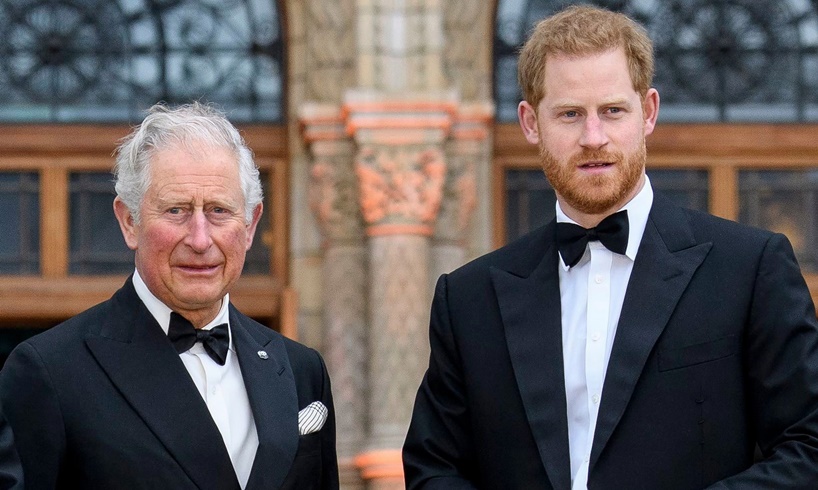
When Prince Harry and Meghan Markle returned to Britain after six years in California, there was always going to be one enormous question hanging over their homecoming, because beyond the new schools, security concerns and the decision to establish their family life in Britain again, everyone wanted to know whether their return would finally lead to a repaired relationship with King Charles III and the wider Royal Family.
Instead, the picture emerging now is far more complicated: while Charles remains Harry’s father and can maintain a personal relationship with his son and grandchildren, the institutional response surrounding the Sussexes suggests their return has not reopened the doors to the royal inner circle. Journalist Charlotte Griffiths has offered a revealing account of just how guarded communication between the two sides reportedly remains.
Griffiths was discussing reports that Meghan has been documenting her interactions with members of her in-laws’ family when she pointed to a familiar pattern from the Sussexes’ years as working royals. saying there had long been a persistent rumor that Meghan kept detailed records of conversations and interactions with senior members of the institution.
“This sounds familiar because when Meghan and Harry were part of the British royal family and living in the UK, there was this persistent rumour that Meghan was keeping a very detailed record of every single interaction, and that courtiers were absolutely terrified of this because they felt that she was using it as some sort of threat,” Griffiths said.
She then made a striking observation about the situation today. She suggested that if Meghan is once again keeping a record of her dealings with the Royal Family, there would not be nearly as much to document because contact between the two sides is reportedly extremely limited.
“So that would sound about right if she’s doing it again,” Griffiths said, adding, “But the only thing I’d say about this time is that the record would be very easy to keep because there isn’t a lot of interaction.”
That comment goes directly to the heart of the Harry and Meghan story, because the couple may now be physically closer to King Charles than they have been in years, yet physical proximity has clearly not translated into the kind of regular family interaction that might have been expected when they announced their return to Britain.
Griffiths went further, saying she had spoken with people connected to the Palace and described them as extremely cautious about their dealings with the Sussexes, with communication apparently limited to occasional exchanges rather than the regular family contact some might imagine.
“We’re talking like the odd email exchange, the odd phone call here and there,” she explained, before adding, “Because I’ve spoken to the various people in the palace, and they are incredibly guarded.”
Then came perhaps the most revealing claim of all. Griffiths said her Palace contacts told her that Harry and Meghan send more communications than the institution actually answers, suggesting that requests, emails and letters can sometimes simply disappear into silence.
“They said they receive more messages and emails and letters from Harry and Meghan than they respond to, and that sometimes they just completely ignore messages and emails from their team,” she revealed.
If that account is accurate, it provides a much more concrete picture of the boundary King Charles has established than simply looking at the wording of his formal letter. Because rather than engaging in another public confrontation with his son, the Palace can maintain distance through controlled communication, limited access and carefully managed contact.
Griffiths summed up the atmosphere by saying, “They’re both being incredibly guarded with one another, both the Sussexes and Buckingham Palace,” before making an observation that may explain why the relationship remains so difficult to repair.
“I still don’t think there’s much in the way of trust there,” she said, adding, “So it would make sense if she’s keeping a catalog of the requests.”
Those comments provide an interesting window into the practical reality behind the formal royal statements that have surrounded Harry and Meghan since their return.
King Charles’ letter was blunt on the fact that Harry and Meghan will always remain non-working royals and private citizens with commercial and charitable interests. That clarification was significant because it prevented their physical return to Britain from being interpreted as an automatic return to official royal life.
The reported guarded communication described by Griffiths suggests that this separation between family and institution may be exactly how the King is choosing to handle the situation.
There is no dramatic royal confrontation required when the Palace can simply control access, limit official communication and refuse to allow uncertainty over Harry and Meghan’s position to grow, because sometimes the clearest demonstration of a boundary is not what is said publicly but what quietly stops happening behind the scenes.
For Harry and Meghan, that may be the most uncomfortable reality of their return to Britain. They have come home geographically while still remaining at a considerable distance from the institution they once represented, and if Griffiths’ account is correct, the King’s warning was not an empty statement that would disappear once the headlines faded.
King Charles was not bluffing; the concrete action appears to be in the boundaries themselves, with the Palace keeping its distance, controlling communication and refusing to treat the Sussexes’ return as though the events of the past six years simply never happened.
The Sussexes may be back in Britain, but that does not mean they have returned to the old royal world, and the most telling sign may be that the distance between Harry and the Palace is no longer measured in miles across the Atlantic, but in unanswered messages, limited conversations and a level of caution that suggests trust remains one of the biggest obstacles between them.
Comments (0)