Cardi B and Nicki Minaj have maintained their dominance at the top of the hip-hop industry for over a decade. The rivalry between these two talented women can be described as a ‘resistance’ that has lasted more than ten years.
Their feud has unfolded through diss tracks, social media jabs, public snubs, and competing narratives about authenticity, power, and control.
Now, that rivalry appears to be entering a new phase. This one is shaped more by politics than by music.
Over the past few weeks, both artists have found themselves back in the headlines for remarks that stirred political and cultural debate. At first glance, the contrasts are stark — Minaj offering praise for conservative figures at a right-leaning gathering in Arizona, while Cardi B spoke favorably about life in Saudi Arabia even as she took aim at conditions in the United States. Yet beneath the contrast lies a striking similarity — both women are deliberately aligning themselves against the expectations traditionally placed on Black female artists in American pop culture.
Nicki Minaj Pushes Alignment Through Ideology and Defiance
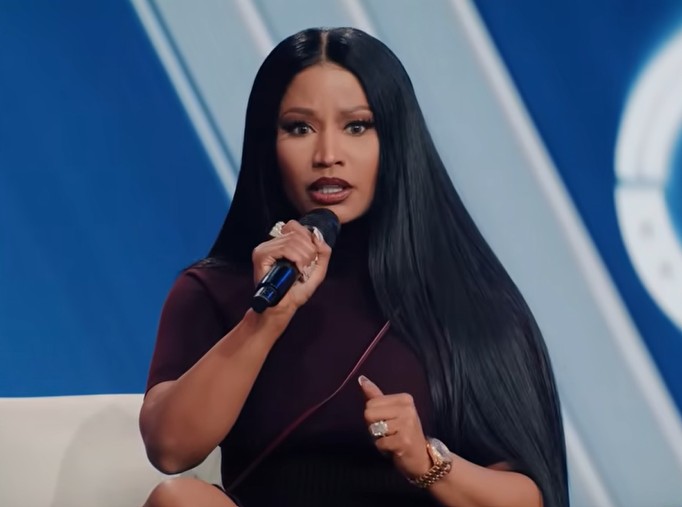
Nicki Minaj’s appearance at Turning Point USA’s AmFest was not subtle. Sitting alongside Erika Kirk, the widow of slain conservative activist Charlie Kirk, Minaj openly praised President Donald Trump and Vice President JD Vance.
The popular femcee opted to endorse the political duo as role models for young men. Even a highly publicized verbal misstep — referring to Vance as an “assassin” — did little to derail the broader message she delivered: admiration for conservative leadership and rejection of progressive orthodoxy.
For Minaj, this moment fits a longer pattern. Over the years, she has increasingly positioned herself as resistant to mainstream liberal culture. She often takes suprising stance on issues like gender, censorship, cancel culture, and elite media control.
Appearing at a conservative conference — even one marked by infighting and ideological tension — allowed her to cast herself as a truth-teller in hostile territory, unafraid of backlash.
The episode reinforced Minaj’s reputation for doing things her own way. Whether responding to critics, challenging the media, or brushing off political expectations, she has consistently viewed controversy as a sign of self-direction rather than something to dial back.
Cardi B: Alienation, Power, and the Pull of Order
Cardi B’s comments from Saudi Arabia took a different path altogether, yet they sparked a comparable level of controversy. While touring and performing in the kingdom, she praised the country’s cleanliness, order, and strict enforcement of rules — even acknowledging its authoritarian nature. At the same time, she delivered a scathing critique of the United States, calling it “ghetto,” “dusty,” and disrespectful, particularly when it comes to public behavior and homelessness.
Cardi, unlike Minaj, did stop short of aligning herself with a specific political movement. Her comments reflected personal dissatisfaction — from feeling unrecognized at home to frustration with taxes and online political attacks. Her views on Saudi Arabia were not ideological; she referred more to enforcement, order, and a culture of respecting each other.
That’s a key distinction. Minaj seems to be picking a side, while Cardi seems to be opting out — flirting with the idea that America is no longer defensible.
The Similarities: Influence, Intrigue, and Rewriting the Narrative
Snakes notwithstanding, the similarities are striking.
Both women:
- Commented, fully aware that they would be criticized
- Positioned themselves against prevailing US liberal narratives
- Framed authority figure, political or otherwise, as something to be respected
- Portrayed themselves as victims of suppression for telling the truth
In both cases, provocations are intentional. They pay the bills.
And in the context of their rivalry, these moves function as competing claims to authenticity. Minaj signals strength through ideological alignment and resistance to cancellation. Cardi signals strength through rejection of American decline and admiration for rigid systems that “don’t play around.”
A Feud by Other Means?
Whether intentional or not, these political choices also read as a continuation of their long-standing conflict.
Minaj’s positioning resonates with listeners who favor structure, order, and established authority — qualities that contrast sharply with Cardi’s unruly, grassroots ascent. Cardi, by comparison, doubles down on her outsider image, rejecting any obligation to defend a system she openly says no longer works for her.
In that sense, their politics mirror their personas. Minaj seeks legitimacy through power structures. Cardi seeks freedom through disavowal.
Neither approach is without risk. Both invite criticism. And both reinforce the same underlying message: this rivalry is no longer just about charts, awards, or bars — it’s about worldview.
As Cardi B and Nicki Minaj continue to redefine themselves in increasingly political terms, one thing remains consistent. Even when they aren’t speaking about each other, they still seem to be responding — move for move, stance for stance — in a feud that has simply found a new arena.