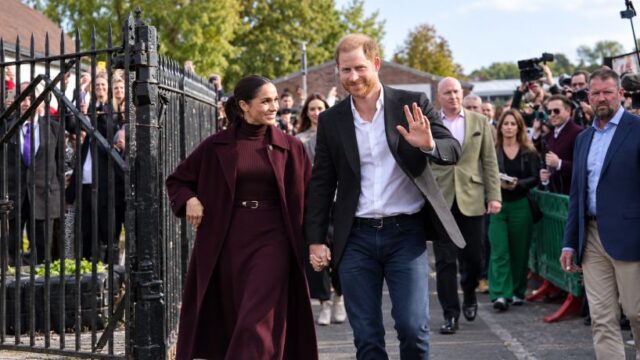
Prince Harry and Meghan Markle may believe that their days of anything resembling an ordinary private life are over, but their return to Britain is exposing a more complicated reality. The Duke and Duchess of Sussex are undeniably famous, their movements generate international interest, and Harry has legitimate reasons to take threats against his family seriously. None of that, however, automatically means the couple has lost the ability to create a largely private life for themselves and their children.
That distinction has become increasingly important after King Charles III formally reaffirmed that Harry and Meghan remain non-working members of the Royal Family and that they undertake their activities in a private capacity. The Palace described their position as being “akin to private citizens with commercial and charitable interests,” while people close to the Sussexes pushed back, insisting that they remain public figures whose fame carries unavoidable security consequences.
Both things can be true. Harry and Meghan can be extraordinarily famous public figures while still being private citizens in terms of their relationship with the state and the monarchy. What is much harder to sustain is the suggestion that their fame, by itself, means an ordinary family existence is now beyond their reach.
Harry’s Security Concerns Are Real, but That Is Not the Whole Argument
There is little reason to dismiss Harry’s concerns about security. An assessment commissioned by his private security operation and reported by ITV News this summer concluded that he faced an “elevated” threat in Britain and identified several extremist plots involving the Duke. That is considerably more serious than the ordinary inconvenience of photographers waiting outside a restaurant.
Security professionals have also explained just how demanding protection can become for people at Harry and Meghan’s level of recognition. Anthony Davis, a security specialist whose firm has protected major entertainers, told Forbes that for extremely high-profile clients, “Every move has to be choreographed,” with even seemingly routine journeys requiring advance consideration of routes, crowds and possible threats.
That expertise strengthens Harry’s argument that his family’s circumstances are unusual, but it does not necessarily support the conclusion that normality is impossible. Security arrangements and private life are not opposites. Presidents after leaving office, internationally famous performers, wealthy business figures and other recognizable families routinely live with protection while continuing to have schools, friendships, family routines and homes that remain substantially outside public view.
Harry’s own anonymity may be gone for good, but his children’s privacy is a separate matter. Their lives do not have to become public simply because their father is instantly recognizable.
Being a Public Figure Does Not Make Someone a Working Royal
The disagreement also risks confusing two very different definitions of “public.”
Harry and Meghan are plainly public figures in the everyday sense. Their names sell newspapers, attract television coverage and create commercial value. Yet King Charles’ description of them as private citizens concerns their institutional status. They no longer represent the monarch, do not perform state duties and conduct their charitable and commercial work on their own behalf.
Former Metropolitan Police assistant commissioner Bob Quick made that distinction precisely after the Sussexes first stepped away from royal duties. “Harry and Meghan are now private individuals,” he said, juxtaposing their freedom with working royals who are obligated to perform state functions.
Six years later, that distinction is arguably even clearer. Harry and Meghan have built commercial projects, signed entertainment deals, developed charitable initiatives and formed their own public schedules without being directed by Buckingham Palace. King Charles’ latest clarification does not suddenly transform them into private people. It recognizes the arrangement they themselves sought when they walked away from full-time royal life.
Independence brought freedoms that Prince William and Catherine do not possess. Harry and Meghan can select projects, negotiate commercial contracts, express themselves publicly and decide when they appear. The other side of that independence is that royal status no longer automatically determines how institutions treat them.
The Sussexes Have More Control Over Their Visibility Than They Admit
The strongest challenge to the claim that normal life is “sadly over” may be found in Harry and Meghan’s own post-royal career.
Their public profile has not simply happened to them. Some of it has been deliberately cultivated through interviews, television projects, speeches, public appearances, social media and commercial ventures. That does not surrender their right to privacy, particularly when their children are involved, but it does demonstrate that visibility is at least partly a choice.
Associate Professor Lauren Rosewarne, a social and political sciences academic at the University of Melbourne, made that point when assessing the Sussexes’ public activities earlier this year. Because they are no longer working royals, she argued, their appearances now operate partly in service of their personal brand. “The primary way to measure the success of the visit is whether it helped their brand,” Rosewarne said.
That position creates obvious tension. Much of Harry and Meghan’s post-royal work relies, at least in part, on the public interest surrounding them. Their name recognition helps attract audiences to commercial ventures, charitable campaigns and media appearances. That does not cancel their right to privacy, but it does make the relationship with fame more complicated than simply portraying it as an unwanted burden.
The issue, then, is not whether the Sussexes deserve privacy. They do. The harder question is how much public visibility they want to maintain.
Privacy Does Not Require Anonymity
A fundamental difference between privacy and anonymity also gets lost in the Sussex debate. Harry is the King’s son and was one of the most recognizable children in the world long before Meghan entered his life. No realistic scenario allows him to disappear into complete anonymity.
As security consultant Christopher Falkenberg has explained, Harry’s problem is not simply that he is wealthy or high-profile. He is instantly recognizable. That makes the kind of discretion available to many private clients considerably harder to achieve.
Yet that does not make privacy meaningless. Privacy can mean preventing photographers from entering school grounds, refusing to disclose children’s routines, limiting access to a family home, choosing carefully which events are public and declining to turn private disagreements into public battles. It can mean accepting that somebody may recognize Harry at a school gate without concluding that the entire school run has therefore become a public event.
There is also the obvious comparison with William and Catherine. William is the future King, George is directly behind him in the line of succession, and public interest in their family is enormous. Yet their children’s education has not become a running public spectacle. Despite smartphones, social media and relentless attention around the royals, the Waleses have managed to keep large parts of that world out of view.
Their lives are certainly not normal in the conventional sense, but they demonstrate that extraordinary public status and meaningful private boundaries are able to coexist.
The Children Should Not Inherit the Assumption That Normality Is Impossible
Archie and Lilibet are perhaps the strongest reason not to declare normal family life impossible before it has even been tried. They will always have an unusual family history and a famous surname, but neither automatically requires them to grow up with every school run or weekend outing treated as a major public event.
Harry and Meghan also have some control over how that life takes shape. If school runs, family outings and other everyday moments are approached as extraordinary events from the outset, the children could end up living inside the same culture of celebrity their parents have often said they want to keep at a distance. Sensible security is clearly part of the equation, especially where credible risks exist. But once those protections are in place, there is also something to be said for allowing ordinary family routines to remain just that — ordinary.
Their reported move to the countryside may already show this can work. Meghan has recently been seen in the Cotswolds without the sort of uncontrolled media frenzy that once accompanied many Sussex appearances, while the children’s school arrangements have been handled with an emphasis on privacy.
That does not prove there will never be problems. It does suggest that Britain is not automatically the impossible environment the couple formerly feared.
King Charles May Be Proffering a Boundary, Not a Rejection
Seen in that light, King Charles’ insistence that Harry and Meghan are private citizens may be less punitive than it initially appears.
The King is not claiming that photographers will suddenly stop recognizing his son. Nor can Buckingham Palace determine the security assessment that will ultimately be made by the appropriate authorities. The Palace appears instead to be defining a constitutional and institutional boundary: Harry and Meghan remain members of the King’s family, but they are not representatives of the Crown.
That boundary gives them something they once said they wanted — independence. It also means accepting the consequences of that independence.
Harry and Meghan cannot realistically expect to enjoy complete commercial and personal freedom while retaining every assumption that once accompanied their positions as working royals. Nor should they have to disappear from public life simply because they want to protect their children. A middle ground exists, but reaching it requires recognizing that being famous, being at risk, and being a private citizen are not mutually exclusive.
The Sussexes may never have an ordinary life by most people’s definition. Harry will always be the son of a King, Meghan will remain one of the world’s most recognizable women, and Archie and Lilibet will always be grandchildren of the monarch.
But that is not the same as saying normal family life is “sadly over.”
The more persuasive conclusion may be almost the opposite. Harry and Meghan now possess something they had far less of when they were working royals: the ability to decide how much of themselves they put into the public arena.
Fame may limit their choices, but it has not eliminated them. Privacy still is possible. So does security. So does a quieter childhood for their children.
The uncomfortable part is that achieving those things may require Harry and Meghan to decide whether being treated as permanently exceptional public figures is really compatible with the private life they say they want.
Comments (0)