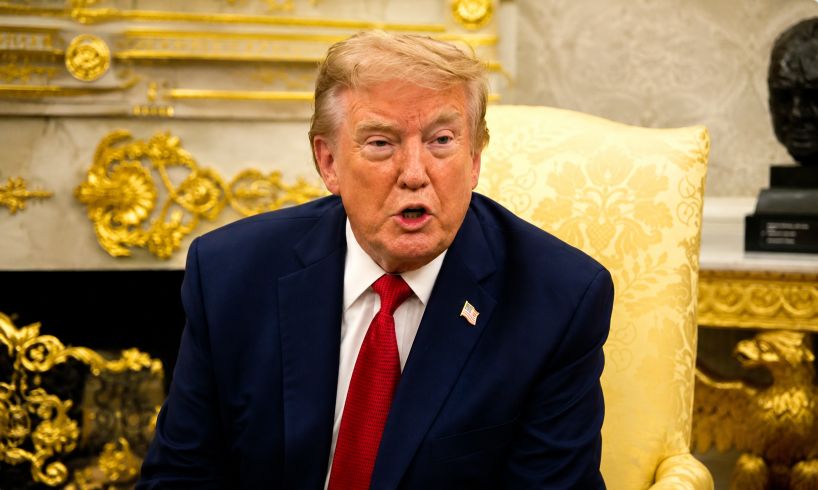
The White House has finally addressed the viral picture appearing to show President Donald Trump kissing his close aide Natalie Harp, and the official response could not have been clearer: “This is clearly a fake photo,” a White House official told the Daily Beast. The image was determined to be AI-generated, with one version containing an obvious giveaway — the woman pictured appears to have six fingers — while an analysis cited by the Daily Beast found an OpenAI-generated watermark.
But once the White House says an image is fake, the obvious question becomes what happens to the millions of people who may have already seen it, shared it, or formed an opinion before the correction arrived. That is where this story becomes bigger than one bizarre picture of Trump and Harp.
There is now an uncomfortable political reality in which fabricated images and videos are being used against public figures across the political spectrum, making it increasingly difficult for ordinary social-media users to know what they are actually looking at. During the 2024 campaign, fabricated and misleading sexualized images purporting to show Kamala Harris circulated online, including images falsely presenting her as an escort; fact-checkers found no evidence supporting those claims and determined that the images appeared AI-generated.
On countless occasions, Trump has himself happily used AI-generated or manipulated imagery and videos in his political messaging or to hit back at his enemies and to make himself look more powerful. In February 2026, his Truth Social account shared a video depicting Barack and Michelle Obama as apes before the post was removed, an episode that drew criticism from members of both parties.
That does not make the fake Harp image legitimate, and it does not make every piece of synthetic political content equivalent. It does, however, expose the same underlying problem: once people become accustomed to political figures circulating fabricated imagery, the distinction between reality, parody, propaganda and deliberate deception becomes harder to maintain.
And the Trump-Harp story has another layer because the real relationship between the president and his aide has already attracted public attention.
Harp has worked closely with Trump since 2022 and has frequently accompanied him, while previously published letters from her to Trump contained strikingly personal language. In one letter, she described him as her “Guardian and Protector” and wrote, “You are all that matters to me. I don’t want to ever let you down.”
Those documented facts may explain why the fabricated picture found an audience, but they do not authenticate the image itself. And that distinction matters.
The danger of the current information environment is not simply that people can create convincing fake pictures. It is that every new fake can make genuine evidence easier to dismiss, while every real photograph can be attacked as artificial.
The result is a political culture in which “the truth does not matter when Trump is president” and “alternative facts” can begin to feel like the easiest explanation — even though the truth still matters enormously.
The challenge now is making people slow down long enough to determine what is real before reacting to what merely looks real.
Comments (0)