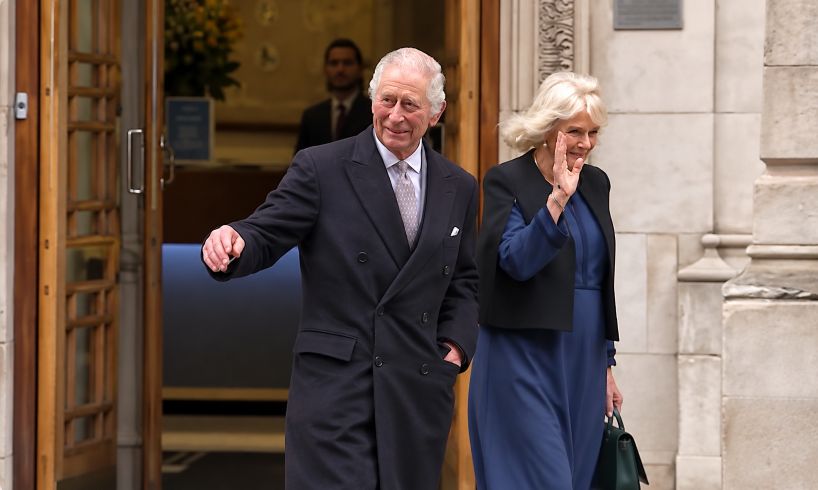
King Charles III has been pulled into a stunning new royal controversy, but the biggest shock may not simply be what Charles Spencer wrote about Princess Diana’s death — it may be the fact that the King and Buckingham Palace were apparently given no advance warning about the explosive allegations contained in Spencer’s forthcoming memoir.
According to The Telegraph, Earl Spencer kept the manuscript under such tight security that it was not shared in advance with Buckingham Palace, King Charles, or Diana’s sons, Prince William and Prince Harry. Although the existence of the memoir had been announced, those closest to the royal family were reportedly not warned about the specific claims that would appear in its pages.
That means the Palace was not dealing with a controversy it had been quietly preparing for behind the scenes. Instead, one of the most sensitive accusations in the book suddenly emerged into public view, forcing Buckingham Palace to respond to an allegation involving an intensely painful period in the royal family’s history.
And the allegation could hardly have been more explosive. In Swan Song: Diana, My Sister, Spencer claims that shortly after Diana’s death in 1997, the then-Prince Charles made a deeply shocking remark during an argument over whether Prince William and Prince Harry should walk behind their mother’s coffin.
Spencer recalls Charles allegedly telling him, “Rest assured, we’ll forget her soon enough.” According to Spencer’s account, he was stunned by what he had heard and replied, “I can’t believe you just said that,” before ending the conversation. The allegation is presented as Spencer’s recollection of an emotionally charged conversation almost three decades ago, rather than as an independently established fact.
But what makes the story even more remarkable is what happened after the claim became public. Buckingham Palace, which generally does not comment on books, issued an unusually pointed statement addressing the broader issue of Spencer’s recollection. “While we do not comment on books as a matter of principle, His Majesty is mindful that the pain of fraternal grief can cloud reason, affect judgment and colour memory in ways others do not recognise, even many years after such a loss.”
It was a carefully worded response, but its timing was impossible to ignore. The Palace had apparently not been given the opportunity to address the allegation before it became public, and King Charles was suddenly confronted with a decades-old account involving Diana, the funeral that became one of the most watched events in modern British history, and the two young boys who were required to walk behind their mother’s coffin.
Spencer has defended the purpose of his memoir as an attempt to tell Diana’s story from the perspective of her brother, saying, “The aim of this book is to tell the truth about Diana from her brother’s perspective,” and that he wanted to speak on her behalf in an “openly positive” way.
The book therefore arrives with an extraordinary complication: King Charles is now publicly responding to a claim from his former brother-in-law that he apparently had not been warned was coming.
And that may be the real bombshell surrounding Swan Song. Spencer did not simply publish another royal memoir in which familiar family tensions were revisited. If the Telegraph’s account is correct, he kept the manuscript sufficiently protected that even the people at the center of its most sensitive allegations were left waiting for the revelations along with everyone else.
Nearly thirty years after Diana’s death, Charles Spencer has reopened one of the most painful chapters in the royal family’s history — and this time, King Charles appears to have been blindsided by what his former brother-in-law decided to put on the page.



Comments (0)