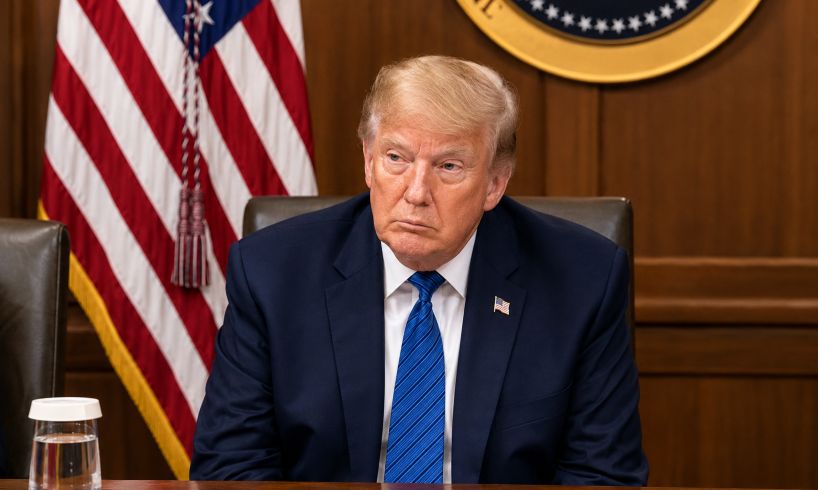
For years, Donald Trump built one of the most intensely loyal political movements in modern American politics, with supporters buying the merchandise, embracing the slogans, defending him through controversy after controversy, and repeatedly turning out to vote for him even when his statements, personal feuds, or political decisions created fresh waves of criticism, but now there are signs that something inside that relationship may be changing — and the most revealing evidence is not necessarily coming from Trump’s loudest critics, but from polling, political behavior, and the performance of businesses built around the Trump brand.
The latest Reuters/Ipsos poll offers one of the clearest warning signs yet, showing Trump’s overall approval falling to 32%, the lowest of his political career, while approval among Republicans dropped from 82% to 73% in just one week. The poll also found that only 17% of Americans approved of Trump’s handling of the cost of living, an issue that respondents identified as the most important factor in deciding how they will vote in the November 3 midterm elections.
That does not mean the MAGA movement has disappeared, and the numbers certainly do not prove that Trump has lost his Republican base, because 73% Republican approval remains substantial, but it does show that the once-unquestioning political environment around Trump is facing measurable pressure.
And that is where the bigger question begins. For years, Trump’s political formula depended heavily on loyalty. Supporters did not merely vote for him; many turned his political identity into part of their consumer identity, buying Trump-branded sneakers and other merchandise, embracing Truth Social, supporting his cryptocurrency ventures and treating attacks on Trump as attacks on the movement itself. Trump understood that connection and repeatedly turned his name into a political and commercial brand.
But some of those ventures are now encountering serious financial or audience challenges.
Trump Media & Technology Group, the company behind Truth Social and Truth+, reported a $238 million loss in the second quarter of 2026, prompting the company to scale back some of its expansion plans and refocus on its core media business.
Then came another striking development: Trump TV, a 24-hour YouTube livestream operated by the White House, launched this week as a direct vehicle for Trump administration content. Yet The Guardian reported that despite the channel having more than three million subscribers, its initial live audience was only around 1,500 viewers during one observed period.
That contrast is difficult to ignore because Trump’s political power has always been tied to his ability to command attention.
The question is whether the attention is still translating into the same level of enthusiasm.
Trump has repeatedly presented himself as the politician who would deliver what his supporters wanted, particularly on the economy and foreign policy. But the latest Reuters/Ipsos findings show that those promises are colliding with economic frustrations, especially over the cost of living and fuel prices, while dissatisfaction with his handling of the Iran war has also grown.
The political consequences are already becoming visible in some Republican campaigns. Reuters reported this week that Republican Senate candidates Mike Rogers in Michigan and Ashley Hinson in Iowa have called for a quicker end to the Iran conflict, positions that diverge from Trump’s approach.
That does not amount to the collapse of MAGA, but it is evidence that some Republicans are increasingly making distinctions between their own political interests and Trump’s preferred positions.
And perhaps that is the real story.
The Trump movement was built around an extraordinary level of personal loyalty, but political loyalty is not necessarily unlimited, particularly when voters begin feeling the consequences of policies in their everyday lives. A supporter can remain committed to Trump’s broader political identity while becoming dissatisfied with inflation, fuel prices, foreign wars or specific decisions coming from the White House.
That is precisely why the current numbers matter.
The latest poll found Trump’s approval among Republicans falling by nine points in a single week, while his overall approval reached its lowest point of his political career.
So the claim that “MAGA is gone” would go further than the evidence allows.
A more defensible conclusion is that the movement is being tested.
Trump spent years convincing supporters that loyalty to him was inseparable from loyalty to the movement, and now the midterm elections will provide one of the clearest tests of whether that personal bond remains as strong when voters are dealing with higher costs and frustration over policy outcomes.
The striking part is that Trump may not need to lose his entire base for the political landscape around him to change.
If even a portion of the voters who once treated every Trump controversy as something to defend instead begin asking whether the promises were delivered, whether the policies improved their lives and whether the costs have become too high, then the political equation becomes very different.
For now, the evidence points to pressure, not disappearance.
But for a movement built so heavily around the idea that Trump could always command unwavering loyalty, a 32% overall approval rating, declining Republican approval, Republican candidates publicly diverging from him on Iran and financial struggles surrounding parts of the Trump-branded media empire represent signals that deserve attention.
The question heading toward the midterms is no longer simply whether Trump can dominate the political conversation.
It is whether the loyalty that once seemed nearly unbreakable can survive disappointment with the results.
Comments (0)