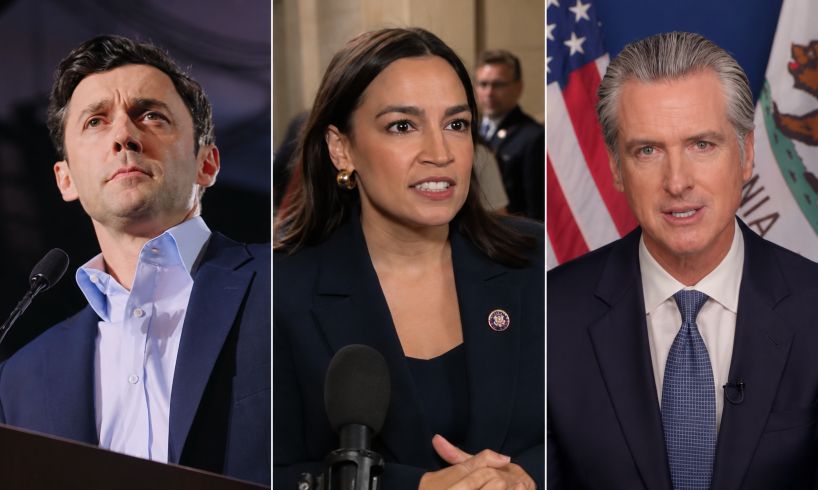
It took Democrats less than three weeks after their spectacular performance in the 2026 midterm elections to give some of their own supporters another reason to worry about 2028.
On Monday, November 23, the Democratic National Committee announced the framework for its next presidential primary debates, outlining a process that could see as many as 20 candidates competing for attention while contending with new campaign financing restrictions and strict rules governing their participation in political events.
The announcement was intended to demonstrate that Democrats are organized, united, and committed to reclaiming the White House.
Instead, it prompted expressions of frustration from some political observers on social media who fear the party is perfectly capable of throwing away an election that should be within its reach.
“They’re really serious about losing the next election,” one commentator wrote on X in response to the announcement.
Another expressed concern that Democrats could lose an otherwise winnable presidential election unless a severe economic downturn damages the Republican nominee.
Those reactions are anecdotal and should not be mistaken for broader public opinion. However, the underlying concern is considerably more substantial than a few frustrated social media posts might suggest.
Several experienced Democratic strategists have already warned that the party’s extraordinary midterm performance does not necessarily mean voters have rediscovered their enthusiasm for Democrats.
And the distinction could prove decisive in 2028.
Democrats unveil an ambitious and potentially divisive primary process
The DNC plans to organize 12 presidential primary debates, beginning in June 2027 and, under the current schedule, concluding in March 2028.
Five debates will take place in 2027, with another seven scheduled for the following year.
If a particularly large field of candidates qualifies, early debates could be spread over two consecutive nights, with participation capped at 20 presidential hopefuls.
Candidates will be selected through criteria that include polling performance and indicators of grassroots financial support.
The precise qualification thresholds for the first two debates will be announced in January 2027.
The party will also prohibit candidates from participating in unauthorized debates that bring multiple presidential contenders together to answer questions on the same stage. Candidates who violate the restriction risk losing access to future official DNC debates.
Individual town halls and forums will remain permissible.
Democratic officials also intend to incorporate content creators and social media influencers into the process to broaden the debates’ audience.
5 debates
7 debates
Democratic National Committee, November 23, 2026. Schedule subject to change.
DNC Chairman Ken Martin insisted that the party is building on its recent electoral success.
“Democrats are on offense after our historic victories in the midterms,” Martin said in a statement.
The party maintains that the process will promote fairness, strengthen its eventual nominee and help Democrats regain control of the executive branch.
Democrats
There is nothing inherently unreasonable about those objectives.
The question is whether the structure Democrats have chosen will reward the qualities needed to win a presidential election or motivate candidates to compete for the approval of the most politically engaged segments of the Democratic electorate.
Democrats have been down this road before
One of the more striking aspects of Monday’s announcement is how closely the proposed debate structure resembles the one used during the 2020 presidential election cycle.
That contest featured a remarkably crowded Democratic field, intense ideological disagreements, and debates in which candidates frequently had little time to explain complicated policy positions.
The competition for attention encouraged memorable confrontations, sharp ideological distinctions and exchanges that generated considerable media coverage.
Whether those moments helped prepare candidates for a general election is another matter.
Political columnist Ed Kilgore, writing for New York Magazine on Monday, noted that the DNC was returning to much of its previous debate structure, despite some Democrats’ dissatisfaction with it during the last competitive presidential primary.
Kilgore anticipated another round of disputes over candidates who fail to qualify and changes to eligibility requirements as the field shrinks.
The fundamental problem with a debate featuring 10 candidates on a stage is that nuance rarely attracts as much attention as confrontation.
A governor explaining the details of housing construction, electricity prices or healthcare costs may struggle to generate the same headlines as a rival delivering a devastating personal attack.
That creates an incentive structure that may have little relationship with what ordinary voters are looking for in a president.
Democrats should also remember that their eventual 2020 nominee, Joe Biden, defeated Donald Trump after presenting himself as a relatively reassuring and broadly acceptable alternative, rather than as the candidate offering the most dramatic ideological transformation.
That history does not establish that progressive candidates cannot win nationally. It does, however, illustrate that the qualities rewarded during a primary debate are not necessarily the qualities that determine a general election.
David Plouffe delivers a warning Democrats cannot afford to ignore
Perhaps the most important warning for Democrats came shortly after their midterm victories from a man who knows something about winning presidential elections.
David Plouffe, who managed Barack Obama’s successful 2008 presidential campaign and served as a senior adviser to Kamala Harris in 2024, offered a particularly revealing assessment during a discussion at Harvard University.
“The night was a vote against Trump rather than a vote for the Democratic Party,” Plouffe said.
That distinction should be at the center of every strategic decision the Democratic Party makes over the next two years.
Democrats secured at least 258 House seats in the midterms, their strongest showing since 1992, while also regaining control of the Senate.
However, those victories came against a backdrop of broad dissatisfaction with the Trump administration, affordability concerns, and frustration with the country’s direction.
In 2028, Democrats will not necessarily be running against Donald Trump himself.
They could be confronting a Republican nominee who retains many of Trump’s electoral advantages while presenting a different political personality and distancing themselves from some of his administration’s most unpopular decisions.
That could fundamentally change the nature of the election.
A Democratic nominee whose principal qualification is an ability to articulate opposition to Trump could discover that the political environment of 2028 is very different from the one that produced the party’s remarkable victories in 2026.
New campaign financing rules could create additional complications
The DNC’s decision to require presidential contenders to reject certain forms of outside political spending publicly represents the most significant new element of its debate framework.
Candidates will have to sign a Fair Campaign Practices Pledge committing themselves to denouncing qualifying super PAC and dark-money spending in the Democratic primary.
Campaigns that fail to comply could find themselves excluded from the next scheduled debate.
However, the party cannot actually prevent independent organizations from spending money on behalf of candidates.
The rules consequently create a system under which campaigns may report their rivals’ outside support to the DNC, possibly prompting compliance disputes.
The pledge applies to the primary rather than the general election. There is a legitimate argument in favor of the restrictions.
Lowering the perceived influence of wealthy donors could help rebuild confidence among voters who believe billionaires, corporations, and special interests excessively influence American politics.
There is also a legitimate concern that the rules could turn campaign financing into another source of internal conflict, particularly if candidates begin using complaints about outside spending as a tactical weapon.
The challenge for Democratic officials will be making sure that a system intended to promote fairness does not become another distraction from the electorate’s concerns.
Democrats still have an economic messaging problem
Earlier this year, Jim Messina, who managed Barack Obama’s successful 2012 reelection campaign, issued a remarkably direct warning about his party’s prospects.
“We have no economic message. And if we don’t get one, we’re not going to win,” Messina said during a gathering organized by the centrist Democratic group Third Way, according to Axios.
Democrats’ success in the midterms may have temporarily obscured the seriousness of that warning.
The party now faces the challenge of showing that Democratic control of Congress can deliver meaningful results for Americans struggling with housing costs, food prices, healthcare expenses, and economic uncertainty.
An economic recovery over the next two years could make that difficulty even more complicated.
If inflation eases, household purchasing power improves, and energy prices fall, a Republican presidential nominee could have a considerably more attractive economic record to run on.
Conversely, a recession or another prolonged period of economic crisis could create a substantial obstacle for the Republican Party. Neither outcome is guaranteed.
Democrats would therefore be making a potentially serious strategic mistake if they constructed their entire presidential campaign around the assumption that economic conditions will remain unfavorable to Republicans.
They need a convincing economic argument that works even if the economy improves.
History offers Democrats another uncomfortable lesson
Political scholars Elaine Kamarck and William Galston of the Brookings Institution examined the Democratic midterm victories in an analysis published on November 6.
Their conclusions offered little support for the idea that the 2028 election is already moving decisively in the Democrats’ direction.
“History shows that the midterms do not predict the results of the ensuing presidential election,” the scholars wrote.
Bill Clinton won reelection in 1996 after Democrats suffered a devastating defeat in the 1994 midterms.
Barack Obama accomplished something similar in 2012, two years after Republicans made enormous congressional gains.
Conversely, Democratic midterm victories in 2006 and 2018 preceded Democratic presidential victories in 2008 and 2020.
The historical record supports several possible outcomes, rather than a guaranteed trajectory.
Selected historical examples discussed by the
Brookings Institution, November 6, 2026. Not an exhaustive sample of American elections.
Kamarck and Galston also pointed out that both moderate and progressive Democrats enjoyed significant victories in 2026, meaning the midterm results did not definitively resolve the party’s continuing debate over which ideological direction offers its best chance of winning nationally. That is an important qualification.
Democrats do not necessarily have to become more conservative to win the presidency, nor does their recent success show that moving further left is the answer.
What matters is whether their eventual nominee can assemble a sufficiently broad coalition while offering credible solutions to the problems Americans consider most urgent.
Democrats have a golden opportunity — and plenty of time to squander it
The decision to organize 12 debates will not, by itself, cost Democrats the 2028 presidential election.
A competitive primary could produce a stronger nominee, expose weaknesses before Republicans can exploit them, and allow an exceptional candidate to emerge from relative obscurity.
The new campaign financing rules could also support a potentially powerful Democratic message about political corruption and the influence of money in Washington.
However, the party must avoid confusing a process designed to satisfy its internal constituencies with a strategy capable of winning over the country.
Voters who supported Democrats in November 2026 because they were unhappy with Donald Trump have not necessarily committed themselves to supporting whichever candidate emerges from the Democratic presidential primary. They will need to be persuaded again.
That is why the pessimism expressed by some Democratic supporters following Monday’s announcement should not be dismissed entirely.
Their concern is not simply that Democrats have scheduled too many debates or introduced unnecessary rules.
It is that the party might once again become so consumed by its internal arguments that it loses sight of the Americans whose votes will ultimately determine its future.
Comments