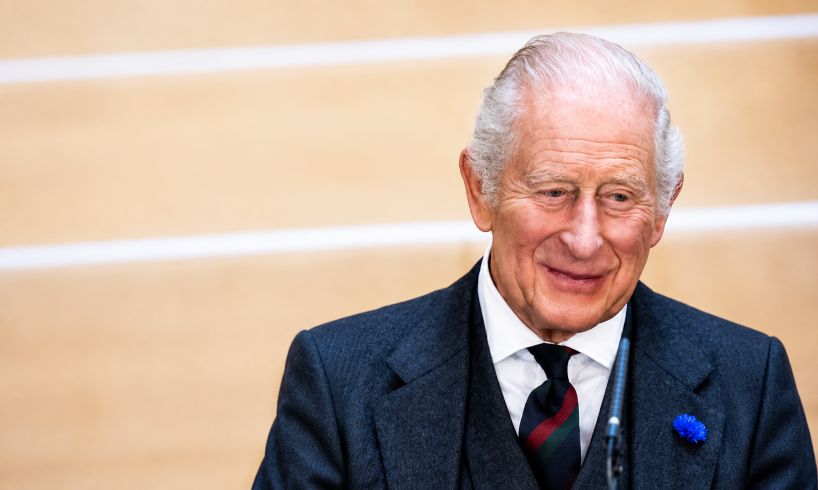
Buckingham Palace has defended King Charles III’s handling of the royal family’s increasingly complicated internal affairs after a new poll revealed the monarch’s approval ratings have fallen to their lowest level since he took the throne. The numbers are even more troubling for Prince Harry and Meghan Markle, whose return to Britain has done little to improve their standing with the public.
Charles may be facing fresh questions about his family, but Palace officials say he has no doubts about the decisions he has made. His strained relationship with Harry and Meghan remains under scrutiny, while the troubles surrounding his brother Andrew show little sign of fading.
The comments, reported by HELLO! magazine and the Press Association on October 31, came just days after YouGov published a survey showing that only 58% of British adults viewed the King favorably.
That figure shows a four-point decline since July and the weakest result recorded during his reign.
Harry and Meghan fared considerably worse.
Just 29% of respondents showed a positive opinion of Harry, while Meghan’s favorability rating fell to 20%. Nearly seven in ten Britons held an unfavorable view of the Duchess.
The results have intensified questions about the monarchy’s handling of the Sussexes, who returned to the United Kingdom with their children in late August after six years of living primarily in California.
But the Palace’s response suggests Charles has no immediate intention of reconsidering his approach simply because public opinion has shifted.
Buckingham Palace Defends Charles as Questions Mount
The King’s position became clearer when a senior royal aide was asked whether Charles and his advisers remained confident in how they were handling family matters.
The answer was unequivocal.
“Yes. That is why he takes the actions he does – and has done,” the aide told reporters.
The Palace representative also explained how Charles balances his responsibilities as monarch with the personal demands of being a father, brother and grandfather.
According to the aide, the King must divide his attention among his duties as head of state, his responsibilities toward the Church, the Commonwealth and the military, and his obligations to his family.
Those priorities, the official explained, can change throughout the day depending on what requires the King’s attention.
The comments are significant because they offer a rare public explanation of how Charles approaches the competing demands of his position.
They also arrive at a time when his relationship with Harry has returned to the center of royal coverage.
For some observers, the Palace’s emphasis on institutional responsibilities reinforces an important distinction: Charles may be Harry’s father, but he is also the sovereign.
That does not mean family necessarily comes last in the King’s private calculations. The aide said priorities are not fixed.
Nevertheless, the remarks make clear that family considerations have to be balanced against responsibilities extending well beyond Buckingham Palace.
And that presents an uncomfortable reality for Harry and Meghan.
Their return to British soil does not automatically change their standing within the monarchy.
YouGov Poll Delivers Difficult Numbers for the Sussexes
The latest figures provide a revealing picture of the public mood.
YouGov surveyed 2,116 adults across Great Britain on October 22 and 23 and published the results on October 29.
Charles remained more popular than unpopular, with 58% expressing favorable opinions and 34% viewing him negatively.
His net favorability rating of plus 24 was nevertheless the lowest recorded since his accession in September 2022.
Harry’s position was considerably weaker.
Only 29% of respondents viewed the duke positively, down four percentage points from July, while 60% held an unfavorable opinion.
Meghan recorded the weakest result of her time in YouGov’s royal tracker.
Just 20% viewed her favorably, compared with 68% who expressed negative opinions. Her net favorability rating stood at minus 48.
The numbers told a very different story for William and Kate. While Harry and Meghan struggled in the survey, the Prince of Wales attracted favorable opinions from 74% of Britons. Kate stood at 72%, with Princess Anne not far behind at 68%.
The wider institution continued to enjoy majority support, with 64% of Britons saying the country should retain the monarchy.
Those figures complicate any suggestion that the royal family’s internal disputes have turned the British public against the Crown as a whole.
They also highlight the difference between attitudes toward working royals and the Sussexes.
However, the survey did not ask whether respondents blamed Charles for allowing Harry and Meghan to return.
It therefore cannot establish that the Sussexes caused the King’s four-point decline or that their unpopularity has influenced any particular Palace decision.
What it does show is that the couple’s relocation has not been accompanied by an improvement in their public standing.
Charles Already Drew a Line After Harry and Meghan Returned
The King’s position toward the Sussexes became clear in September, shortly after their relocation.
A letter issued by the Lord Chamberlain on Charles’s instructions reminded government officials and other public authorities that Harry and Meghan remained non-working members of the royal family.
Living in Britain again does not restore Harry and Meghan to their former royal positions. The letter spelled out that they would continue their charity work on their own, and that any decisions about security would be made by the proper authorities rather than the Palace.
It also directed official organizations to consult Buckingham Palace about courtesies or arrangements involving public resources.
The message was administrative rather than an announcement of a new punishment.
Nevertheless, it drew a boundary between the Sussexes’ public activities and the monarchy’s official work.
The couple’s representatives reportedly objected to how the clarification was handled, saying they had received little advance notice and preferred to be described as public figures rather than private citizens.
The disagreement demonstrated how sensitive even questions of protocol have become.
Harry and Meghan may now live in Britain again, but Charles has made no public move to reinstate them as working royals.
Buckingham Palace has also not indicated that such a change is under consideration.
That position adds context to the senior aide’s latest defense of the King’s decision-making.
The Markle Family Investigation Adds Another Complication
The polling was conducted during the same period that serious allegations involving Meghan’s estranged father, Thomas Markle Sr., were becoming public.
Authorities in the Philippines are investigating allegations that Markle possessed child sexual abuse material.
Markle has denied the accusations, describing them as lies. He has not been charged.
On November 3, Philippine police said material suspected to contain child sexual abuse imagery had been discovered during a search of a property associated with him. Investigators examined devices and worked to establish ownership and any connection to the alleged material.
Meghan publicly expressed distress over the reports and concern for any children who might have been harmed.
The Metropolitan Police also acknowledged receiving a letter in 2019 containing allegations against Markle that had not been referred to overseas law enforcement agencies at the time.
British authorities subsequently began making referrals, while the police watchdog opened an investigation into how the information was handled earlier.
The developments have brought additional attention to Meghan’s already complicated family relationships.
But the allegations concern her father, not Meghan herself, and no evidence connects Harry or Meghan to the suspected offenses.
There is also no basis for concluding that the investigation caused the Sussexes’ declining polling numbers, even though the stories appeared around the same time.
For Buckingham Palace, the situation nevertheless illustrates the difficulty of handling overlapping family controversies that attract extensive media coverage without necessarily involving the monarchy’s official work.
Why the Palace’s Words Matter More Than Their Order
The most revealing aspect of the Palace response may be its insistence that Charles remains satisfied with the decisions he has already made.
The aide did not announce a policy change or suggest that the King was reconsidering Harry and Meghan’s position.
The Palace was essentially saying that Charles stood by his decisions. Nothing suggested he was about to take a different approach. And while his family remains important, the comments made clear that the King has other responsibilities competing for his attention.
But the aide did not explicitly rank Harry and Meghan below the Church, the Commonwealth, or the military. Nor did the Palace say that reconciliation was off the table.
The official’s explanation was more flexible: Charles must adjust his attention as circumstances demand.
Still, the monarchy faces a genuine challenge in defending that distinction.
If Charles appears too accommodating toward family members who no longer perform royal duties, commentators could question whether the institution is applying its own rules consistently.
If he maintains strict distance, he risks letting personal disagreements become prolonged public disputes.
Neither outcome offers an easy resolution.
For Harry and Meghan, the difficulty is that returning to Britain does not erase the circumstances surrounding their departure or the public disagreements that followed.
Rebuilding personal relationships and regaining an official place within the monarchy are separate questions.
The Palace has offered no indication that it intends to merge the two.
King Charles Faces a Test Bigger Than Harry and Meghan
Charles’s responsibilities have become increasingly demanding while he navigates his reign amid family disputes and the continuing controversy surrounding Andrew Mountbatten-Windsor.
The King has also maintained a busy schedule of public engagements and overseas duties, including his recent Caribbean visit.
The Palace said Charles remains focused on his duties, regardless of the problems involving his family. But the latest polling reminds us that his standing with the British public is not guaranteed.
Although a majority of Britons continue to view Charles favorably, his personal rating has declined.
The younger generation presents another challenge.
Among adults aged 18 to 24, YouGov found that only 46% favored retaining the monarchy, compared with 81% of those aged 65 and older.
Such differences indicate that the institution’s longer-term challenges extend well beyond the current disagreement involving Harry and Meghan.
For the Sussexes, the immediate question is whether their return to Britain will eventually improve their relationships with the royal family and the public.
Their latest ratings suggest that simply living in the country again has not been enough.
For Charles, the challenge is different.
He must preserve the distinction between his role as a father and his responsibilities as King while responding to a public that is still divided over several members of his family.
The Palace wasn’t picking another fight with Harry and Meghan. Its message was simpler: Charles stands by the decisions he’s already made and sees no reason to change course.
The Sussexes are back in Britain. Their official royal status remains unchanged. And for now, Buckingham Palace appears determined to keep those two realities separate.
Whether that approach ultimately strengthens public faith in the King is a question the latest poll cannot answer.
But one thing is already apparent: Harry and Meghan’s return has not brought the automatic change in public opinion that a new phase might have offered.
Comments (0)