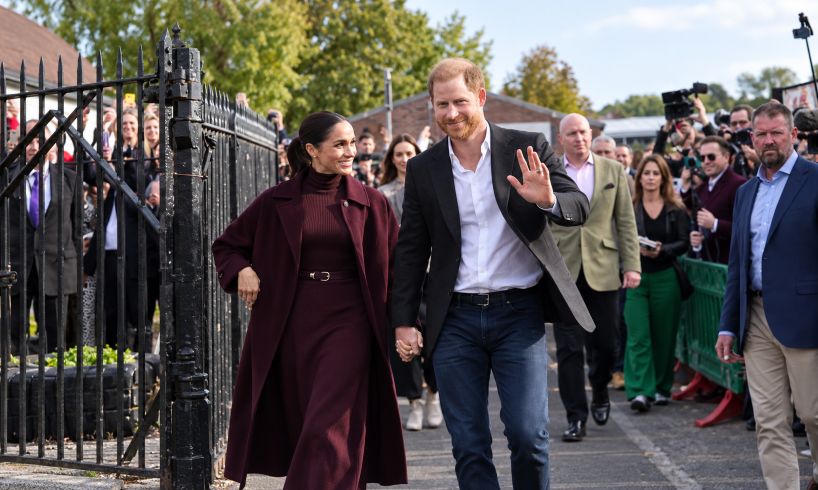
Prince Harry and Meghan Markle appear to have put their plans for a £10 million ($14 million) British country estate on hold, opting instead for a new living arrangement on a wealthy friend’s property. The surprising decision arrives less than three months after their return to the United Kingdom with Prince Archie and Princess Lilibet, raising fresh questions about how firmly the Sussexes intend to establish themselves in Britain.
The Duke and Duchess of Sussex have reportedly moved from the main residence of a businessman’s sprawling Cotswolds estate into another property on the same grounds.
According to the Daily Mail’s Richard Eden, the couple had been staying with the businessman since relocating from California in late August.
“They were living in the main house,” a friend of the businessman told the newspaper. “They have now moved to a property on the estate.”
The arrangement is reportedly the result of a longstanding friendship between Harry and the property owner, who became acquainted through their mutual interest in military charities.
The businessman is understood to be comfortable with the Sussexes continuing to live on his estate.
The development has also called into question their much-discussed search for a permanent British home.
Harry and Meghan were previously reported to be considering properties costing up to £10 million ($14 million), with enough land to provide the privacy they have repeatedly identified as a priority.
But instead of purchasing a large country residence, they appear to have settled, at least for now, on a home that belongs to someone else.
That distinction creates an interesting question about the couple’s latest British chapter.
Have they found a feasible solution that gives their family the stability they need, or are they deliberately keeping their options open?
Harry and Meghan’s Cotswolds Plans Take a Surprise Turn
Harry and Meghan had barely returned to Britain in August before people began wondering where they would make their new home.
The Cotswolds seemed like an obvious choice, particularly as reports suggested they were interested in buying a large property in the countryside.
Harry already knew the region, and its proximity to King Charles III’s Highgrove estate could allow more frequent family contact.
According to earlier reports, the couple wanted a substantial country property with at least nine bedrooms, generous grounds and no public rights of way crossing the land.
The reported budget of up to £10 million suggested that they were prepared to invest heavily in creating a permanent British base.
But recent developments suggest those plans may have changed.
Richard Eden reported on November 3 that Harry and Meghan had moved into another residence on their friend’s estate shortly before leaving for a family holiday during the school half-term break.
HELLO! magazine subsequently reported that the second property had been prepared for the couple and was now ready for occupation.
The publication also noted that their search for a separate family home could have ended.
Neither Harry nor Meghan has publicly confirmed that the property hunt has permanently ended.
Unanswered questions remain about the new arrangement.
It is not known whether the couple is paying rent, how long they intend to stay or whether they have entered into a formal lease.
The size and precise nature of the new residence have not been independently established.
For security reasons, its location has not been openly revealed.
Still, the decision to remain on a friend’s property rather than buy their own estate is an interesting departure from expectations around their return.
The One Big Catch: Privacy Lacking Complete Independence
For Harry and Meghan, the Cotswolds arrangement may offer several immediate advantages.
Living on a large private estate can provide substantial separation from public roads, photographers and curious visitors.
It may also spare the couple the complications of purchasing, renovating and securing a major country residence while their children adjust to living in Britain.
But the arrangement comes with an obvious limitation. The Sussexes are living on property owned by someone outside their immediate family.
However comfortable or private the accommodation may be, it is not the same as controlling an independently owned residence.
That can matter when a family values privacy and security highly.
The couple’s freedom to make long-term changes to the property, establish security arrangements or remain there indefinitely may depend on whatever agreement they have with its owner.
There is no public evidence of any disagreement with the businessman or indication that he wants the family to leave.
Indeed, reports suggest the opposite.
Nevertheless, the arrangement means that at least some aspects of the family’s housing situation remain tied to another person’s property.
For a couple who spent years pursuing greater control over their private lives, that is a noteworthy compromise. It may also be sensible.
Maintaining versatility during the first few months of a major international relocation can be more practical than immediately committing millions of pounds to a property.
The question is whether that flexibility is temporary or becomes a defining feature of their new life in Britain.
Their Montecito Mansion Remains Part of the Picture
While Harry and Meghan establish themselves in the Cotswolds, they have retained the California estate that served as their primary family residence for six years.
The couple purchased the Mediterranean-style property in Montecito for approximately $14.65 million in 2020.
The sprawling residence became closely associated with their new lives outside the working monarchy.
It has additionally played a prominent role in Meghan’s lifestyle business, As Ever, whose marketing draws heavily on the gardens and domestic atmosphere of the California property.
Reports indicate that the mansion continues to be kept despite the family’s relocation to Britain. The decision to keep it is significant.
Rather than sell their American home and base themselves entirely in the United Kingdom, Harry and Meghan have preserved a substantial base in California.
They have also reportedly retained a holiday property in Portugal.
Taken together, those holdings provide the family with considerable geographical flexibility.
They could remain primarily based in Britain while returning to California for business or personal reasons.
They could divide their time between countries. Or they could eventually reconsider where they want to live. None of those possibilities has been established as their long-term plan.
But keeping the Montecito estate means returning to California would not necessarily require finding and buying another family home. That is a meaningful practical advantage.
Does Avoiding a British Purchase Reveal Their Long-Term Plans?
One possible interpretation of the Cotswolds arrangement is that Harry and Meghan are reluctant to make an expensive commitment before determining whether their return to Britain will work for the entire family.
There are reasonable grounds for reviewing that possibility.
The couple has moved their children across the Atlantic, begun rebuilding their lives in a country they left six years earlier, and entered a new phase of their relationship with the monarchy.
Purchasing a £10 million property would represent a major financial decision at a time when many aspects of their new routine are still developing.
But it would be misleading to suggest that buying such a home would automatically establish their UK tax residency.
British tax rules take more than property ownership into account. Under the Statutory Residence Test, a person’s residency status depends on factors such as how many days they spend in the UK, where they work, and their family and housing arrangements.
Buying a house in Britain does not automatically make someone a UK tax resident. Equally, staying at a friend’s property does not necessarily mean they are exempt from those rules.
The Sussexes’ personal tax arrangements are not public.
Their housing decision therefore cannot establish whether they are seeking to avoid British tax obligations or shortening the duration of their stay.
The move does suggest, however, that they have not yet made the substantial property purchase previously associated with their return.
That leaves their longer-term intentions open to interpretation.
Harry’s British Priorities May Explain the Unusual Choice
Harry has spoken publicly about wanting Archie and Lilibet to experience the country where he grew up.
Reporting has identified the children’s education and opportunities to develop closer relationships with relatives as important considerations behind the family’s return.
Their relocation also created the possibility of Harry spending more time on British charitable work, particularly his longstanding commitments connected to veterans and military service.
Those priorities do not necessarily require a permanent country estate.
A comfortable private home near schools, friends and family could meet the family’s immediate needs without forcing a major real estate decision.
There are also indications that the Sussexes are making plans that go beyond a brief autumn visit.
On November 4, HELLO! reported that Harry and Meghan were considering spending Christmas in Britain with Meghan’s mother, Doria Ragland.
The arrangements reportedly remain dependent on her availability, and no final plans have been publicly confirmed.
Still, the possibility of a British Christmas complicates the notion that the couple is already preparing to retreat to California.
Harry and Meghan may simply be building a new routine before deciding what type of permanent home they want.
That explanation is at least as plausible as the suggestion that their stay is deliberately temporary.
A Familiar Pattern From Their First American Move
Another interesting parallel appears in the Sussexes’ latest housing decision.
When Harry and Meghan first settled in California in 2020, they initially stayed at a property belonging to entertainment executive Tyler Perry.
That arrangement provided them with accommodation and privacy while they established their new lives in the United States.
They subsequently purchased the Montecito estate. Their latest move to Britain follows a similar pattern.
Once again, the couple has relied on a wealthy friend’s hospitality during a major transition.
Once again, privacy appears to have been a major consideration. And once again, they have delayed making an immediate property purchase.
The difference is that this time they already own an expensive home on another continent.
That gives them options they did not have when they first arrived in California. It also makes their decision to remain on a friend’s estate more intriguing.
But their experience in 2020 demonstrates why temporary accommodation should not automatically be interpreted as reluctance to settle.
In that instance, staying with a friend eventually led to purchasing a permanent home.
Whether the same pattern will unfold in Britain remains unknown.
The Bigger Question Is Whether Britain Becomes Home Again
The Sussexes’ latest move emphasizes the complicated nature of their return to the United Kingdom.
They have brought Archie and Lilibet back to Britain, reportedly enrolled them in local schools and begun establishing a different family routine.
At the same time, they have retained their American residence, continued their international business interests and avoided committing to the expensive British property they were previously said to be seeking.
Those decisions create a picture of a family with several possible paths ahead. The new Cotswolds arrangement could be a workable solution that eventually leads to a permanent purchase.
It could also develop into a longer-term residence without the couple owning the property. Or the family could ultimately decide that maintaining homes in multiple countries better suits their personal and professional lives.
The most important unanswered question is not whether the Sussexes can afford a £10 million estate. Their reported housing budget suggests they considered substantial property purchases.
The question is whether they believe buying one is necessary.
For now, Harry and Meghan appear to have found a way to enjoy the privacy of the English countryside without making the major property commitment many expected. But that freedom comes with a trade-off: their British home is part of someone else’s estate, while their own mansion waits across the Atlantic. That does not prove their return to Britain is temporary.
It does, however, leave them with something that could become increasingly valuable if their circumstances change: the ability to choose their next move without first selling a multimillion-pound British home.
And after six years of rebuilding their lives abroad, that flexibility may be precisely what the Sussexes want.


Comments (0)