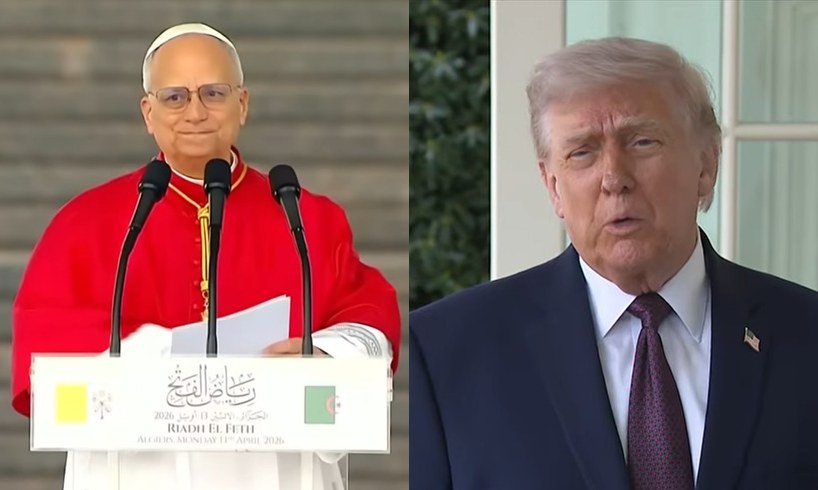
As a de facto oil blockade further paralyzes Cuba, Pope Leo XIV has emerged as a maverick, no-BS mediator, attempting to bridge the widening gap between the communist government and the White House.
The Vatican has confirmed that the brave and cocky American Pontiff has attended multiple high-level meetings with the leaders of the Caribbean island to facilitate talks with the Trump administration.
Does that imply that President Donald Trump will have to, at some point, communicate with Pope Leo?
Cuban officials have heard the many and loud threats from Mr. Trump, who has declared that, following the American interventions in Iran and Venezuela, he is aiming for a “regime reckoning” in Havana.
Speaking to reporters last week, Trump was blunt: “We may stop by Cuba after we’re finished with [Iran]… Cuba is next, by the way, but pretend I didn’t say that.”
The White House Pressure Campaign
Cuban politicians feel that Trump is “knocking on their doors and breathing down their necks” with stunning moves such as the January 29 executive order declaring a national emergency.
This order authorized an oil blockade, with the United States threatening crippling tariffs on any third-party country — including Mexico and Russia — that dares to supply the island with crude.
The Cubans have seen how the pope has stood up to Trump over immigration, the wars in Iran and Venezuela, and even the proposed purchase of Greenland.
They believe he can get through to a President who recently claimed: “Leo should be thankful because… he was only put there by the Church because he was an American, and they thought that would be the best way to deal with President Donald J. Trump.”
A Clash of Titans: The “Magical” Vatican vs. “Mad Max” Reality
The island’s leadership believes that Pope Leo XIV has positioned himself as the ultimate “shield for the vulnerable.” The nation is betting on the pope after their allies in Mexico and Venezuela have caved to Trump.
John S. Kavulich, president of the U.S.-Cuba Trade and Economic Council, describes the Cuban perception: “The Cubans have always believed that the Vatican has somewhat of a magical property. And that its imprimatur will result in more coming back to Cuba than they are putting in.”
However, while US government-funded humanitarian aid is being channeled through the Catholic Church, Trump has made it clear he is not thrilled with the pope being hailed as a “mighty savior.” The administration remains unimpressed by the Vatican’s “soft power,” betting instead on the regime’s total collapse.
Washington’s Cold Calculation
In Washington, the prevailing sentiment is that the Cuban government is on the precipice of ruin, and now is the time to squeeze, not talk.
An anonymous source familiar with the high-stakes negotiations made it clear that the White House is not in the business of taking orders from the pope: “The administration is not going to let the Vatican dictate its Cuba policy. They’re welcome to speak, but the response is, ‘You’re right, there are problems, but we didn’t cause them.’”
As blackouts last up to 20 hours and Secretary of State Marco Rubio warns of an “Extra-Special Period” of hunger and decay, Pope Leo has stood tall and declared while in Algeria that he is the only figure fearless and daring enough to disrupt Trump’s endgame.
The battle for Cuba has become a duel between the “obliteration” doctrine of the White House and the “dialogue-based” steel of the American pope.
The administration’s strategy is one of patience — waiting for a total internal implosion rather than offering a way out.
The same source explained the refusal to engage in a quid pro quo. The insider shares the administration’s belief that the Cuban government is nearing collapse: “The Cuban government could make changes that would mitigate them. So we’re not terribly excited about a quid pro quo because we really don’t need to do anything to get them to do anything because they’re collapsing on their own, and so, eventually, we’re [going to] get what we want.”
A “Mad Max” Humanitarian Crisis
While the titans of power and faith clash in the diplomatic arena, the reality on the ground in Cuba has turned apocalyptic for almost 10 million people. The fuel shortage has not only stopped cars; it has paused the delivery of survival itself. The fuel shortages are so severe that hospitals are forced to operate by candlelight, and basic food distribution has ground to a halt.
A person familiar with the relief effort described a logistical deadlock that has rendered aid shipments useless: “On one hand, they want to deliver humanitarian assistance to those in need through the Catholic Church because it is] present in the whole of the island. But at the same time, that assistance cannot be delivered because of the blockade of oil. You need to lift those sanctions because it’s been like this for a couple of months.”
Miami Archbishop Thomas Wenski, a veteran of Cuban aid missions, confirmed that the desperation has reached a breaking point.
He noted that even the proud Cuban government has had to lower its guard: “They swallowed hard and said they’d take U.S. government assistance.”
Yet, even with aid arriving at the ports, the lack of fuel has turned distribution into a prehistoric struggle. Archbishop Wenski’s description of the scene was visceral: “It’s like a Mad Max movie.”
Pope Leo A Titan of Diplomacy?
Despite the dismissive rhetoric from Washington, Pope Leo XIV has refused to back down. He has leaned into his role as a “formidable” defender of the poor, echoing the daring statements of the Catholic Bishops in Cuba who argued that: “Governments should be able to resolve their disagreements and conflicts through dialogue and diplomacy, not coercion or war.”
In a public appeal that directly challenged Trump’s “obliteration” doctrine, Pope Leo XIV demanded that: “all responsible parties [should engage in dialogue] to avoid violence and every action that could increase the suffering of the dear Cuban people.”
Despite Trump’s ongoing ruthless maneuvers against anyone he deems an enemy or nuisance, the Vatican stunningly remains the only power capable of going toe-to-toe with the White House on major issues and conflicts.
While the Trump administration “waits for the collapse of the island,” Leo XIV is ready to fight and prove that moral authority and faith can shatter a blockade. The question remains: in a “Mad Max” world created by Trump, does the Gospel still have the power to force a deal?