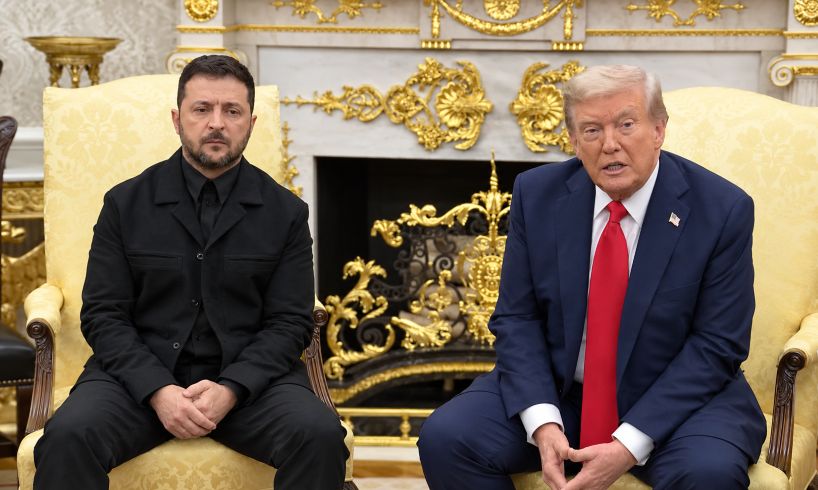
President Donald Trump has received a pointed warning from Volodymyr Zelenskyy over his proposed new security arrangement for Europe, with the Ukrainian president making it clear that he will not accept a deal that allows Russia to have a say in the continent’s future while its war against Ukraine continues.
The warning comes at a sensitive moment for the Trump administration, which is trying to move negotiations forward and has suggested that a major agreement could involve much more than simply ending the war in Ukraine. Trump has even indicated that the proposed deal could extend to the wider European security system, an idea that has raised serious concerns in Kyiv.
Speaking to CNN’s Jake Tapper, Zelenskyy acknowledged that he did not yet know all the details of the American proposal, but he was already concerned about the direction of the discussions. His main objection was that Russia appeared interested in negotiating a new security arrangement for Europe without first showing any genuine willingness to end its invasion of Ukraine.
For Zelenskyy, that is a dangerous way to approach negotiations, and he made sure his concerns were heard.
Zelenskyy Warns Trump Against a New European Security Deal
The Ukrainian president was particularly concerned that Moscow could use discussions about Europe’s future security to advance its own interests while avoiding the difficult question of how to end the war.
“We didn’t see yet any kind of demonstration and signals from Russian side that they are ready to do something,” Zelenskyy told CNN.
He went on to explain that Russia appeared more interested in discussing a new security structure for Europe than finding a way to end the fighting.
“This is, I think this is, that’s why it’s dangerous,” he said.
His remarks were a clear warning to Washington that Ukraine cannot be treated as a secondary issue while the United States and Russia discuss the future of European security. Although Zelenskyy said he did not have all the details of Trump’s proposal, he was unwilling to accept an arrangement that could leave Ukraine and other European countries vulnerable to decisions made without their participation.
He also stressed that sovereignty and territorial integrity must remain central to any agreement involving independent countries.
‘We Don’t Want Yalta 2’: Zelenskyy Draws a Firm Line
Perhaps the most striking part of Zelenskyy’s interview came when he referred to the Yalta Conference of 1945, when the leaders of the United States, Britain and the Soviet Union discussed the postwar order in Europe.
The reference to Yalta was significant because the agreement helped shape postwar Europe, leaving several Eastern European countries under Soviet control with little say over what happened to their own future.
“We don’t want to have Yalta, Yalta 2. Yes, we are not ready for such a format. We don’t want to be divided by Russia,” Zelenskyy said.
His message was that Ukraine would not accept another arrangement in which powerful countries negotiate over the heads of those whose security and independence are directly at stake.
The Ukrainian leader also pointed out that although his country is not yet a member of either the European Union or NATO, the consequences of a new security agreement would extend across the continent.
“We all live in Europe,” he said, making the point that the future of European security cannot be treated as a matter concerning only Washington and Moscow.
Trump’s Ambitious Proposal Raises Questions Across Europe
Trump’s comments about a possible wider agreement came after his November 5 meeting with Kirill Dmitriev, an envoy of Russian President Vladimir Putin. Following that meeting, the American president suggested that negotiations were moving toward a major settlement that could extend beyond Ukraine.
“It’s going to be an agreement, it’s going to be a big agreement,” Trump told reporters, adding that it could involve all of Europe.
His special envoy, Jared Kushner, has also described efforts to develop a broader security framework intended to prevent renewed hostilities. Meanwhile, US envoy Steve Witkoff announced that Ukraine, Russia and the United States were preparing for another round of trilateral talks in Abu Dhabi on November 10 and 11.
Those discussions are expected to cover postwar security arrangements, de-escalation and humanitarian issues, among other matters.
However, Zelenskyy’s warning highlights the difficulty facing the Trump administration. A deal that Washington considers an opportunity to reshape European security could look very different from Kyiv’s perspective if it gives Moscow influence over decisions involving countries it has threatened or attacked.
Ukraine wants more than an end to the fighting. Zelenskyy is looking for firm guarantees that Russia will not simply regroup and launch another invasion a few years later. He has also made it clear that any agreement must respect Ukraine’s independence and the right of every European country to decide its own future.
Trump may be hoping to reach a much bigger deal with Moscow, but Zelenskyy does not want Ukraine’s future being negotiated without its involvement. His warning about “Yalta 2” was a reminder that he will not accept a repeat of history in which powerful countries sit around a table and make decisions that leave smaller nations paying the price.
Comments (0)