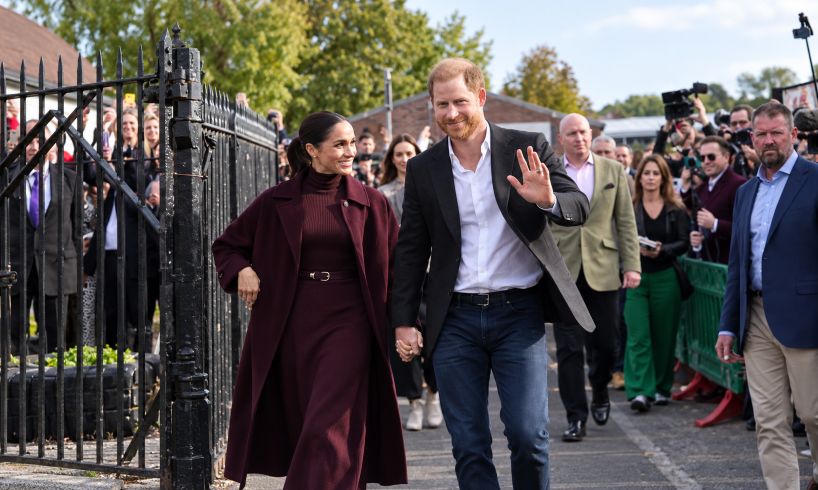
Prince Harry has been forced into an unusually delicate damage-control operation after his latest GQ interview sparked fresh speculation about whether his comments on reconciliation were aimed at Prince William, with the Duke of Sussex’s spokesperson now stepping in to insist that his words were never intended as a swipe at his brother or any other member of the Royal Family.
The clarification was direct, but it has not necessarily settled the controversy, because the problem is not simply what Harry says he meant, but the question that was asked, the family relationships being discussed and the timing of his answer, all of which have left critics wondering why such an apparently general comment needed to be explained away in the first place.
“It was absolutely not intended as a swipe at his brother or any other member of his family,” Harry’s spokesperson said. “The comment was made in a general context and was not directed at his family in any way.”
That is a significant statement from the Sussex camp, particularly because Harry was speaking about one of the most painful and persistent issues surrounding his public life: his fractured relationships with his father, King Charles, and his brother, Prince William.
The Question That Started the Trouble
The difficulty for Harry is that the interviewer had specifically raised those family relationships before asking whether he grieved the complicated relationship he had with his brother and father.
Prince Harry acknowledged that he did, before discussing how family breakdown was something many people could relate to, from disagreements between siblings to strained relationships between parents and their children.
He then suggested that people look at his own family and wonder how the estrangement might eventually be resolved, perhaps finding hope or inspiration in seeing the family work through its difficulties.
Then came the remark that triggered the latest round of speculation. “Some people don’t want it to work out. I want it to work out,” Harry said.
The interviewer appeared surprised enough to ask whether he genuinely wanted reconciliation, prompting Harry to reiterate that he did and to argue that, with so much happening in the world, making peace was especially important.
Prince Harry’s defenders could argue that his remarks were about reconciliation in general, but the timing inevitably raised questions about whether he was also thinking about members of his own family who have shown little public interest in reuniting with him.
That is what makes the clarification that followed so significant, because it offered a chance to explain what Harry really meant and why his words had attracted so much attention.
Harry’s Spokesperson Steps In
The spokesperson’s statement appears designed to draw a firm line between Harry’s general message about fractured families and the specific interpretation that his words were aimed at Prince William.
Yet the explanation also highlights the difficulty Prince Harry faces whenever he speaks publicly about reconciliation, because even when he is trying to make a broader point about family relationships, his own history with the Royal Family inevitably becomes part of the conversation.
Over the years, Harry’s comments about his family have repeatedly made headlines. Prince Harry oversharing nature has often caused major controversies that often overshadow the message he may have intended to convey. His latest interview has once again shown how quickly a few remarks can spark fresh speculation, leaving his team to clarify his meaning after the original comments have already attracted attention.
There is a French expression for this kind of situation: mettre les choses au clair, which means to clear things up. And that appears to be precisely what Harry’s spokesperson was trying to do, making it clear that the Duke’s stated desire for reconciliation should not be interpreted as an accusation that Prince William or King Charles is deliberately standing in his way.
The Bigger Problem Harry Cannot Escape
The clarification may help explain Harry’s intended meaning, but it cannot erase the fact that the question was explicitly about his family, or prevent readers from interpreting his answer through the history of the brothers’ estrangement.
Nor does the statement establish that William or Charles has rejected every possibility of reconciliation. Their private positions cannot be determined simply from Harry’s comments or his spokesperson’s response.
Ultimately, the episode exposes the difficult balance Harry must strike between speaking honestly about his personal experiences, trauma and avoiding another public dispute with the very relatives he says he wants to reconcile with.
He has now made his position clear: he says he wants things to work out, and his spokesperson insists that he was not taking a swipe at his family.
But the fact that a clarification was necessary shows just how combustible the subject remains.
Harry may want reconciliation, but rebuilding trust is a different matter from explaining an interview after the headlines have already landed. If he genuinely hopes to repair those relationships with his estranged family the most meaningful statement may eventually be the one he makes privately, away from the cameras, where reconciliation would have to become more than a carefully explained public message.


Comments (0)