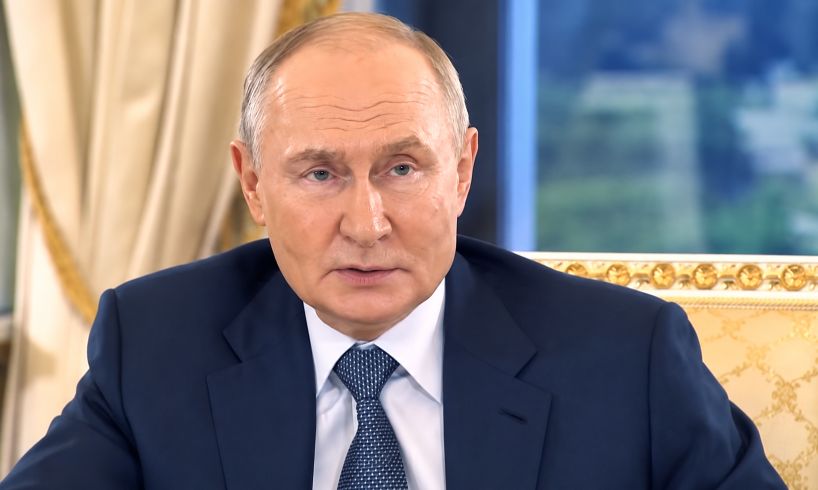
Vladimir Putin appears to be following his own diplomatic calendar, and that is creating an awkward new moment for Donald Trump, because while the Russian president is reportedly preparing to attend the Asia-Pacific Economic Cooperation summit in China for the first time since 2017, his participation in the G20 gathering Trump plans to host in Miami has been described as extremely remote — a development that suddenly makes Washington’s invitation look far more important than Moscow’s willingness to accept it.
According to Bloomberg, people close to the Kremlin said Putin intends to participate in the APEC summit in China, while the possibility of him attending the G20 gathering in Florida was considered extremely remote. Kremlin spokesman Dmitry Peskov did not respond to Bloomberg’s request for comment.
Then came the remarkable part. The United States did not simply leave the matter alone.
Secretary of State Marco Rubio said Wednesday that Washington had invited Putin to the December G20 meeting in Miami, where the Russian leader could potentially meet Trump. Reuters reported that the invitation was confirmed publicly by Rubio after his meeting with Russian Foreign Minister Sergei Lavrov in New York.
That sequence creates a striking diplomatic contrast. Putin can appear to decide where he wants to go, whether he wants to participate and which international gatherings deserve his attention, while Trump is now publicly extending an invitation for the Russian president to come to an event hosted by the United States, even as Russia continues its war against Ukraine.
That does not prove that Putin is deliberately snubbing Trump, and there has been no public Kremlin statement saying that the G20 decision was intended as an insult. But politically, the optics are difficult to miss: one side appears to be keeping its options open while the other side is making the invitation unmistakably public.
And that is where the Trump-Putin relationship becomes particularly interesting.
Trump has repeatedly emphasized his desire to bring Putin into negotiations over Ukraine, and earlier this year he said Putin’s attendance at the G20 would “probably be very helpful.” Bloomberg reported in April that Trump did not expect Putin to attend but nevertheless argued that his participation could be useful.
Now the invitation is on the table.
The problem is that Putin has continued to operate according to Moscow’s own calculations, and the war in Ukraine has not stopped simply because Trump has repeatedly pushed for negotiations. Recent diplomatic efforts have included meetings between Putin and Trump’s representatives, Steve Witkoff and Jared Kushner, but the fighting has continued and the negotiations remain unresolved. The Wall Street Journal reported earlier this month that the American envoys went to Moscow in an effort to revive stalled peace negotiations, while Russia continued to insist on major demands concerning the war.
That history makes the Miami invitation especially revealing.
Trump wants the G20 meeting to be an important international gathering on American soil, and Putin’s presence would give it enormous geopolitical significance. But Putin does not appear to need the meeting in the same way Washington might want him there. Russia has maintained relationships with China and other countries outside the Western diplomatic sphere, and Putin’s planned appearance at APEC would put him alongside Chinese President Xi Jinping at an event centered on the Asia-Pacific region.
In other words, Moscow has alternatives. And that may be the part of this story that makes the situation so uncomfortable for Trump.
The president has repeatedly presented himself as the leader capable of bringing Putin to the negotiating table and ending the Ukraine war. But the reality of diplomacy is that getting another leader to accept an invitation is not the same thing as getting that leader to accept the terms Washington wants. Putin has demonstrated that distinction repeatedly.
Even when American officials push for negotiations, Moscow has continued to pursue its military objectives in Ukraine. Even when Trump publicly talks about ending the war, Russia has continued military operations. And even when Washington offers another opportunity for direct contact, Putin remains free to decide how, when and whether he participates.
That does not necessarily mean Trump is “begging” Putin, as some critics may characterize the situation, but the sequence certainly gives ammunition to that interpretation.
The United States is publicly inviting Putin. Putin’s attendance remains uncertain. And Russia is continuing to fight.
That is a very different picture from the idea that a presidential invitation automatically gives Washington leverage over Moscow.
The irony is that Trump himself has often portrayed personal diplomacy as one of his greatest strengths, particularly when dealing with leaders such as Putin. Yet the Russian president continues to show that he is willing to move according to Russia’s own timetable, even while maintaining diplomatic contact with Washington.
The G20 invitation could therefore become another test of whether Trump’s personal relationship with Putin can actually translate into concrete movement on Ukraine.
For now, there is no agreement that Putin will attend. There is an invitation. There is a possibility of a Trump-Putin meeting in Miami.
And there is a war that continues to rage despite repeated diplomatic efforts. That leaves Trump in the unusual position of publicly opening the door while Putin decides whether he wants to walk through it.
And perhaps that is the most revealing part of this latest chapter: Trump can invite Putin, but only Putin can decide whether the invitation matters to him.


Comments (0)