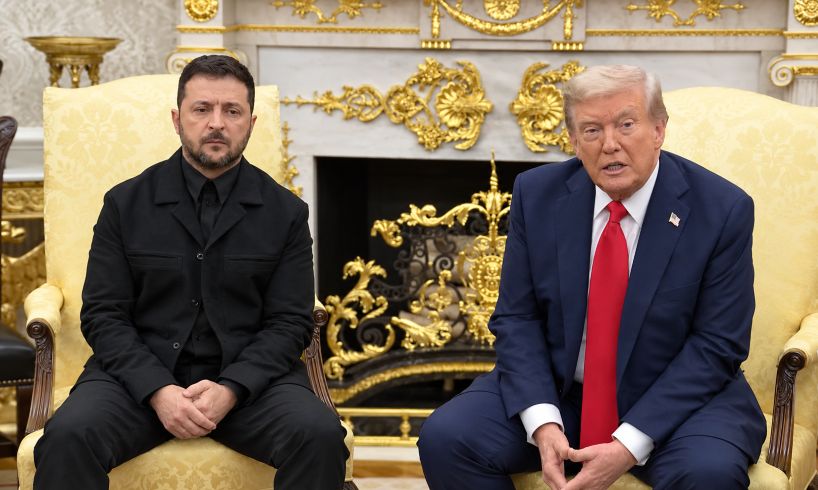
A renewed Ukrainian drone attack on Russian oil infrastructure has intensified tensions among President Donald Trump, Russian President Vladimir Putin and Ukrainian President Volodymyr Zelenskyy, exposing a growing divide over one of the most controversial elements of the Ukraine war.
A large refinery in Russia’s Samara region was struck Friday, October 30, according to a Ukrainian defense company, following an apparent reduction in attacks against Russian energy facilities.
The reported strike came after the Trump administration pressured Kyiv to scale down operations targeting refineries, due to worries over fuel prices and global energy supplies.
According to The Washington Post, Ukrainian defense contractor Fire Point said drones had hit the Novokuibyshevsk refinery, a facility owned by Russia’s state-controlled energy company Rosneft.
The company reported multiple impacts at the site. The full extent of the damage has not been independently verified.
Russian regional authorities acknowledged drone attacks against infrastructure but did not confirm all the details reported by the Ukrainian company.
Still, the incident immediately triggered a political response from Moscow.
Putin’s Government Accuses Ukraine of Ignoring Trump
Yuri Ushakov, a senior foreign policy adviser to Putin, accused Ukraine of disregarding the American president’s demands.
He portrayed the attack as evidence that Kyiv was unwilling to follow Trump’s requests concerning energy infrastructure.
The comments appear designed to emphasize the disagreement between Washington and Kyiv.
That disagreement has grown increasingly visible as Trump seeks to negotiate with Russia while tackling economic concerns at home.
The president has criticized Ukrainian attacks on Russian refineries, suggesting they add to rising fuel costs.
Zelenskyy has defended Ukraine’s ability to target facilities that support Russia’s war effort.
For the Ukrainian government, the issue is not simply about energy markets.
It concerns whether Russia should retain uninterrupted access to facilities that provide revenue and fuel while its armed forces continues attacking Ukrainian territory.
The Energy Ceasefire That Never Became Clear
Trump announced on October 11 that Russia and Ukraine had agreed to an immediate ceasefire involving energy infrastructure. But the announcement created confusion.
Zelenskyy indicated that Ukraine had not been informed of a finalized agreement and said Kyiv would support a reciprocal arrangement if Russia stopped attacking Ukrainian energy facilities.
The reported ceasefire lacked a clearly established public framework overseeing verification and enforcement.
Ukraine subsequently accused Russia of continuing attacks against its power infrastructure.
Those allegations challenged efforts to maintain an informal pause in strikes on Ukrainian refineries.
A Wall Street Journal report cited by Reuters said Ukrainian long-range strike units were instructed in mid-October to suspend some refinery missions after pressure from Washington.
Reuters said it could not independently verify that report. Friday’s attack therefore appears to mark another challenge to Trump’s attempt to reduce energy-related attacks.
Why Trump Wants Russian Oil Flowing
The war involving the United States and Iran has contributed substantially to global energy-market disruption.
Higher diesel and gasoline prices have become a major political problem for Republicans ahead of the November 3 midterms.
Trump has attempted to increase available fuel supplies, including by easing restrictions affecting Russian diesel exports.
His administration has also pursued energy-related arrangements with Moscow as part of wider foreign policy efforts.
Supporters maintain that lowering fuel prices can help American families and reduce economic instability.
Critics warn that allowing Russia greater access to international energy markets could provide economic benefits to Putin without obtaining meaningful concessions over Ukraine.
That concern is particularly serious because sanctions have been an important instrument of Western pressure since Russia’s full-scale invasion in 2022.
The policy dispute is therefore about more than diesel prices.
It involves whether economic incentives can help end the war or instead strengthen Russia’s ability to maintain it.
Zelenskyy’s Strategic Dilemma
Ukraine’s attacks on Russian refineries meet several possible objectives.
They are able to disrupt fuel supplies, impose financial costs, and demonstrate that Russian infrastructure continues to be vulnerable despite Moscow’s military advantages.
But such operations also risk alienating the United States at a time when Ukraine urgently needs American-made defensive weapons.
Zelenskyy has little room to maneuver. Scaling back the strikes might ease tensions with Trump and keep diplomatic channels open. But doing so would mean giving up a source of pressure on Moscow, even as Russian attacks on Ukraine continue.
Meanwhile, Russian attacks on Ukrainian cities and infrastructure have continued.
That reality makes unilateral restraint particularly difficult for Kyiv to justify.
What the Latest Strike Means
The reported Samara attack does not automatically mean a comprehensive diplomatic initiative has collapsed.
No clearly enforceable energy ceasefire had been publicly established. Nor does the attack prove that Ukraine’s leadership is abandoning negotiations.
It does, however, show how fragile the current diplomatic process remains. Trump wants stability in global energy markets.
Putin wants sanctions relief and a settlement favorable to Russia. Zelenskyy wants to preserve military leverage and prevent Ukraine from being forced into an unacceptable agreement.
Those objectives are not necessarily compatible.
The burning Russian refinery has become a powerful illustration of the conflict between Trump’s economic priorities, Putin’s strategic ambitions and Zelenskyy’s determination to keep pressure on Moscow. Until those competing interests are addressed, every new strike risks becoming another diplomatic crisis.

Comments (0)