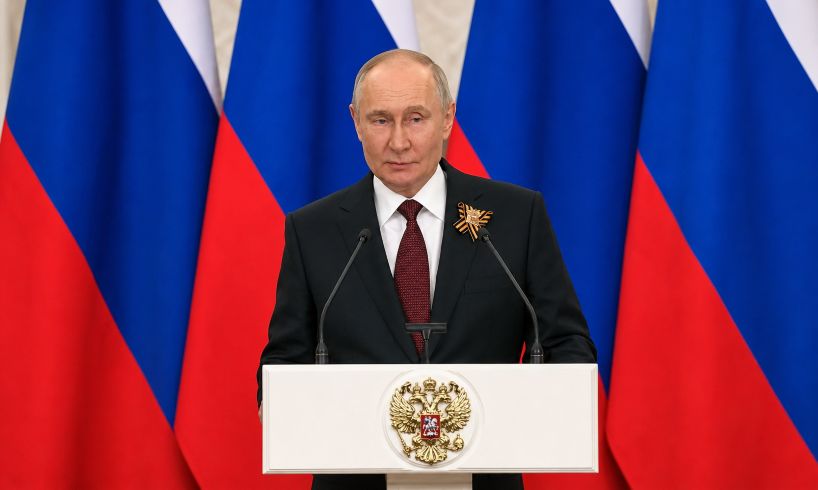
Vladimir Putin has spent years testing how far he can push the West, and Britain is increasingly warning that it cannot afford to look weak in the face of growing threats from Moscow. Now Nigel Farage has entered the debate with a message that leaves little room for misunderstanding: “We mean business.”
The Reform UK leader used a new announcement on defense and national security to argue that Britain needs to stop allowing its military strength and international influence to decline. His comments come as concerns grow over Russia’s actions, including its threats toward countries supporting Ukraine and the wider security risks facing Europe.
Farage is not simply talking about sending a warning to the Kremlin. He wants a significant change in Britain’s approach to defense, arguing that the country needs stronger armed forces, better protection for critical infrastructure and a much clearer willingness to defend its own interests.
And he made his position particularly clear when discussing Putin.
“Vladimir Putin sees our weaknesses and exploits them,” Farage said. He added that Britain’s airports, hospitals, energy supplies, food security and wider infrastructure must be protected from attack.
“More than that, we will invest heavily in them to ensure that any and all attempts to attack us fail.”
It is a much tougher message than the usual expressions of concern that often accompany warnings about Russian aggression.
Farage’s Three-Word Warning
In his remarks, Farage accused successive Labour and Conservative governments of allowing Britain’s position in the world to weaken, arguing that the country needs to rebuild its ability to defend itself and project influence.
“The threats to Britain are no longer abstract,” he said, pointing to the dangers posed by Russia, Iran and China, as well as terrorism and state-sponsored activity.
He also criticized what he described as a political establishment that had failed to take those threats seriously enough.
His three-word message was unmistakable: “We mean business.”
Farage argued that Britain should stop behaving as though its influence is inevitably in decline and instead pursue a more assertive defense and foreign policy.
“Britain’s role in the world has been diminished over decades,” he said. “But the power we once projected across the globe does not have to give way to the establishment doctrine of managed decline.”
It is an ambitious claim, particularly at a time when European governments are facing difficult questions about military spending, the war in Ukraine and how much responsibility they should take for their own security.
A Major Increase in Defense Spending
Farage also set out specific spending targets, saying a Reform government would aim to raise defense spending to three percent of GDP by 2030 and 3.5 percent by 2035.
He suggested that part of the additional funding could come from placing a hard £1 billion cap on the foreign aid budget.
His proposals also include a more assertive use of Britain’s position on the United Nations Security Council, stronger intelligence cooperation with allies and changes to the country’s relationship with international legal institutions.
Whether those plans would be affordable or how they would work in practice is another question, but Farage is clearly trying to make national security a central part of Reform’s political message.
He also argued that Britain should place its own interests first when dealing with international partners, insisting that alliances must be based on shared commitments to freedom, security and cooperation.
Putin’s Threats Put Britain on Alert
The timing of Farage’s intervention is significant. Russia’s war against Ukraine has changed the security debate across Europe, while Moscow has repeatedly issued warnings to countries providing military assistance to Kyiv.
For Britain, the concern extends beyond the possibility of a direct military confrontation. Cyberattacks, sabotage, espionage and attempts to disrupt critical infrastructure have all become part of the wider discussion about national security.
Farage’s comments also come amid renewed scrutiny of his own past remarks about Putin. The Reform leader has previously faced criticism over comments he made about Russia’s annexation of Crimea, but he has more recently described the Russian president as a major threat to Britain and Western Europe.
In his latest intervention, he left little doubt about the position he wants Reform to take.
“To help bring peace abroad, we must build strength at home,” he said. “You cannot simply declare yourself a world power; you have to create one.”
That is the argument at the heart of his message to the Kremlin: Britain needs to strengthen its defenses rather than rely on warnings and diplomatic statements.
For now, these are Farage’s proposals for a future Reform government, not new measures announced by the British government. But his three-word declaration captures the tougher approach he wants Britain to adopt as Putin’s threats continue to shape the security debate across Europe.
Comments (0)