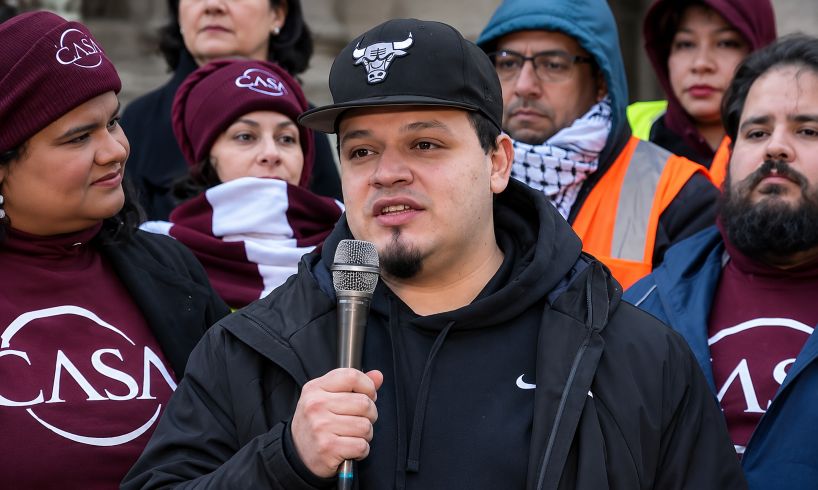
Kilmar Abrego Garcia, the Salvadoran immigrant whose wrongful deportation to a notorious prison triggered a national political firestorm, has voluntarily left the United States for Spain, bringing a remarkable new chapter to one of the most contentious immigration cases of President Donald Trump’s second administration.
The departure, confirmed by federal officials and Abrego Garcia’s attorneys on Tuesday, November 24, 2026, comes after nearly 20 months of legal confrontations involving federal judges, the Supreme Court, congressional lawmakers and the Trump administration.
But the announcement has also prompted a question that may resonate with Americans who followed his case: If Abrego Garcia was ultimately willing to leave the country, why did he fight deportation so aggressively in the first place?
The apparent contradiction is politically compelling, but the legal answer is considerably more complicated.
Abrego Garcia’s legal battle was never simply about securing an unconditional right to remain in the United States. It also concerned the government’s decision to send him to a country where a judge had already determined he faced persecution, the administration’s efforts to deport him to other countries, and the legal protections available to people facing removal.
His departure to Spain does not erase those disputes. Instead, it raises new questions about whether the outcome represents a victory for the Trump administration, a vindication of Abrego Garcia’s legal arguments or a compromise that allowed both sides to claim success.
Trump Administration Celebrates as Abrego Garcia Leaves for Spain
The Department of Homeland Security confirmed that Abrego Garcia departed the United States on Tuesday aboard a commercial flight bound for Madrid.
Homeland Security Secretary Markwayne Mullin welcomed the announcement.
“We are DELIGHTED to announce that Kilmar Abrego Garcia has self-deported from the United States to Spain,” Mullin wrote on X.
The administration characterized his departure as another success in its immigration enforcement campaign.
According to the Associated Press, DHS said Abrego Garcia received no incentives to leave and would not be permitted to return to the United States.
But his attorneys offered a sharply different interpretation.
Simon Sandoval-Moshenberg, one of Abrego Garcia’s lawyers, said his client had spent much of the previous year and a half seeking permission to leave the country on terms that would protect his freedom.
Rather than being forcibly transported to Liberia in federal custody, Abrego Garcia was permitted to board a commercial flight to Spain.
His attorney described the outcome as a negotiated departure that allowed him to travel freely.
Abrego Garcia himself expressed relief.
“I am leaving happy. I am leaving with my freedom,” he said in a statement reported by the Associated Press.
For supporters of the administration’s immigration policies, however, the central fact remains that Abrego Garcia is no longer in the United States.
For his lawyers, the crucial distinction is that he left for a country of his choosing rather than being sent involuntarily to a destination selected by the government.
Why Did He Fight So Hard if He Was Willing to Leave?
The answer begins with an immigration court ruling from 2019.
Abrego Garcia entered the United States without authorization as a teenager and later settled in Maryland, where he established a family.
In 2019, an immigration judge determined that he faced a credible threat of persecution if returned to El Salvador.
The judge granted him a protection known as withholding of removal.
That ruling did not make Abrego Garcia a permanent legal resident or provide him with a pathway to citizenship.
However, it prohibited the federal government from deporting him to El Salvador while the protection remained in effect.
He was permitted to remain in the United States and work under immigration supervision.
In March 2025, federal authorities nevertheless arrested him and transferred him to El Salvador’s Terrorism Confinement Center, commonly known as CECOT.
The Justice Department subsequently acknowledged that his removal had resulted from an administrative error. The distinction matters.
Abrego Garcia’s legal challenge was not based on a claim that immigration law prevented the United States from ever deporting him.
Rather, the government had sent him to a specific country despite an existing judicial order prohibiting that action.
His attorneys argued that the administration was required to respect the court’s ruling and provide the legal process necessary to determine what could happen next.
In April 2025, the Supreme Court upheld an order requiring the administration to facilitate his release from Salvadoran custody and ensure his case proceeded as though the improper deportation had not occurred.
That was a significant legal development independent of whether Abrego Garcia would eventually remain in America.
The legal decisions and developments behind Kilmar Abrego Garcia’s departure.
Associated Press
and
Reuters.
Legal Experts Explain Why Due Process Matters
The controversy surrounding Abrego Garcia became part of a broader debate about presidential authority and the constitutional protections afforded to noncitizens.
Amy Grenier, an attorney with the American Immigration Lawyers Association, emphasized that the Constitution does not restrict due-process protections exclusively to American citizens.
“The thing about due process is that it either applies to everyone present in the United States or it applies to no one,” Grenier told FactCheck.org in April 2025.
Her observation addresses the central legal issue behind Abrego Garcia’s case.
People who enter the country unlawfully can still be subject to deportation. But the government must follow applicable legal procedures, including complying with court orders that limit where an individual may be removed.
Matthew Waxman, a senior fellow specializing in law and foreign policy at the Council on Foreign Relations, addressed the separation-of-powers implications in an April 2025 analysis.
“But courts are not barred altogether from enforcing the law in such matters,” Waxman explained.
He also warned that aggressive assertions of executive authority could provoke greater judicial involvement in immigration and foreign-policy disputes.
Northwestern University law professor Monica Haymond raised a related concern about the practical limits of judicial authority.
In comments published in April 2025, she observed that courts can consider sanctions against officials or agencies that fail to comply with their orders, although such measures can encounter institutional obstacles.
Together, those legal assessments suggest that Abrego Garcia’s case involved issues extending well beyond one individual’s immigration status.
The broader question was whether the executive branch could disregard judicial restrictions when carrying out its deportation policies.
A Second Deportation Fight Made the Situation Even More Complicated
After the administration returned Abrego Garcia to the United States in June 2025, his legal troubles continued.
Federal prosecutors charged him with human smuggling in Tennessee, stemming from an earlier traffic stop.
Abrego Garcia denied the allegations, and his attorneys argued that the prosecution was retaliation for his successful challenge to the government’s deportation actions.
In May 2026, a federal judge dismissed the criminal case, finding that the prosecution was improperly motivated. The government appealed that decision.
Meanwhile, immigration officials continued exploring options to remove Abrego Garcia from the United States.
Among the proposed destinations were Uganda, Eswatini, Ghana and Liberia.
Abrego Garcia’s attorneys argued that if he were required to leave the country, he should be allowed to relocate to Costa Rica, which had agreed to receive him.
The Trump administration resisted that proposal.
According to the Associated Press, former acting Immigration and Customs Enforcement Director Todd Lyons argued in a March 2026 memorandum that sending Abrego Garcia to Costa Rica would be prejudicial to American interests, given the resources expended on arrangements with Liberia.
The dispute over his destination became a major obstacle to resolving the case.
In other words, the administration and Abrego Garcia were not simply arguing over whether he would remain in the United States.
They were also fighting over where he could be sent, the circumstances of his departure and whether his legal rights would be respected.
His eventual relocation to Spain offers a clearer explanation for his previous resistance.
The Immigration Fight Creates Two Competing Political Narratives
The Trump administration has repeatedly accused Abrego Garcia of membership in the MS-13 gang, allegations he denies.
Administration officials have also cited criminal allegations and domestic abuse accusations in explaining why they considered his removal necessary.
Those accusations have been politically significant, but they must be distinguished from the question of whether the government was legally permitted to deport him to El Salvador in violation of the 2019 order.
Critics of the administration argue that a person’s immigration status or alleged misconduct does not eliminate the government’s responsibility to obey the law.
Supporters of tougher immigration enforcement counter that Abrego Garcia entered the country unlawfully and that his ultimate departure demonstrates the administration’s ability to enforce removal orders.
Both sides can point to elements of the outcome supporting their arguments.
Trump officials secured the departure of a man whose continued presence they had strongly opposed.
Abrego Garcia’s attorneys secured his release from the threat of forced transfer to Liberia and arranged travel to Spain.
Neither accomplishment, however, settles every legal question raised by the case.
Could Abrego Garcia Eventually Return to America?
Another important aspect of Tuesday’s announcement concerns whether Abrego Garcia’s departure is necessarily permanent. His lawyers do not believe that it must be.
Sandoval-Moshenberg suggested that his client could seek to return to the United States under a future administration more willing to reconsider his circumstances.
DHS, however, maintains that he will not be allowed back into the country.
That disagreement is significant because Abrego Garcia’s wife and children remain in the United States.
His departure therefore creates the prospect of an extended family separation, even though the legal fight over his treatment has attracted national attention.
Whether he eventually obtains permission to return will depend on immigration law, the terms of his departure and decisions by future federal authorities.
There is no guarantee that a change of administration would automatically make him eligible for readmission.
The Real Meaning of Abrego Garcia’s Departure
The question circulating on social media — why fight so hard to stay in America only to leave voluntarily? — is understandable.
But it assumes that the objective of every immigration appeal is permanent residence. That is not always the case.
A person facing deportation may contest the government’s authority to send them to a particular country, challenge the procedures used to remove them, seek release from detention or attempt to negotiate a departure to a safer destination.
Abrego Garcia’s case involved several of those issues.
His departure to Spain illustrates that fighting deportation and ultimately leaving the United States are not necessarily contradictory actions.
It also illustrates the competing priorities that have driven the controversy.
For the Trump administration, removing Abrego Garcia from American territory represents the desired immigration enforcement outcome.
For his lawyers, obtaining his freedom and the ability to choose his destination represents a meaningful result after months of litigation.
For the courts, the case has raised questions about the government’s obligation to respect judicial decisions.
And for the American public, it offers an opportunity to distinguish between whether someone has a legal right to remain in the country and whether the government has a legal right to remove that person in a particular manner.
Kilmar Abrego Garcia may have left the United States, but his departure does not establish that his legal fight was pointless. It shows that the fight was about much more than simply staying in America.




Comments