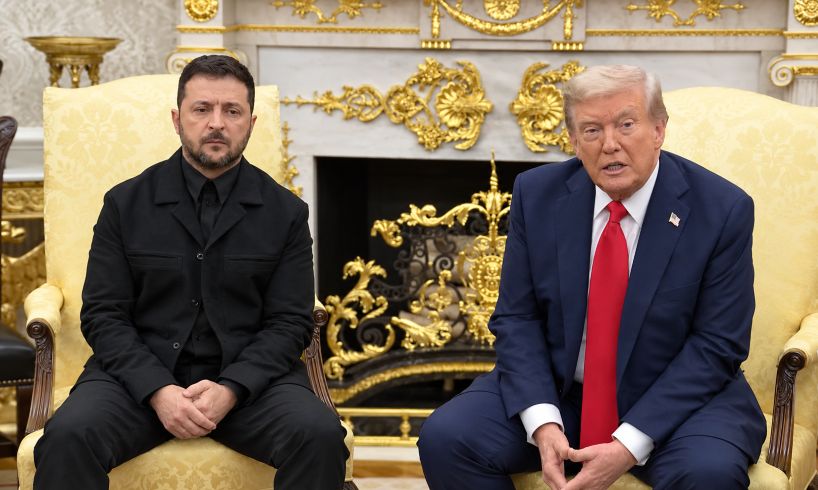
Ukrainian President Volodymyr Zelenskyy is willing to sit down with Donald Trump and Vladimir Putin in Türkiye to discuss an end to the war. But he has made one thing clear: Ukraine will not surrender its territory to satisfy Moscow’s demands.
The proposal followed Zelenskyy’s October 31 meeting with Turkish President Recep Tayyip Erdoğan in Istanbul, where the two leaders discussed possible negotiations involving Ukraine, Russia and the United States.
In an interview with CNN Türk published November 1, Zelenskyy showed confidence that Erdoğan’s relationships with Trump and Putin could help bring the three presidents together.
Ukraine would welcome such a meeting if Türkiye could arrange it, he said.
But the Ukrainian leader paired that willingness to negotiate with a territorial position Moscow has repeatedly rejected.
Ukraine, he insisted, would not surrender its territory or legally recognize Russian sovereignty over occupied regions, including Crimea.
He dismissed demands Moscow communicated through intermediaries as “neither a sensible nor a reasonable approach.”
Instead, Zelenskyy proposed securing a ceasefire along the existing front line before attempting to resolve the war’s most difficult political disputes. The distinction is significant.
Zelenskyy is offering to stop the fighting where the armies currently stand. He is not offering to accept that the territory Russia occupies legally belongs to Moscow.
That difference could determine whether the latest diplomatic push leads to productive negotiations or another stalemate.
Zelenskyy Wants a Ceasefire Before the Territorial Fight
At the heart of Ukraine’s proposal is a separation between two questions that have repeatedly complicated negotiations. The first is how to stop the killing.
The second is what happens to the Ukrainian territory occupied by Russia.
Zelenskyy believes the immediate priority should be a comprehensive ceasefire along the current line of contact, supported by an effective international monitoring mechanism.
Such an arrangement would not necessarily require Russia to withdraw immediately from every occupied area.
Nor would it mean Ukraine was abandoning its legal claims to those territories.
Instead, it would create a distinction between the military situation on the ground and Ukraine’s internationally recognized boundaries.
That distinction is particularly important in Crimea, which Russia seized and annexed in 2014, and in eastern and southern Ukrainian regions Moscow claims as Russian territory.
Russia has demanded that Ukraine accept territorial and security conditions as part of a wider settlement. Moscow also claims areas it does not fully control.
Ukraine has repeatedly refused to accept Russia’s annexations, warning that doing so would undermine its sovereignty and could encourage Moscow to seize more territory in the future.
Zelenskyy is willing to consider stopping the fighting along the current front line, but that does not mean Kyiv would recognize the occupied regions as Russian territory.
But it also creates an immediate challenge for Putin.
Russia has commonly favored negotiations addressing its wider political and security demands before agreeing to a lasting cessation of hostilities.
Ukraine wants the fighting stopped first.
The two governments are not simply disagreeing about territory. They are disagreeing about the order in which peace must be negotiated.
Why Agreeing to Meet Putin Matters Politically
Zelenskyy’s willingness to sit down with Putin also carries an important diplomatic message.
By publicly revealing readiness for a leaders’ summit, the Ukrainian president is making clear that Kyiv is not rejecting direct negotiations.
That matters particularly in Washington, where Trump has repeatedly stressed his desire to end the war through diplomacy.
It also challenges an argument that can emerge whenever peace efforts fail: that one side is unwilling to interact directly with the other.
Zelenskyy’s position does not eliminate disagreements with Trump over the terms of a settlement.
Nor does it establish that Putin is refusing a specific confirmed meeting.
No three-president summit in Türkiye has been formally scheduled, and the Kremlin has not publicly committed Putin to attending one.
Nevertheless, the proposal changes the diplomatic conversation.
Rather than arguing over whether Ukrainian and Russian leaders should meet, the discussion can shift toward what each side would actually be ready to negotiate.
For Kyiv, that creates an opportunity to present its preferred sequence: halt military operations, establish monitoring arrangements, negotiate security guarantees and then address longer-term territorial questions.
For Moscow, the difficulty is that a ceasefire along the present front line could leave Russia short of some of the territory it claims.
No evidence shows that Putin has accepted Zelenskyy’s proposal.
And willingness to attend talks is not the same as willingness to accept the other side’s conditions.
Still, Zelenskyy’s public offer makes Ukraine’s position more explicit at a moment when diplomatic pressure for a settlement is intensifying.
Energy, the Black Sea and Prisoner Exchanges Offer a Starting Point
Even if a meeting between the three presidents is still uncertain, lower-level negotiations are already moving forward.
Ukraine, Russia and the United States are preparing for discussions in Abu Dhabi on November 10 and 11.
Those talks are expected to address several narrower issues that could produce progress without resolving the entire war.
Zelenskyy has identified a halt to attacks on energy infrastructure, a maritime ceasefire and additional prisoner exchanges as potential subjects for technical negotiations.
For Ukrainians, these aren’t abstract diplomatic issues. Russian strikes have damaged power plants and transmission lines, leaving households facing blackouts and the possibility of losing heat.
Protecting those facilities would become particularly important as colder weather approaches.
A maritime agreement could also reduce threats to commercial shipping in the Black Sea, an essential route for Ukrainian agricultural exports.
Prisoner exchanges offer another area where limited cooperation may be possible even when negotiations over territory remain deadlocked.
Ukraine’s proposal envisions technical teams addressing those practical questions while national leaders handle the wider political decisions.
Zelenskyy has argued that officials below the presidential level cannot settle every issue standing between the two countries and a lasting peace.
That is why he wants direct engagement with the leaders who have the authority to make major concessions.
But smaller agreements would still require both sides to respect their commitments.
A ceasefire restricted to energy infrastructure, for example, would not end ground combat or prevent attacks on other military and civilian targets.
A maritime arrangement would require clear rules on which vessels and facilities are protected.
Those limitations help explain why Kyiv continues to insist that any comprehensive ceasefire must include credible monitoring and enforcement arrangements.
Erdoğan Moves to Bring Putin Into the Conversation
Türkiye’s role has become increasingly important in the renewed diplomatic push.
Erdoğan maintains relationships with both Moscow and Kyiv, giving Ankara access to political channels that have become difficult for many Western governments to use.
Türkiye has also hosted previous rounds of Russian-Ukrainian negotiations and played a central role in efforts to maintain grain shipments through the Black Sea.
During their October 31 meeting, Erdoğan and Zelenskyy agreed to work toward restoring a more effective Black Sea grain corridor.
They also discussed Ukrainian energy needs and additional Turkish support for infrastructure damaged during the war.
The diplomatic effort gained another development Thursday, November 5.
Speaking after returning from South Korea, Erdoğan said he wanted to discuss ending the war directly with Putin following his meeting with Zelenskyy.
Turkish officials were already communicating with Russian and Ukrainian representatives about a possible meeting in Türkiye.
However, Kremlin spokesman Dmitry Peskov said there were no concrete arrangements for a Putin-Erdoğan telephone conversation, although one could be organized quickly.
The comments accentuate the difference between diplomatic interest and an actual agreement to meet.
Ankara is attempting to create the conditions for another round of high-level engagement.
Whether Russia accepts that opportunity remains unresolved.
Moscow’s Demands Remain the Central Obstacle
The Kremlin has indicated that it is willing in principle to participate in renewed U.S.-mediated negotiations.
But Russia’s demands remain far removed from Ukraine’s stated position.
Moscow continues to insist that any settlement address its security concerns and territorial claims.
Ukraine, meanwhile, argues that it cannot accept an agreement leaving the nation vulnerable to renewed Russian attacks.
For Zelenskyy, security guarantees are therefore inseparable from the question of a ceasefire.
Stopping military operations without establishing credible protections could leave Ukraine facing another period of uncertainty.
A ceasefire could also allow both militaries to reinforce their positions, potentially creating the conditions for renewed fighting if negotiations collapse.
These concerns are among the reasons both governments have resisted proposals they believe could favor the other side.
Zelenskyy’s latest offer does not resolve those disagreements.
It places them into a proposed sequence of negotiations that Ukraine considers more workable.
And that is where the diplomatic tension becomes especially important.
If Russia accepts a ceasefire along the existing front line without receiving legal recognition of its territorial claims, the two sides could begin discussing a longer-term political settlement while the fighting is suspended.
If Moscow continues to demand concessions before a ceasefire, the negotiations could stall over the same disagreements that have blocked previous efforts.
Neither outcome is inevitable.
The Kremlin could put forward alternative security arrangements or seek changes to the sequencing. Ukraine could also face difficult choices over what monitoring and enforcement provisions it considers acceptable.
But the territorial disagreement cannot simply be ignored.
Trump Faces a Difficult Test of His Peace Strategy
The developments also create a challenge for Trump.
The American president has presented negotiations as the route toward ending a war that has continued for more than four years.
His administration has maintained diplomatic contact with both governments and helped arrange fresh discussions involving Russian and Ukrainian representatives.
Yet there is still a substantial difference between securing agreement to negotiate and persuading both sides to accept a settlement.
Ukraine wants an unconditional ceasefire before resolving territorial disputes.
Russia seeks broader political and security commitments as part of the settlement process.
Bridging those positions would require more than assembling the three leaders for a photograph.
Washington would need to help develop an arrangement acceptable to Kyiv and Moscow, while additionally addressing European concerns about the continent’s security.
The United States would also face questions about what guarantees it would provide and how it would monitor any agreement.
Trump’s willingness to pursue direct engagement could create opportunities for negotiations.
But the result would depend on what the parties are prepared to concede, not simply whether their presidents agree to attend a summit.
Zelenskyy’s Territorial Red Line Defines the Next Phase
For now, Zelenskyy’s latest diplomatic initiative leaves two distinct messages.
He is prepared to negotiate directly with Putin, with Trump potentially participating and Türkiye acting as a mediator.
But he is not prepared to recognize Russian ownership of Ukrainian territory as the price of starting those negotiations.
The position allows Ukraine to pursue a ceasefire without formally abandoning its territorial claims.
It also keeps attention on the unresolved question at the heart of the conflict: whether Russia would accept an end to the fighting before receiving the political concessions it seeks.
The upcoming Abu Dhabi talks may provide the first indication of whether the parties can narrow their disagreements on energy, maritime security and humanitarian issues.
A meeting in Türkiye could follow, but none has been confirmed.
Even then, a leaders’ summit would be only the beginning of a much more difficult process.
Zelenskyy has made clear that he is willing to sit across the table from Trump and Putin. He will not recognize Russia’s annexations merely to secure that meeting.
The next move belongs to diplomacy—and to the governments that must decide whether stopping the war is possible before settling the land dispute.
Comments (0)