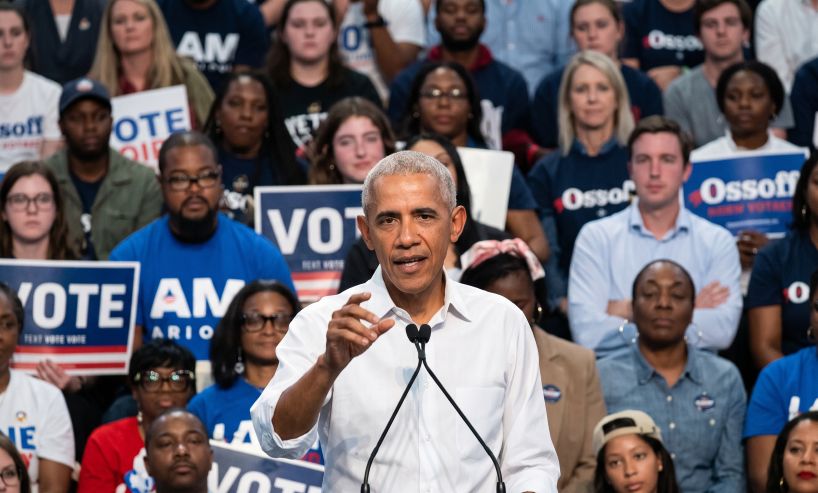
Barack Obama’s support for Jon Ossoff was meant to help the Georgia senator secure another six years in Washington, but now that the election is over, the former president’s words have taken on a wider significance. Ossoff has comfortably won re-election, defeating Republican challenger Mike Collins, and the attention surrounding his campaign has only added to the growing discussion about who could emerge as a Democratic contender in 2028.
Obama was among the most prominent figures to campaign for Ossoff before voters went to the polls, appearing alongside him at an Atlanta rally in late October. His speech included a personal endorsement, a comparison that was bound to attract attention, and a reminder of the political figure who helped shape both men’s careers: the late civil rights leader John Lewis.
The former president told the crowd that Ossoff was the “only common-sense choice in this race,” before adding that his appeal went beyond his appearance. “It’s not because he looks like a Kennedy all handsome in the videos,” Obama said. “It’s because he learned from his mentor and my mentor, one of the greats, John Lewis, what it means to stir up some good trouble.”
It was a generous public assessment from a former president whose endorsement still carries considerable weight among Democratic voters. Now, with Ossoff having secured another term, those remarks are being viewed in the context of a much bigger question: whether the Georgia senator could eventually have a role in the party’s search for its next presidential candidate.
Obama’s Praise Takes on a New Meaning After Ossoff’s Victory
Ossoff’s victory gives him a stronger national platform than he had before the campaign. At 39, he is the youngest member of the Senate, and his re-election campaign turned him into one of the more recognizable Democratic voices challenging President Donald Trump.
According to the Associated Press, Ossoff raised more than $100 million during the campaign, while his rallies and sharply delivered speeches attracted attention well beyond Georgia. His victory was also significant because he was the only Democratic Senate incumbent defending a seat in a state Trump had carried in 2024. The AP called the race for Ossoff on election night, confirming that he would return to Washington for a second term.
Obama’s appearance had already given the senator a valuable moment on the national stage. By comparing him to a Kennedy, even while joking about his polished appearance, the former president drew attention to the qualities that have helped make Ossoff popular with some Democratic supporters. But he was also careful to explain that his praise was rooted in the senator’s record, particularly his work on foster care, online child protection and the cost of prescription medication.
Obama also spoke about the late Georgia congressman and civil rights icon John Lewis, who had mentored Ossoff and played a part in his own political journey. Lewis had a lasting influence on both men, and Obama used the rally to remind voters of the connection they shared with him. For Ossoff, it was also a chance to show that his approach to public service had been shaped by someone whose work and legacy reached far beyond Georgia.
The 2028 Question Is Not Going Away
There is, however, one complication for those already imagining Ossoff in a presidential campaign: the senator has repeatedly said that he has no intention of running.
During an October 13 debate with Collins, Ossoff was asked whether he would commit to serving a full six-year Senate term if re-elected. His answer was direct: “Yes, I will. I have zero interest in running for president. I’m not running for president. I’m running for re-election to the Senate.”
He had made a similar statement earlier in the year, insisting that his focus was firmly on Georgia rather than the next presidential election. Although speculation about 2028 has continued to follow him, Ossoff has repeatedly made clear that he intends to concentrate on his work in the Senate rather than discuss a possible White House bid.
Still, the comparisons with Obama are difficult to ignore. In 2006, Obama, then an Illinois senator, also said he would not run for president in 2008 and promised to serve his full Senate term. He announced his presidential campaign the following year. That history helps explain why Ossoff’s denials have not ended the speculation, although it does not mean the two situations will follow the same course.
A National Profile That Extends Beyond Georgia
Ossoff’s appeal to Democratic supporters also comes from the way he has presented himself during the Trump administration. His campaign speeches have frequently focused on the president’s policies, the cost of living and allegations of corruption, while his team has made effective use of short video clips to reach audiences online.
His campaign style has helped him gain recognition beyond Georgia, but national attention comes with a different set of expectations. Winning over voters in his home state is one thing; building support across the country would require him to reach people with different priorities, political views and expectations of their next president.
For now, Ossoff has a Senate term ahead of him, and his immediate responsibility is to the people who returned him to Washington. Obama has not announced him as a future presidential candidate, and his praise at the Atlanta rally should not be mistaken for a political succession plan.
But the former president has certainly helped place Ossoff in a conversation that is unlikely to end with the Georgia election. His victory has strengthened his standing within the Democratic Party, while Obama’s public comparison has given supporters another reason to discuss his future. Whether that attention eventually leads anywhere near the White House remains an open question, and one Ossoff himself has repeatedly tried to put aside.

Comments (0)