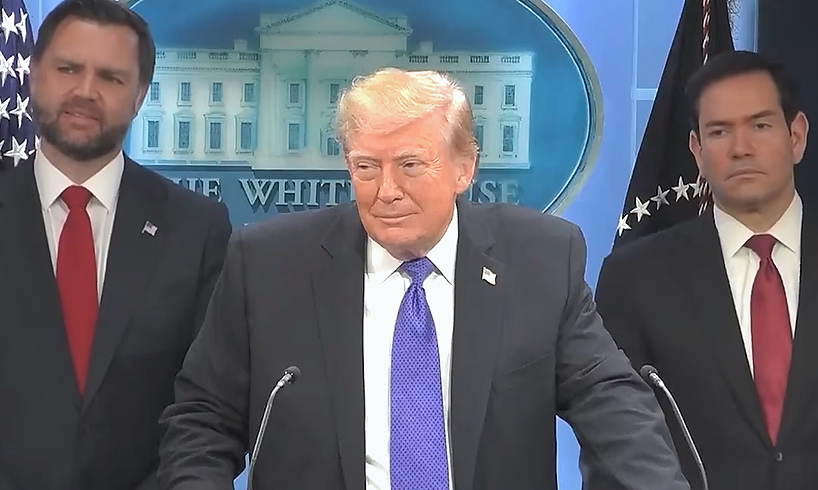
A new survey showing Marco Rubio dominating JD Vance in four crucial early-voting states raises questions about whether Republicans can preserve Donald Trump’s working-class coalition while moving toward a more traditional form of conservatism.
The assumption that Vice President JD Vance would inherit Donald Trump’s political movement and emerge as the natural Republican presidential nominee in 2028 is suddenly looking considerably less convincing.
Secretary of State Marco Rubio has opened a commanding lead over Vance in a new survey of likely Republican primary and caucus voters, suggesting that the political scene within the GOP may be undergoing a major transformation following the party’s disappointing performance in the 2026 midterm elections.
However, beyond the immediate embarrassment for Vance lies a potentially more consequential question for Republicans: Could the party’s efforts to move beyond Trump ultimately cost it some of the white working-class voters who helped return him to the White House in 2024?
For a Republican Party that has spent the better part of a decade reshaping its electoral coalition around Trump’s brand of populism, that question has potentially enormous consequences.
Marco Rubio takes commanding lead over JD Vance.
The survey, conducted by Republican polling firm OnMessage Inc. on behalf of the Combat Antisemitism Movement and CAM Action, interviewed 1,000 likely Republican primary and caucus voters between November 7 and 10 across Iowa, New Hampshire, Nevada and South Carolina.
The poll included 250 respondents from each state and reported an overall margin of error of 3.1 percentage points.
Rubio received 47 percent support in the hypothetical multicandidate primary, comfortably ahead of Vance.
In a confrontation between the two Trump administration officials, Rubio’s advantage grew to 21 percentage points, with the secretary of state receiving 52 percent against 31 percent for the vice president. Another 17 percent remained undecided.
52%
31%
17%
Marco Rubio over JD Vance
Perhaps even more troubling for Vance is the geographical consistency of Rubio’s advantage.
Vance
Undecided
Rubio +27
Rubio +19
Rubio +24
Rubio +17
Head-to-head primary ballot.
Rubio’s strength also extends across ideological groups, including voters who describe themselves as very conservative, making any argument that his growing popularity is merely the product of moderate Republicans looking to reclaim their party.
Curt Anderson, a Republican strategist with OnMessage, suggested that Rubio’s strength should not come as a surprise.
“These numbers are shocking in Washington, D.C., and boringly obvious everywhere else,” Anderson told the Washington Examiner.
Could Republicans lose their advantage with white working-class voters?
Before Trump emerged as the dominant figure in Republican politics, the GOP was already competitive among white working-class Americans. What Trump accomplished, however, was expanding the party’s advantage among those voters while developing a political identity that appealed to Americans who had traditionally felt overlooked by Washington.
According to a 2026 Council on Foreign Relations report, Republican presidential candidates performed as follows among white voters without college degrees:
56%
57%
62%
66%
Trump in 2024 compared with Romney in 2012
The Trump Coalition.
White working-class voters are defined as white voters without a college degree.
The nine-point difference between Mitt Romney’s performance in 2012 and Trump’s performance in 2024 shows the potential danger facing Republicans.
A return to Romney-era support among these voters could substantially complicate the Republican path to victory in states such as Michigan, Pennsylvania and Wisconsin, particularly if the party fails to offset those losses elsewhere.
Following Trump’s 2024 victory, veteran Republican pollster Whit Ayres explained the significance of the transformation.
“Donald Trump has recast the Republican Party into a multiethnic, working-class party,” Ayres told The Washington Post at the time.
Trump’s criticism of globalization, opposition to international trade arrangements, hard-line immigration policies and attacks on political and corporate elites helped distinguish him from previous Republican nominees.
His appeal was not exclusively about conservatism. It was additionally about challenging an economic and political establishment that many Americans believed had failed them.
Vance, whose rise to national prominence began with his bestselling memoir Hillbilly Elegy, has built much of his political identity around similar concerns.
Rubio, by contrast, entered national politics as a more conventional Republican, although his positions have evolved considerably since his unsuccessful 2016 presidential campaign.
The question is whether Rubio can retain the voters Trump brought into the Republican fold while also appealing to Americans exhausted by the president’s confrontational political style.
The 2026 midterms have exposed vulnerabilities in Trump’s coalition.
The timing of Rubio’s rise is especially significant.
A separate post-election survey released on November 13 by polling firm Cygnal identified both defections from Republican candidates and weaker turnout among Republican-leaning voters as major contributors to the party’s midterm defeat.
“Republicans lost their base as they lost the middle, and they lost those voters a year before anyone cast a ballot,” said Brent Buchanan, Cygnal’s CEO and pollster.
Cygnal
The firm’s research also found Rubio leading Vance by 34 percent to 31 percent in a hypothetical Republican presidential primary, with Florida Governor Ron DeSantis receiving 14 percent.
Among Republicans, 46 percent favored retaining Trump’s policies while adopting a different political style, compared with 23 percent who wanted to preserve both his policies and his style.
That distinction could be central to Rubio’s emerging political appeal.
Republicans may not necessarily be abandoning Trumpism. Instead, some may be looking for a politician who can deliver elements of Trump’s agenda without the controversies and political turbulence associated with his presidency.
There is, however, a significant difference between changing the Republican Party’s rhetoric and changing the economic policies that attracted working-class voters in the first place.
A candidate who misunderstands that distinction could discover that winning a Republican primary is considerably easier than reconstructing Trump’s general-election coalition.
Democrats could benefit from a Republican return to its political roots.
For Democrats, a Republican retreat from economic populism could create an opportunity to reconnect with voters who have drifted away from the party over the past decade.
The potential opening would not necessarily involve persuading Trump’s most committed supporters to become Democrats. Smaller shifts among less ideologically committed voters, combined with changes in turnout, could be enough to alter the outcome of closely fought presidential elections.
Political scientist John DiIulio, discussing working-class voters as part of the Council on Foreign Relations study, stressed how important of economic security.
He explained that for many Americans, the “union as a concept mainly signals secure, decent, benefit-rich jobs.”
Republican pollster Patrick Ruffini similarly identified a “ruptured sense of economic security” as one of the factors behind Trump’s success with working-class and minority voters.
Council on Foreign Relations
These observations suggest that the political allegiance of some Trump voters may be more conditional than Republican leaders would like to believe.
Democrats would still face considerable obstacles. Disagreements over immigration, cultural issues, and the party’s relationship with working-class communities existed long before Trump entered the White House.
Republicans also have longstanding advantages among socially conservative and evangelical white voters, meaning a wholesale return of the white working class to the Democratic Party is hardly inevitable.
Nevertheless, the possibility of Republicans surrendering several percentage points among these voters deserves serious consideration.
Rubio’s impressive numbers come with important caveats.
Despite the strength of Rubio’s performance, Vance’s presidential prospects should not be written off.
The OnMessage survey covered only four states, surveyed likely Republican primary participants rather than the general electorate, and excluded DeSantis from its hypothetical ballot.
Moreover, a Reuters/Ipsos survey published on November 12 found that 45 percent of Republicans considered Rubio an excellent potential presidential candidate, compared with 43 percent for Vance—a considerably narrower gap.
Trump’s influence could also prove decisive should he eventually endorse either candidate.
Crucially, the OnMessage findings do not establish that white working-class voters are abandoning the Republican Party or that Rubio would perform worse than Vance among them in a general election. Establishing such a trend would require additional demographic polling and comparisons with Democratic candidates.
Rubio could ultimately prove capable of maintaining Trump’s working-class support while winning back voters alienated by the president. Such an outcome would expand the Republican coalition rather than dismantle it.
But that remains an untested proposition.
Trump’s most consequential political achievement may not have been winning two presidential elections. It may have been persuading millions of Americans who had little enthusiasm for traditional Republican politics that the GOP could represent their interests.
Rubio’s surge raises the possibility that Republicans are ready to move beyond Trump himself.
Whether they can do so without losing the voters who made Trumpism an electoral force could become one of the defining political questions of the 2028 presidential election.
Comments