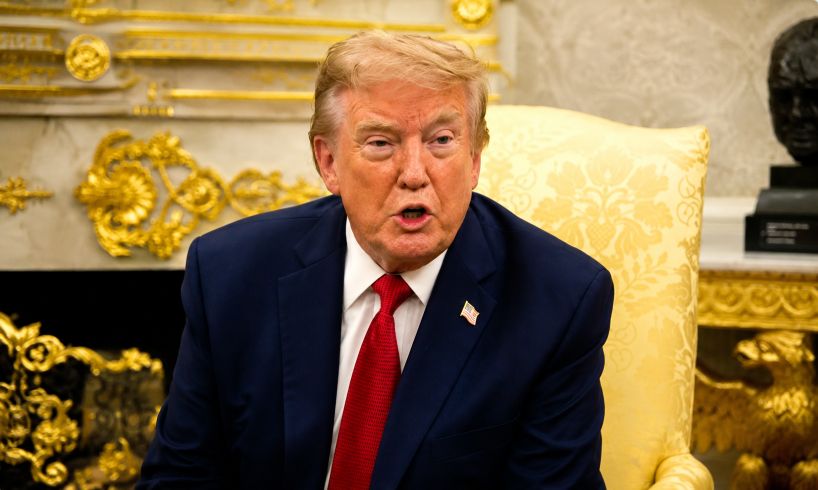
President Donald Trump has delivered one of the most surprising political developments of his second term, announcing that he intends to meet with newly elected Democratic Senator Abdul El-Sayed to discuss a universal healthcare proposal branded with the president’s own name.
The announcement is remarkable not simply because Medicare for All has long been associated with progressive Democrats, but because Trump spent much of the 2026 election campaign viciously attacking the Michigan Democrat, including making inflammatory and false allegations about his religious identity.
Now, just weeks after El-Sayed’s historic victory, Trump is calling him a smart politician and indicating interest in finding common ground on healthcare.
For Democrats hoping to present a united opposition to the president ahead of the 2028 election, the development creates an extraordinary political complication.
Could a progressive Democrat persuade Trump to embrace one of the American left’s most ambitious policy goals? Or is the president opening the door to a negotiation that could divide his opponents without requiring him to make any meaningful concessions?
The answer could have far-reaching implications for the final two years of Trump’s presidency.
Trump Makes Stunning Reversal on Abdul El-Sayed
During a November 24 interview with the New York Post, Trump praised El-Sayed’s efforts to interest him in universal healthcare by attaching the Trump brand to the proposal.
“He’s a smart guy,” Trump said, describing El-Sayed’s political maneuver as impressive.
The president also confirmed that he expected to meet with the senator-elect. “Maybe there’s some place in the middle that we could go,” Trump suggested.
The comments represent a remarkable change in tone.
During the midterm campaign, Trump repeatedly attacked El-Sayed, who became the first Muslim elected to the United States Senate.
At an October campaign event, Trump falsely characterized El-Sayed as a jihadist and referred to him as “Mohammed.” Days before the election, the president suggested that the Michigan-born Democrat should be sent back to where he came from.
El-Sayed rejected those attacks and continued emphasizing affordability, healthcare, and economic security.
Following his election victory, however, the senator-elect adopted an approach that few political observers anticipated.
Instead of simply condemning Trump’s attacks, he offered the president a chance to claim one of the most significant potential healthcare achievements in modern American history.
There was just one condition: Trump would have to support guaranteed healthcare coverage for every American.
A Gold Card and a Political Strategy That Got Trump’s Attention
On November 12, El-Sayed published an image of a golden healthcare card labeled “TrumpCare.” The message was easy to understand.
“Guarantee healthcare for every American, from cradle to grave,” El-Sayed wrote in his appeal to the president.
The proposal appeared carefully designed to appeal to Trump’s enthusiasm for personal branding and highly visible political accomplishments.
Rather than asking Trump to embrace legislation associated with Bernie Sanders and the progressive movement, El-Sayed offered him the opportunity to make universal healthcare part of his presidential legacy.
Trump later shared the proposal on Truth Social, stoking speculation that the president might be interested in discussing it.
His latest comments have now taken that speculation a step further.
However, there is an important distinction between the president indicating interest in a conversation and endorsing Medicare for All.
Trump has not agreed to support a single-payer healthcare system, endorsed specific legislation, or explained how he would finance universal coverage.
His suggestion that the parties might meet somewhere in the middle indicates that any eventual agreement could look considerably different from the proposals championed by progressive Democrats.
Americans’ support for Medicare for All under different descriptions and potential consequences.
PolitiFact, November 24, 2026.
Responses reflect different descriptions and potential consequences.
Political Experts Warn Democrats Against Celebrating Too Soon
Political analysts are already questioning whether Trump’s apparent openness represents a genuine policy opportunity or a potentially dangerous distraction for Democrats.
Bill Scher, a political analyst writing for Washington Monthly, offered a particularly skeptical assessment on November 24.
In his analysis, titled No, Trump Isn’t Going to Enact Medicare for All, Scher argued that the president’s healthcare record offers little reason to believe he is preparing to embrace sweeping progressive reforms.
Scher also raised the possibility that Trump’s positive comments could aggravate disagreements within the Democratic Party about how aggressively to confront his administration.
That concern is particularly relevant as Democrats prepare to assume control of both chambers of Congress in January 2027.
Some party leaders favor ambitious healthcare reforms, while others prefer incremental changes that might attract bipartisan support.
The president could exploit those differences by presenting himself as willing to negotiate with selected Democrats while criticizing others as obstacles to progress.
Boston College political scientist David Hopkins has also stressed how difficult it is to achieve such sweeping reforms.
According to comments reported by the Tampa Free Press, Hopkins sees “little realistic possibility” of congressional Democrats and the Trump administration reaching agreement on a comprehensive revamp.
His assessment reflects a fundamental political reality: universal healthcare would require far more than a presidential meeting and an attention-grabbing marketing campaign.
The Healthcare Numbers Reveal Trump’s Biggest Obstacle
No question has become more popular with American voters than expanding access to healthcare.
An October 2026 KFF survey found that 66 percent of Americans supported a national Medicare for All plan.
However, the same polling revealed significant vulnerabilities when respondents were presented with potential consequences.
Support declined to 52 percent when respondents were told that private insurance could be eliminated.
It dropped to just 35 percent when they were told that most Americans might face higher taxes.
Those findings illustrate why the political appeal of universal healthcare does not automatically translate into public support for a specific legislative proposal.
They also help explain why El-Sayed has described a version of universal coverage that would let Americans keep private insurance rather than requiring everyone to join a single government program.
That approach differs from the traditional Medicare for All proposals advanced by Sanders and Representative Pramila Jayapal.
Larry Levitt, KFF’s executive vice president for health policy, addressed the wider obstacles in an October 29 analysis published in JAMA Health Forum.
“Medicare for All is unlikely to be enacted in the near future,” Levitt wrote.
He nevertheless suggested that the debate could generate progress toward expanding existing Medicare benefits and tackling healthcare affordability.
Health policy experts also warn that a full-scale overhaul would create substantial economic disturbance.
Emory University professor Kenneth Thorpe told PolitiFact that a sweeping transition would have enormous effects, with significant winners and losers.
The challenge, therefore, is not simply convincing Trump that a golden healthcare card would make an attractive political legacy.
It is designing a workable system, securing sufficient congressional support and reaching agreement on how to finance it.
Democrats Have a Real Opening — but Trump Still Holds the Veto Pen
The political environment has changed dramatically following the 2026 midterm elections.
Democrats are preparing to control the House and hold 56 Senate seats, creating an opportunity to advance legislation Republicans previously blocked.
But a Senate majority does not guarantee passage.
Most legislation remains subject to the chamber’s 60-vote threshold for overcoming a filibuster, while Trump retains the power to veto bills that reach his desk.
Overriding a presidential veto generally requires two-thirds support in both chambers.
Those institutional obstacles could force Democrats to consider smaller reforms rather than an immediate transition to universal healthcare.
Incoming House Democratic leader Hakeem Jeffries has already identified several potential priorities, including lowering the Medicare eligibility age, expanding dental and vision benefits, and improving access to health care for children.
Bernie Sanders, who has spent decades advocating Medicare for All, has supported a phased approach.
For Democrats, the strategic question is whether cooperating with Trump could produce meaningful results without allowing the president to dictate the political narrative.
For Trump, the opportunity is different.
A healthcare agreement could potentially soften his relationship with congressional Democrats, offer a major domestic policy accomplishment, and create disagreements within a party preparing to challenge his administration’s legacy in 2028.
Neither side can assume that the other is negotiating without political calculations.
Could Trump Turn Democrats’ Own Healthcare Agenda Against Them?
The most intriguing aspect of this episode may be its possible effect on the Democratic Party’s internal politics.
El-Sayed represents an increasingly assertive progressive movement that believes the party must pursue a more ambitious economic agenda to keep up its recent electoral success.
More moderate Democrats worry that sweeping healthcare proposals could alienate voters concerned about higher taxes, government spending, and losing existing insurance coverage.
Trump’s openness to engaging El-Sayed could complicate that debate.
If the president publicly supports limited healthcare reforms, Democrats who reject those measures could find themselves accused of placing priority on political opposition rather than practical accomplishments.
If progressive Democrats insist on a comprehensive Medicare for All system, more moderate members could resist legislation they regard as financially or politically unrealistic.
Alternatively, a successful bipartisan healthcare agreement could benefit both parties and show that cooperation remains possible despite deep ideological disagreements.
That possibility should not be dismissed. But it is equally important not to confuse Trump’s favorable comments with evidence of an imminent breakthrough.
A political compliment is not a policy commitment. A meeting is not a legislative agreement. And a presidential repost of a gold-colored healthcare card does not guarantee that millions of Americans will receive additional coverage.
The Next Move Could Be More Important Than the Headlines
The sudden transformation of Trump’s relationship with El-Sayed is undeniably striking.
A president who attacked the Democratic candidate in intensely personal terms is now praising his political instincts and indicating interest in discussing one of the candidate’s signature proposals.
For El-Sayed, securing the president’s attention represents an early political accomplishment before he has even taken office.
For Democrats, it creates an opportunity to test whether Trump is genuinely interested in healthcare reform.
For Republicans, it raises uncomfortable questions about how their party would respond if Trump publicly embraced ideas that conservative lawmakers have spent years opposing.
And for the American public, it reminds us that political alliances can change rapidly when an appealing deal — or a valuable political legacy — appears to be available.
But the most consequential question remains unanswered.
Is Donald Trump preparing to make a historic healthcare deal with Democrats, or has he discovered a way to keep his political opponents arguing among themselves while he controls the negotiations?
The answer will depend not on the branding of “Trumpcare,” but on the concrete legislation, financing, and political commitments that follow.
Comments