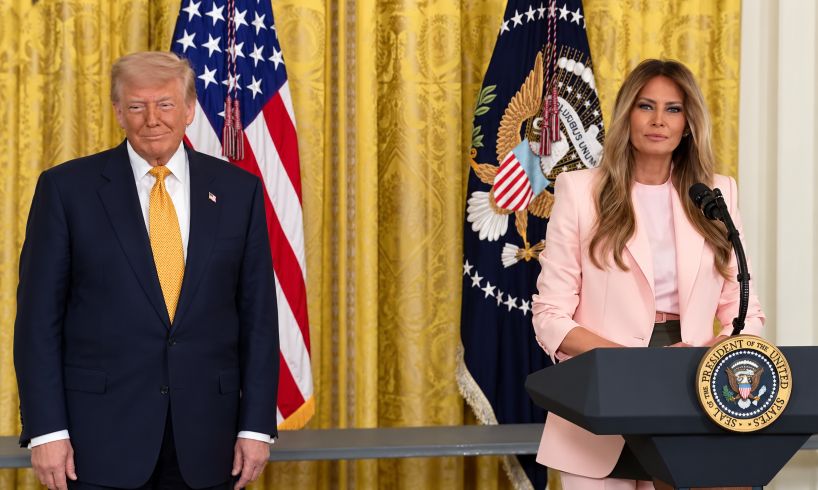
Melania Trump has announced another humanitarian development involving Russia and Ukraine, helping facilitate the return of nine more children to their families.
The White House confirmed the latest reunifications on Wednesday, November 25.
According to the administration, the first lady has now helped arrange seven rounds of reunifications involving a total of 43 children separated from relatives during the conflict.
The announcement is significant because it places Melania in an unusual diplomatic role.
While President Donald Trump continues trying to negotiate a broader settlement with Russian President Vladimir Putin and Ukrainian President Volodymyr Zelensky, the first lady has been involved in a separate effort focused on children and families.
The Associated Press confirmed the latest announcement, while Reuters reported that Russian and Ukrainian representatives acknowledged the reunifications.
Nine more children are reunited with their families.
The latest development involves nine children whose families had been separated during the war.
The White House said the reunifications were achieved through cooperation involving authorities from Russia and Ukraine.
Melania described the initiative as part of an ongoing commitment to help children affected by the conflict.
The latest operation brings the reported total to 43 children.
That figure is modest compared with the overall scale of displacement caused by Russia’s invasion.
Nevertheless, each successful reunification represents a meaningful outcome for the child and family involved.
The humanitarian significance does not depend on resolving the larger political dispute.
Melania has developed an unusual diplomatic role.
First ladies have historically supported charitable organizations, health initiatives and international humanitarian causes.
Direct involvement in matters connected with an active war is less common.
Melania’s participation reflects an increasingly visible interest in the situation of children affected by the Russia-Ukraine conflict.
The White House has presented her work as a humanitarian initiative conducted through communication with relevant officials.
The administration also credited her with helping facilitate previous reunifications.
However, the precise division of responsibility between her office, government agencies and international organizations is not fully established in the public reporting.
The effort should therefore be understood as a collaborative process rather than a unilateral action.
An important contrast with Donald Trump’s negotiations
The timing creates an interesting political contrast.
Trump’s negotiations with Putin and Zelensky remain focused on territory, security guarantees, and the terms of a possible peace settlement.
Those discussions involve major disagreements.
Russia continues to make demands that Ukraine rejects, while European governments are pressing to protect Ukrainian sovereignty and regional security.
Melania’s initiative operates on a narrower scale.
It focuses on particular children and families rather than the future of the entire conflict.
That limited objective may help explain why cooperation has been possible even while broader negotiations remain difficult.
Governments can disagree fundamentally about the terms of peace while still finding opportunities to resolve individual humanitarian cases.
The October ceasefire offers additional context.
The first lady’s efforts have also been connected to a temporary local ceasefire in southern Ukraine.
According to Associated Press reporting, a six-day pause in fighting around Oleshky, in the Russian-controlled part of the Kherson region, took place between October 27 and November 1.
The agreement was significant because localized ceasefires can allow humanitarian operations even when a comprehensive settlement remains out of reach.
But the pause was limited in geography and duration.
It did not establish a permanent ceasefire across Ukraine.
Nor does the latest reunification announcement mean Russia and Ukraine are close to resolving the conflict.
The 43-children figure is important but limited.
The White House’s total provides a measurable outcome for Melania’s initiative.
However, the number should be considered alongside the broader humanitarian crisis.
Thousands of Ukrainian children have been affected by displacement, family separation, and forced transfers during the war.
International organizations have repeatedly raised concerns about protecting children and establishing reliable processes for family reunification.
The latest initiative demonstrates that individual cases can be resolved through coordination. But it is not evidence that the overall problem has been solved.
The larger challenge remains ensuring that all affected families have access to appropriate information, legal protection and safe reunification procedures.
A new dimension to Melania’s public identity
Melania has generally maintained a selective public schedule during Trump’s second presidency.
Her humanitarian involvement gives her a policy-related profile that differs from traditional ceremonial appearances.
It also creates an unusual relationship between her work and her husband’s diplomacy.
Trump is pursuing a settlement involving the leaders of Russia and Ukraine.
Melania is participating in efforts that address one of the conflict’s most painful human consequences.
The two activities are related, but they should not be treated as interchangeable.
A successful family reunification does not necessarily indicate progress in negotiations over territory or military security.
Still, the latest announcement represents a concrete development.
Nine more children have reportedly returned to their families.
And for the first lady, the total of 43 reunifications marks a measurable milestone in a humanitarian initiative carried out during one of Europe’s most destructive modern wars.
Comments