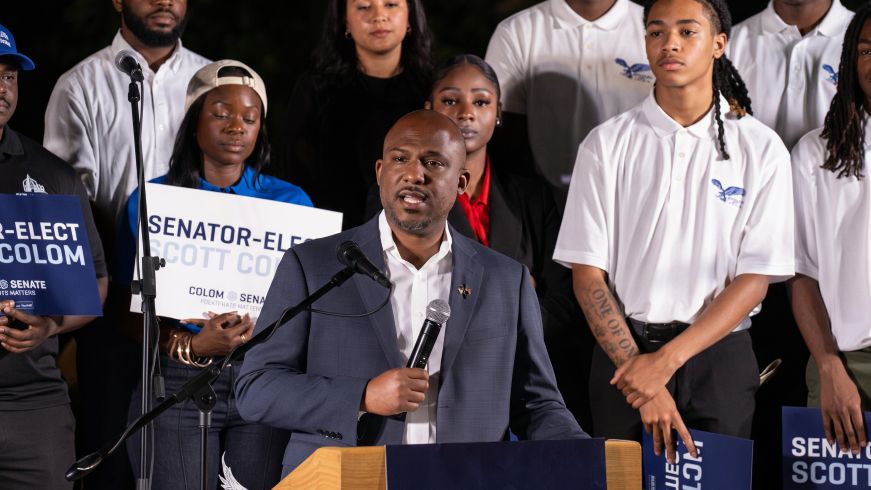
Mississippi Senator-elect Scott Colom has offered one of the most unconventional responses to a question about American foreign policy, openly admitting he does not fully understand the Middle East’s complicated political situation before delivering a pointed message about the United States’ priorities.
Rather than pretending to possess all the answers about the conflicts involving Iran, Israel and neighboring countries, the newly elected Democrat questioned why Washington continues devoting enormous attention and resources to a region whose problems have repeatedly defied American intervention.
His remarks, made during a November 24 appearance on The Clay Edwards Show, quickly circulated on social media, with some commentators praising the response as a welcome change from the well-rehearsed statements usually delivered by American politicians.
But the exchange also raises a more consequential question: Is Colom articulating the kind of foreign-policy restraint American voters increasingly favor, or does his admission reveal a potentially troubling lack of understanding of issues he will soon help decide as a United States senator?
The answer may be more complicated than either his admirers or critics initially suggest.
Scott Colom Makes an Extraordinary Admission About the Middle East
During the interview, Colom discussed President Donald Trump’s military intervention in Iran and the president’s earlier political promises to keep America out of prolonged foreign conflicts.
The Mississippi Democrat argued that Trump’s opposition to endless wars had been an important part of his political appeal, particularly for Americans who grew up watching the Iraq War and its aftermath.
Colom then made a striking admission.
“I don’t understand Middle East politics. It seems very complicated,” he said.
He went on to acknowledge the region’s religious divisions, competing national interests, and persistent conflicts before questioning what the United States had accomplished through decades of involvement.
His central argument was that Americans have domestic problems that call for immediate attention, including housing affordability, education, employment, and the monetary pressures facing ordinary families.
“You can’t try to solve every issue across the world,” Colom said.
The remarks were notable not because an American politician questioned foreign intervention — an argument with a long history in both parties — but because Colom openly acknowledged the limits of his own understanding.
In a political environment where elected officials frequently express absolute certainty about complicated international disputes, such candor is unusual.
Whether it translates into successful foreign policy remains to be seen.
Estimated gasoline-cost increases linked to the Iran conflict, April 2026.
Brookings Institution, April 27, 2026.
Historical estimates, not current November fuel prices.
Political Experts Say the Middle East Is Far More Complicated Than a Religious Conflict
Colom’s characterization of the Middle East as a region divided by longstanding Sunni and Shiite tensions reflects one important dimension of its politics.
However, foreign-policy experts have repeatedly warned against reducing the region’s conflicts to religious divisions alone.
F. Gregory Gause III, a prominent Middle East scholar whose research has examined competition between Iran and Saudi Arabia, addressed that problem in an analysis published by the Brookings Institution.
“Sunni versus Shia makes for a simple headline,” Gause wrote, arguing that the explanation does not capture the region’s full complexity.
His research stresses that governments frequently use sectarian identities to pursue strategic interests, compete for regional influence and strengthen domestic political alliances.
That distinction matters enormously.
The confrontation involving Israel and Iran, for example, cannot be explained simply as a conflict between Sunni and Shiite Muslims.
It involves competing security objectives, military capabilities, territorial disputes, alliances, ideological commitments, and the influence of outside powers.
Similarly, disagreements among predominantly Sunni countries demonstrate that shared religious traditions do not automatically produce shared political interests.
Colom is therefore correct that the region is exceptionally complicated.
But that complexity also places a responsibility on elected officials to understand the issues before making decisions involving military deployments, international assistance, and the possibility of war.
Admitting uncertainty can be a strength when it produces serious investigation and consultation with experts. It becomes a weakness if uncertainty substitutes for developing a coherent policy.
Trump’s Iran War Has Given Colom’s Message Greater Political Significance
The timing of Colom’s remarks is particularly important.
The United States entered a major military confrontation with Iran in February 2026, triggering months of regional unrest, disruption to energy markets, and growing public concern about the costs of another Middle Eastern conflict.
Although the most intensive phase of fighting has subsided, American naval operations and economic restrictions remain central to Washington’s confrontation with Tehran.
The political and economic consequences have been substantial.
William Galston, a senior fellow in governance studies at the Brookings Institution, examined the war’s domestic repercussions in a June 2026 analysis.
“Failed wars have consequences that endure longer than the presidents who start them,” Galston warned.
His assessment emphasized how prolonged military operations, rising energy costs, and uncertainty about strategic objectives can weaken public support for the administration responsible.
Colom’s argument closely reflects that concern.
Rather than evaluating American involvement in the Middle East exclusively through military objectives, he asks whether the intervention improves the lives of the people he represents.
That question resonated throughout his Senate campaign.
Gas Prices Helped Transform a Republican Stronghold Into a Democratic Victory
Colom’s political credibility rests partly on a remarkable electoral achievement.
On November 3, 2026, the Democrat defeated Republican incumbent Cindy Hyde-Smith in Mississippi, a state Donald Trump had carried by approximately 23 percentage points just two years earlier.
The victory made Colom the first Democrat elected to the Senate from Mississippi since 1982 and the state’s first Black U.S. senator since Reconstruction.
He accomplished that breakthrough by stressing issues that cut across conventional partisan divisions, including healthcare costs, gasoline prices, employment, and the economic difficulties facing Mississippi families.
During the campaign, Colom repeatedly connected rising fuel prices to the Iran conflict.
The economic connection was more than a political talking point.
In an April 2026 analysis, Brookings researchers Adie Tomer and Ben Swedberg estimated that the conflict had increased American gasoline prices by roughly $1 per gallon, adding approximately $70 per month to fuel expenses for a representative two-driver household.
The effect was particularly severe for lower-income households and communities where residents depend heavily on their personal vehicles.
For Mississippi farmers, transportation businesses and working families, those consequences were immediate.
Higher diesel prices increase the cost of transporting goods, operating agricultural equipment, and maintaining supply chains.
That means a military confrontation thousands of miles away can eventually affect the price of groceries, household necessities and other everyday purchases.
Colom’s foreign-policy message therefore connects directly to the economic arguments that helped him win an election few Democrats expected to capture.
Experts Warn That Ending America’s Involvement Is Not Necessarily Simple
Colom’s desire to place American domestic priorities ahead of foreign conflicts has political appeal.
But turning that philosophy into a workable national-security strategy presents considerable challenges.
The United States maintains longstanding military, diplomatic, and economic relationships throughout the Middle East.
A sudden withdrawal from regional commitments could affect energy markets, international shipping, allied governments, and the power balance involving Iran.
The risks of escalation remain substantial even without a return to full-scale warfare.
Michael Singh, a former senior Middle East director at the National Security Council who now works at the Washington Institute for Near East Policy, discussed the administration’s options in comments reported by the Associated Press on November 20.
“Patient strategy really looks like the most attractive approach,” Singh said.
His assessment stressed the potential costs of renewed military confrontation and the uncertainty surrounding its likely benefits.
Mona Yacoubian, director of the Middle East program at the Center for Strategic and International Studies, similarly described the situation as highly volatile, noting that neither Washington nor Tehran appeared keen to resume all-out warfare.
Those assessments complicate any argument that the United States can abandon the region without consequences.
There is a substantial difference between refusing to participate in unnecessary wars and withdrawing from the diplomatic and security relationships that may help avert future conflicts.
An effective policy of restraint requires carefully defined objectives, credible diplomacy and a realistic understanding of the consequences of American decisions.
Democrats May Have Discovered a Powerful Political Message
Colom’s comments also deserve attention because they question conventional assumptions about the Democratic Party’s approach to foreign affairs.
For decades, prominent Democrats and Republicans frequently defended American military involvement overseas as necessary to preserve global stability and safeguard national interests.
The experience of Iraq and Afghanistan, however, weakened the public’s confidence in ambitious armed interventions.
Trump recognized that political frustration amid his rise to power stemmed from his repeated criticism of previous administrations for costly wars and his promise to put American interests first.
Colom’s remarks suggest that Democrats may now be competing for some of the same voters who responded to those promises.
His political message is not that the United States should ignore the rest of the world.
During the campaign, he emphasized support for American national defense and assistance to allies facing threats.
He also called for clearer military objectives, stronger congressional oversight, and greater attention to the economic consequences of foreign-policy decisions.
Those positions are consistent with a more restrained approach to American involvement abroad rather than a pledge of complete isolationism.
For Democrats considering what lies ahead to the 2028 presidential election, the distinction could be important.
Voters skeptical of foreign wars may still support strong national defense, international trade, and diplomatic cooperation.
The political challenge is convincing them that American engagement overseas serves understandable purposes and produces benefits that justify its costs.
Scott Colom’s Honesty Could Become a Political Asset — or a Liability
There is an unmistakable attraction to hearing a politician acknowledge that a problem is difficult, rather than delivering another assured yet superficial explanation.
Colom’s remarks may appeal to Americans who have grown frustrated with promises that military force can quickly resolve conflicts rooted in decades of political history.
However, his new position carries responsibilities that go beyond expressing his constituents’ frustrations.
As a United States senator, he will be expected to evaluate defense legislation, consider military authorizations, scrutinize intelligence assessments, and make decisions affecting America’s relationships with allies and adversaries.
The complexity of the Middle East makes expertise more necessary, not less.
Colom will need to demonstrate that his skepticism about foreign intervention is informed by careful analysis rather than an unwillingness to engage with complicated international questions.
His earlier statements advocating congressional oversight and clear national-security objectives suggest that he recognizes at least some of those obligations.
The challenge will be translating them into legislative decisions.
Washington’s Most Important Question May Be the One Colom Is Asking
The significance of Colom’s comments ultimately goes beyond one interview or one newly elected senator.
For years, American presidents from both parties have justified military involvement overseas by citing threats to national security, commitments to allies, and the importance of maintaining international stability.
Those considerations continue to be legitimate.
But voters are also entitled to ask what particular interventions have accomplished, how much they have cost, and whether the same objectives could have been achieved through different means.
Colom’s remarks bring those questions back into the political conversation.
They do not establish that American disengagement would solve the Middle East’s conflicts, nor do they prove that every previous intervention was unnecessary.
Instead, they challenge Washington to explain why its involvement is necessary, what success would look like, and how American families benefit from the sacrifices being requested of them.
For a politician who just accomplished one of the most surprising victories of the 2026 midterm elections, that may prove to be a politically powerful argument.

Comments