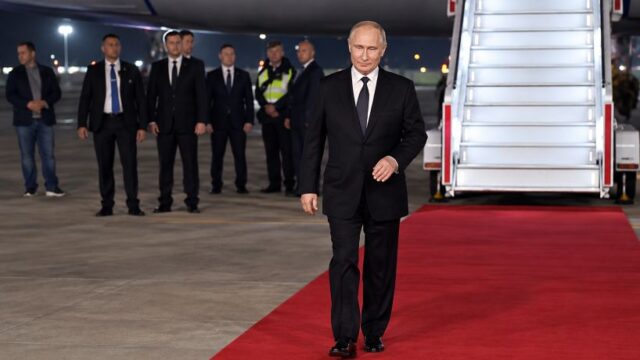
There was a staggering spectacle of political vulnerability and leadership failure in Moscow this week. While speaking at the United Russia Party conference, Russian leader Vladimir Putin, who for decades projected an aura of complete dominance, was a shadow of his former self.
For a warmonger who once promised a swift, multi-day triumph, the move quickly became a public relations disaster, exposing the deep cracks splintering his authoritarian regime.
The Russian president spent two consecutive nights having talks with Belarusian leader Alexander Lukashenko. With all media coverage strictly barred, intense global speculation has mounted that Putin was desperately trying to broker a peace deal to end the costly conflict with Ukraine.
This desperate diplomatic maneuvering highlights a crumbling facade of invincibility that shattered entirely when Putin was forced to deliver an uncharacteristic and devastating admission of domestic vulnerability.
As relentless Ukrainian drone and missile strikes continue to obliterate vital Russian energy infrastructure — leaving major oil refineries completely offline and sparking massive fuel panics at local petrol stations — the Russian strongman claimed that the state was reeling under severe domestic pressures.
Trying to put a brave face on the widening disaster, Putin confessed: “We are going through a difficult period, but it has taught us much.”
Panicked Electoral Posturing Amid Growing Domestic Chaos
The sheer panic vibrating through the senior ranks of the Kremlin became impossible to mask as attention turned to the upcoming State Duma parliamentary elections.
Trapped in a quagmire of global isolation, Western economic sanctions, and a highly embarrassing internal energy crisis, the autocrat desperately attempted to validate his authoritarian regime by promising standard democratic processes.
Defiantly pushing back against international condemnation and the reality of his heavily suppressed political opposition, Putin claimed: “Of course, we will defend against any type of outside intervention or attempt to influence our elections. I’m sure there will be open and free competition. Because adhering to these democratic institutions is a guarantee for the strength and security of our nation.”
Yet, the hollow, not to say empty, rhetoric did little to conceal the immense anxiety consuming the ruling elite. Political observers noted that the dictator appeared unusually frantic as he scrambled to address the massive disconnect between his comfortable Kremlin inner circle and an increasingly restive, exhausted Russian populace.
The Broken Strongman Begs for Feedback Loops
In what many international analysts are calling the ultimate humiliation, the Russian leader openly abandoned his typical top-down arrogance, instead issuing a desperate plea to his own party delegates.
Realizing that the devastating optics of burning infrastructure and endless civilian fuel queues are actively destroying his political capital, the embattled dictator openly begged his politicians to escape their insulated offices to manage the growing public anger.
Demanding immediate damage control on the ground, Putin stated: “You need to spend less time in offices and more time in the field, talking to the people, meeting with folks, and understanding what they think, what they worry about, and test out all kinds of initiatives that you receive from the people through feedback loops.”
Ultimately, the frantic performance did nothing to mask Russia’s undeniable war failures. By emerging from seclusion only to beg for civilian feedback and publicly acknowledge severe internal trauma, the deeply humiliated dictator has signaled to the entire world that control is rapidly slipping through his fingers.
The crumbling strongman is reportedly enduring sleepless nights over fears of a coup from rogue soldiers and enemy nations.
He is also dealing with Russia’s fractured wartime economy, plunging into a brutal downward spiral.
Plagued by skyrocketing inflation, a severe labor shortage, and a crippling budget deficit, the panicked regime is facing an unsustainable reality. Compounding these existential threats is the catastrophic loss of vital oil refining capacity following relentless Ukrainian drone blitzes.
Trapped under the crushing weight of global sanctions and an increasingly vulnerable dependence on China, the Kremlin’s strict command structure is visibly fracturing on the global stage.