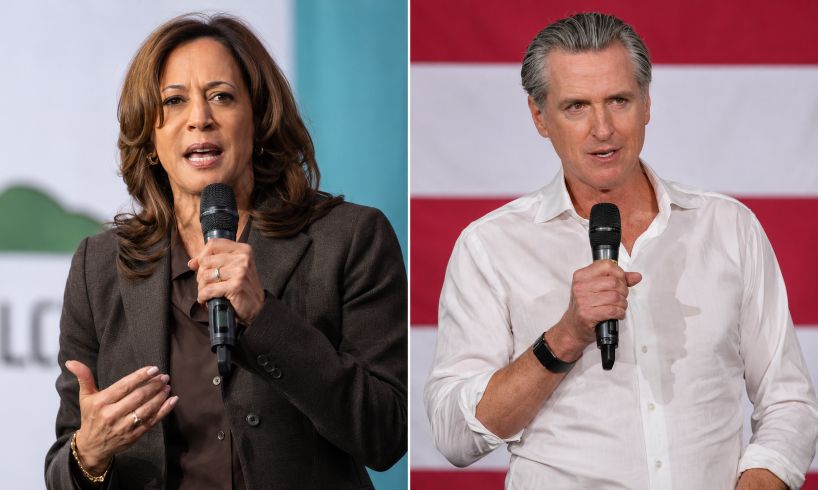
Kamala Harris and Gavin Newsom came together in Los Angeles on Sunday with California’s election just two days away. Their mission was to boost Xavier Becerra’s gubernatorial campaign. Yet seeing the two share a stage brought another political contest into focus, one neither has officially entered: the 2028 presidential race.
The former vice president and California governor spoke at the Hollywood Palladium alongside Sens. Alex Padilla and Adam Schiff. It was Harris and Newsom’s first joint public appearance of the year, according to reporting published November 2. Both praised Becerra, who is running against Republican Steve Hilton to succeed Newsom. Neither announced a presidential campaign.
The reunion followed a week in which Harris gave a more expansive message than a standard get-out-the-vote speech. At events in Georgia, she argued that Democrats must prepare to govern decisively if voters give them power. She also returned to a question she has repeatedly declined to settle: whether she intends to run for president again.
A Hollywood Rally With Two Political Timelines
Sunday’s event was officially about Tuesday’s ballot, not 2028. Becerra, a former U.S. health secretary, is seeking California’s governorship. Hilton has emphasized issues including high living costs, homelessness and tax reductions, while Becerra has tied his campaign to criticism of President Donald Trump and Democratic priorities.
Becerra had some of California’s most recognizable Democrats campaigning for him. Harris and Newsom were there to support him, but their appearance together also attracted attention because both continue to be mentioned as possible presidential candidates in 2028.
The Washington Post described the event as their first joint appearance in nearly a year. The New York Times similarly noted that their mutual stage offered little indication of what either would decide after Election Day. A photograph of both politicians appearing together is evidence of cooperation that evening, not evidence of an alliance or a private deal over the next presidential nomination.
Harris’s Sunday remarks focused on voters’ frustrations with the administration and the cost of everyday life. Speaking in Los Angeles, she framed concerns about groceries, gasoline and health care as reasons she believed people were demanding political change. Those were campaign arguments, not measures of how Tuesday’s results would unfold.
Harris’s Georgia Message Went Further Than Turnout
The Los Angeles reunion attracted attention, but Harris’s recent speeches in Georgia may reveal more about the political argument she wants to make.
At a late-October gathering for Fulton County Democrats, she said her party should not treat an election victory as a finish line. She called for a willingness to use political power to deliver on commitments, describing that resolve as a kind of “ruthlessness” that she explicitly distinguished from cruelty.
Harris took aim at Trump’s actions in office and urged Americans frustrated with his administration to make their voices heard at the ballot box. She called for turnout that would be “too big to rig,” though she offered no evidence that the upcoming election had been compromised.
In more general recent remarks, Harris has also raised structural proposals, including Supreme Court expansion, statehood for Washington, D.C., and Puerto Rico, and changes to the Electoral College. Supporters regard such measures as ways to change representation and government accountability. Opponents question their constitutional, practical, and partisan implications. None could be implemented through a midterm campaign speech alone.
A 2028 Answer She Still Has Not Given
Harris’s travel schedule has carried her through Georgia, Nevada, Mississippi, New Hampshire, Wisconsin and Michigan, where she campaigned for Democratic nominees. Some are states with important roles in presidential nomination contests, a fact that prompts questions about the longer-term meaning of her appearances.
But Harris has repeatedly said the 2026 midterms come first. In a recent conversation with actor Keke Palmer, she said she had not decided whether to seek the presidency in 2028. Her campaign activity does not resolve that question, and neither does Newsom’s presence next to her in Hollywood.
Harris still has plenty of supporters and strong ties within the Democratic Party. But there is no getting around her loss to Trump in 2024. The crowds welcoming her back to the campaign trail suggest she remains popular with party activists, even if they tell us little about her broader appeal.
Newsom faces his own political decisions as he approaches the end of his governorship. For now, both politicians are publicly campaigning for other candidates rather than declaring rival presidential campaigns.
What Election Day Can — and Cannot — Settle
As Americans vote on November 3, Harris has two overlapping political roles. She is campaigning for candidates facing immediate decisions at the ballot box, and she is participating in a longer argument over what Democrats should stand for after their 2024 defeat.
The midterms will determine offices, legislative power and the direction of state governments. They will not, on their own, choose a Democratic presidential nominee for 2028. Nor will the results determine whether Harris’s turnout appeals, Newsom’s appearances, or any one speech changed a particular voter’s mind.
Harris and Newsom came together to support Becerra, but their own political futures remain uncertain. Harris also used the final days of the campaign to explain what she believes Democrats should do with political power. Once the midterms are over, attention will inevitably return to what comes next for both California politicians.


Comments (0)