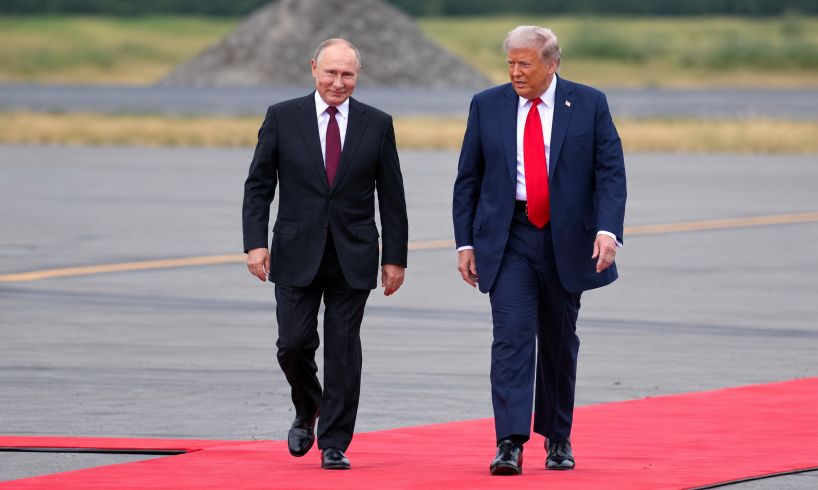
Vladimir Putin is suddenly saying peace with Ukraine may be possible. At almost exactly the same moment, Russia is escalating attacks, boasting about battlefield gains and signaling that Moscow believes additional military pressure could still pay off. For Jared Kushner and Steve Witkoff, the contradiction may be the most important part of their mission.
Vladimir Putin is opening the door. Just not very far. The Russian president spent more than three hours Saturday inside the Kremlin with two of President Donald Trump’s most important negotiators, Jared Kushner and special envoy Steve Witkoff, discussing Washington’s latest effort to end the war in Ukraine.
There were handshakes and some praise for Trump. Moreover, they even had a discussion about potentially lucrative future economic cooperation between the United States and Russia.
Putin has also delivered something Washington has been desperate to hear. Peace, he says, is possible.
“Is there a chance? In my view, yes, there is,” Putin said Thursday when discussing prospects for an agreement ending the war.
Two days later, Kushner and Witkoff were sitting across the table from him. But another Vladimir Putin has been speaking at exactly the same time.
That Putin says Russia is winning and he predicts Ukraine will eventually break. This same person insists Moscow is making “real progress” on the battlefield and remains confident it can accomplish its objectives.
And that Putin has shown no sign of abandoning Russia’s sweeping territorial and security demands.
The Trump administration therefore faces a question considerably more complicated than whether Putin is willing to negotiate.
What if Putin is willing to negotiate precisely because he believes he can keep fighting at the same time?
72 Hours of Contradictions
The remarkable sequence unfolded in barely three days.
Thursday: Putin publicly offered one of his more encouraging assessments of peace prospects, saying he believed an agreement remained possible. Trump, meanwhile, said he wanted the war and the deaths on both sides to end.
Friday: A Russian drone slammed into the headquarters of Ukraine’s SBU security service in central Kyiv, one of the highest-profile Ukrainian government facilities struck during the entire war. At least 12 people were injured, according to Kyiv’s mayor.
Saturday: Putin welcomed Kushner and Witkoff to Moscow and spent more than three hours discussing possible paths toward peace.
Kremlin foreign-policy adviser Yuri Ushakov called the negotiations “highly useful.” A White House official separately described them as substantive.
There was no announced breakthrough.
The contradiction did not disappear once everybody entered the negotiating room.
According to the Kremlin, Putin emphasized Russia’s battlefield gains directly to Kushner and Witkoff, telling them Moscow was making “real progress” and remained confident that Russia would achieve its goals.
He again insisted that any settlement must address what Moscow describes as the “root causes” of the conflict.
Putin was talking about peace. He was also talking like a man who believes he is winning. That may be the single most important detail of the entire meeting.
Why Compromise Now If Putin Thinks He Is Winning?
Only four days before receiving Trump’s negotiators, Putin delivered an unusually confident assessment of Russia’s military position.
“I have no doubt the enemy will crumble,” he told reporters.
Putin claimed Russian forces captured approximately 270 square kilometers of Donetsk during August and were continuing to advance toward Sloviansk and Kramatorsk.
Reuters said it could not independently verify those battlefield assertions.
Putin also said Russia was preparing massive strikes against Ukrainian energy infrastructure.
There is an obvious negotiating dilemma buried inside those statements.
If Putin genuinely believes Russia’s position is improving, what incentive does he have to make major concessions today?
A leader who thinks time is working against him may desperately search for an exit.
A leader who thinks time is working for him has a different calculation.
That does not mean Putin has secretly decided against peace. Russia has economic, military and political reasons to consider ending a war that has now lasted more than four years.
But Moscow does not necessarily have to choose immediately between negotiations and continued warfare.
It can pursue both.
Putin can discuss an American peace proposal on Saturday while continuing to believe that additional Russian advances could strengthen his bargaining position later.
That possibility does not require assuming deception.
It requires only recognizing that negotiations themselves can have strategic value.
The Kremlin Is Still Demanding More
There is another problem for Washington.
Russia’s fundamental negotiating position has not visibly collapsed.
Reuters reported that the Kremlin reiterated Friday that Putin’s previous demand for Ukraine to surrender the entirety of four regions claimed by Russia and abandon its ambition to join NATO remained “unshakeable.”
Ukraine rejects those conditions.
The gulf remains enormous.
Even more strikingly, a person close to the Kremlin told Reuters before the latest visit that Putin remained intent on capturing additional territory and did not expect agreement over the front line until Russia secured the remainder of Donetsk.
Western military analysts cited by Reuters consider Moscow accomplishing that objective on Putin’s apparent timetable unlikely because Russian advances have been relatively slow.
Still, the account matters because it illustrates the central problem confronting Kushner and Witkoff.
They are attempting to negotiate with a Kremlin that may believe the battlefield can still improve the terms available at the negotiating table.
Then Russia Hit Ukraine’s Security Headquarters
The timing could hardly have been more dramatic.
One day before Putin welcomed Trump’s envoys to Moscow, a Russian drone hit the SBU headquarters in Kyiv.
The attack targeted the office of the agency’s chief, according to Ukrainian President Volodymyr Zelenskyy.
“The drone was aimed directly at the office of the Head of the Security Service,” Zelenskyy said.
The strike came during the tenth consecutive day of Russian air attacks on the Ukrainian capital.
Government buildings in Kyiv have rarely been damaged during the war, making the SBU strike especially significant.
Ukraine is escalating its own long-range campaign as well.
Kyiv has repeatedly attacked Russian refineries, oil terminals and other infrastructure in an effort to raise Moscow’s economic cost of continuing the war. Ukraine subsequently agreed to refrain from attacking Moscow while the American delegation traveled through Russia, while Putin ordered Russian forces not to strike Kyiv for three days surrounding the U.S. visit.
That temporary restraint should not be mistaken for a broader ceasefire. Russian and Ukrainian forces remain capable of resuming large-scale attacks, and both governments are continuing to prepare for the possibility that diplomacy fails to produce an agreement.
Western Intelligence Is Reportedly Skeptical
The doubts about Moscow’s intentions are not confined to officials in Kyiv. Reuters reported Friday that most Western intelligence officials remain skeptical that Putin is interested in reaching a short-term agreement, while Ukrainian intelligence believes Russia may be preparing to escalate rather than de-escalate in the near future.
Those assessments do not establish Putin’s intentions, and intelligence judgments are not infallible. They nevertheless provide important context for Trump’s decision to send Jared Kushner and Steve Witkoff back into negotiations with Moscow. The administration is confronting more than a disagreement over borders, security guarantees or the mechanics of a ceasefire. It must also determine whether Moscow and Kyiv share anything approaching the same urgency for ending the war.
That distinction could determine whether the newest diplomatic push produces meaningful negotiations or simply another prolonged round of talks conducted while the fighting continues.
Putin Has Very Little to Lose by Talking
The negotiations also raise an uncomfortable but important strategic question: What does Putin actually sacrifice by continuing to engage with Washington?
Even without assuming that Moscow is negotiating in bad faith, the potential benefits are clear. Continued talks allow Russian officials to examine Washington’s proposals, determine what concessions might be available, press their own demands directly with Trump’s representatives and explore whether an eventual settlement could deliver political or economic advantages that continued warfare alone cannot provide.
The economic dimension became particularly visible during Saturday’s discussions. Kremlin foreign-policy adviser Yuri Ushakov said the meeting extended beyond Ukraine and included detailed conversations about economic issues and potentially significant Russian-American projects that could benefit both countries.
That creates another possible source of leverage. For Moscow, ending the war could eventually reopen opportunities for a broader economic relationship with the United States. For Washington, the prospect of normalization gives the Trump administration something it can potentially offer — or continue withholding — during negotiations.
The administration has already made clear that those benefits are not available unconditionally.
Trump Administration Keeps Economic Pressure on Moscow
That message was delivered directly when Treasury Secretary Scott Bessent met Russian Finance Minister Anton Siluanov at the G20 finance meeting in North Carolina. According to a source familiar with their discussion, Siluanov attempted to raise areas of potential mutual economic interest before Bessent responded with an unusually direct warning.
“Nothing is possible until the war is over,” Bessent said.
The exchange makes the economic discussions inside the Kremlin particularly noteworthy. Washington appears to be leaving open the possibility that relations with Moscow could look considerably different after a peace agreement, while simultaneously making clear that Russia cannot expect those benefits simply for participating in negotiations.
For Putin, that gives diplomacy a potential economic reward. For the Trump administration, it creates another bargaining tool alongside sanctions, political pressure and negotiations over Ukraine’s future. Whether those incentives are substantial enough to alter the Kremlin’s military calculations remains unknown.
Kushner and Witkoff Hear Putin First — Then Zelenskyy
The structure of the American mission also places Kushner and Witkoff in an unusual position. After meeting Putin in Moscow, the two men are expected to travel to Kyiv for talks with Ukrainian President Volodymyr Zelenskyy on Sunday.
Witkoff has visited Moscow repeatedly during the Trump administration’s effort to negotiate an end to the war, but Reuters reported that he had not previously traveled to Ukraine in this particular negotiating role. The latest mission therefore puts the American delegation directly between two governments presenting sharply different interpretations of the conflict and what an acceptable settlement would require.
Putin has emphasized Russian battlefield advances while continuing to insist that Moscow’s underlying demands must be addressed. Zelenskyy, meanwhile, has repeatedly rejected the idea that Ukraine should simply surrender territory Russia has been unable to fully capture through more than four years of war.
Kushner and Witkoff are effectively carrying the same American peace initiative between two capitals whose definitions of peace remain far apart. Their task is not merely to relay proposals but to determine whether enough overlap exists to turn parallel conversations into an actual negotiation.
Could Kushner and Witkoff Be Getting Played?
That is where the more provocative question surrounding the mission emerges: Could Putin be using the diplomatic process to gain time, test Washington’s limits or improve Russia’s position without having made a genuine decision to compromise?
There is currently no public evidence establishing that Putin entered the talks simply to deceive Kushner, Witkoff or Trump. Treating negotiations themselves as proof of Russian bad faith would go beyond what is known.
There is, however, a crucial distinction between Putin being willing to negotiate and Putin being willing to make the concessions necessary for an agreement. Moscow can participate seriously in discussions while simultaneously believing that additional battlefield pressure will improve the deal eventually available to Russia.
In modern conflicts, diplomacy and military pressure frequently operate at the same time. Governments may prepare for negotiations while also preparing for those negotiations to collapse. That is precisely why Washington’s recent experience with Iran offers a useful, if imperfect, comparison.
The Iran Parallel
Kushner and Witkoff confronted a similar diplomatic paradox earlier this year, although under very different circumstances, when they participated in indirect negotiations with Iran over Tehran’s nuclear program.
Iranian Foreign Minister Abbas Araqchi said afterward that the sides had reached an understanding on broad “guiding principles” and suggested that a diplomatic agreement remained possible. At virtually the same time, however, two U.S. officials told Reuters that American military planning for potential strikes against Iran had reached an advanced stage. Trump publicly acknowledged that he was considering limited military action, even as Iran prepared its own counterproposal.
The important lesson is not that Iran necessarily deceived the American negotiators. Washington itself was negotiating while simultaneously preparing military options, demonstrating that diplomacy and preparations for confrontation can proceed along parallel tracks.
The talks ultimately did not prevent another military confrontation involving Washington and Tehran. That history makes the Russia negotiations particularly relevant: the existence of serious discussions does not, by itself, prove that either side has made the strategic decision to de-escalate.
That is the more meaningful parallel facing Kushner and Witkoff now. Putin can genuinely explore an agreement while continuing to prepare Russia for the possibility that no agreement is reached.
Trump Says He Has a New Idea
Trump has nevertheless remained publicly optimistic about the latest effort. “We have an idea for peace,” the president said Friday while announcing the mission, describing Kushner and Witkoff as strong negotiators and suggesting that an agreement could still be possible.
The administration has not publicly disclosed the full details of its newest proposal, making it difficult to determine whether the plan contains compromises capable of narrowing the substantial gap between Moscow and Kyiv.
Previous U.S.-mediated efforts have stalled without producing a lasting settlement, and several of the fundamental disagreements that complicated those negotiations remain unresolved. Russia continues to demand major territorial and security concessions, while Ukraine continues to insist that any agreement must preserve its sovereignty and protect it against future Russian attacks.
Putin’s more receptive rhetoric therefore represents an important diplomatic development, but rhetoric alone cannot establish that Moscow’s underlying calculations have changed. The decisive question is whether the Kremlin is now prepared to modify positions it previously treated as non-negotiable.
Pressure Is Building Beyond Ukraine
The negotiations are also unfolding against a broader confrontation between Russia and the West that extends well beyond the Ukrainian battlefield.
On the same day Putin met Kushner and Witkoff, U.S. Ambassador to NATO Matthew Whitaker warned that alliance members could not tolerate deliberate hybrid actions targeting NATO countries. Whitaker cited an attempted drone attack at Germany’s Leipzig/Halle Airport that Berlin has blamed on Russia, along with incidents in Poland. Russia has denied German allegations concerning the Leipzig episode.
Whitaker said NATO countries must remain vigilant and deliver an unmistakable message when responsibility for such actions can be established: “We will not tolerate it.”
The timing illustrates the complexity surrounding Washington’s diplomacy with Moscow. American representatives were meeting Putin in the Kremlin in an effort to end the war in Ukraine while another senior U.S. official was warning NATO members about alleged Russian activity elsewhere in Europe.
Even a successful Ukrainian settlement would therefore leave unresolved a wider dispute over Russia’s relationship with NATO, European security and Moscow’s willingness to challenge Western governments outside the conventional battlefield.
The Real Test Comes After the Handshakes
Putin has nevertheless given Trump enough to keep the diplomatic process moving. He has publicly acknowledged the possibility of a settlement, spent more than three hours with the American delegation, temporarily halted strikes on Kyiv surrounding their visit and allowed discussions to extend beyond immediate military questions into possible future economic cooperation.
Those developments are meaningful, and dismissing them as empty theater would be premature. At the same time, they exist alongside evidence pointing in a very different direction.
Putin continues to portray Russian forces as advancing. Moscow’s central territorial demands remain intact. Western intelligence officials reportedly remain skeptical about the Kremlin’s willingness to reach a near-term agreement, while Russian attacks have continued to place enormous pressure on Ukraine.
Perhaps most importantly, Putin continues to speak not only as a leader considering an exit from the conflict but also as a commander who believes additional military pressure could still improve Russia’s position.
Kushner and Witkoff are now expected to carry Washington’s latest initiative from Moscow to Kyiv, where they will hear Zelenskyy’s assessment of the same negotiations. The next stage should provide a clearer indication of whether the latest diplomatic opening is beginning to narrow the gap between the two sides or merely creating another channel through which they can pursue fundamentally incompatible objectives.
The handshakes in Moscow are significant, but so are the military preparations occurring around them. Determining which better reflects Putin’s long-term intentions may now be the central challenge facing the Trump administration’s peace effort.

Comments (0)