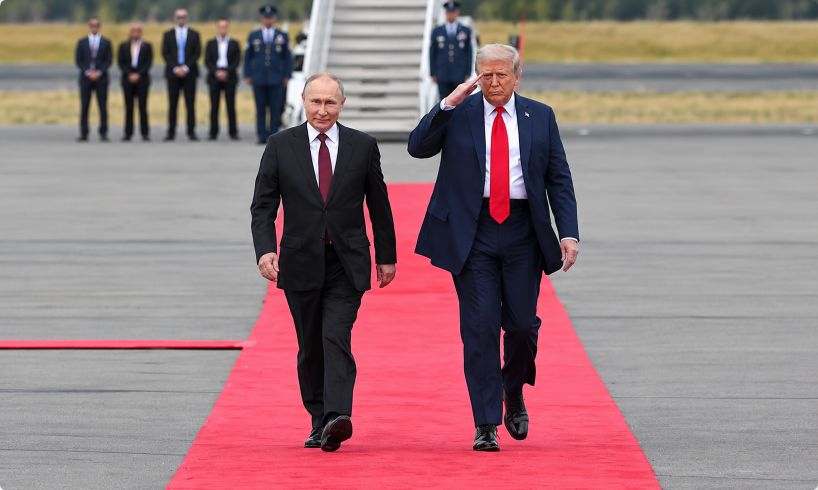
Vladimir Putin continues to tell Donald Trump that Russia has no aggressive intentions toward Europe, but those reassurances are becoming increasingly difficult to square with the threatening rhetoric coming from Moscow and the continuing Russian attacks on Ukraine. According to the Kremlin, Putin told Trump that Russia does not intend to attack European countries, even as European officials are watching Russian military activity move closer to their own borders.
The contrast became particularly striking after former British Prime Minister Boris Johnson found himself on a diplomatic train in Ukraine that narrowly avoided a Russian drone strike. A passenger train traveling behind the one carrying Johnson and other Western officials was hit by a Russian drone, turning what could have been an ordinary diplomatic journey into a frightening reminder of how close the war can come to European leaders.
Johnson was not injured, and there is no established evidence that his particular train was deliberately targeted, but the timing was nevertheless unsettling, particularly given the increasingly aggressive threats that have been coming from senior Russian officials.
Just days earlier, Dmitry Medvedev, Russia’s former president and current deputy chairman of the Russian Security Council, had issued threatening remarks about European officials traveling to Kyiv by train while also warning that Russian strikes could extend to military facilities in Germany.
Medvedev was responding to accusations surrounding an alleged Russian attack involving Leipzig airport, writing: “Berlin has charged Russia with an unproven attack on Leipzig airport. Taking into account the neo—Nazi, ardently Russophobic course of the current leadership of Germany, the invented sabotage is the weakest form of punishment for their sins,”
He also referred ominously to Western leaders traveling to Kyiv by train, remarks that attracted attention because European officials regularly use the railway route to reach the Ukrainian capital.
That backdrop makes the incident involving Johnson even more uncomfortable, although it would be irresponsible to claim that Medvedev’s remarks prove Russia deliberately attempted to assassinate Johnson. The available reporting establishes that the train carrying Johnson was ahead of the train that was struck, not that Johnson’s train itself was attacked.
Johnson nevertheless responded angrily to the Russian strike, writing: “I don’t know what warped logic drove Putin to blow up a stationary Ukrainian locomotive on the Polish border this morning.”
He continued: “What we can say for sure is that this is the kind of random and senseless attack Ukrainians are enduring every day – even on civilian railways.”
Johnson also highlighted the devastating human cost of attacks on Ukraine’s railway system, adding: “So far Putin has been responsible for the deaths of 1700 staff of Ukrzaliznytsia – Ukrainian Railways. They and their daily passengers are absolutely heroic.”
And he asked the question that continues to confront Western governments: “When are we going to give them the air defences they need? Why won’t we unfreeze Putin’s cash and give it to Ukraine?”
That is the petrifying contradiction at the heart of the latest episode. Putin can tell Trump that Russia has no aggressive intentions toward Europe, while Russia’s war continues to produce attacks that alarm European governments and threaten people traveling through Ukraine.
For Trump, Putin’s assurances may sound like diplomacy. For European leaders watching Russian drones strike nearby, the reality is considerably harder to dismiss.
And for Boris Johnson, the journey offered another chilling reminder that while Putin may tell Trump that Europe has nothing to fear, European officials traveling through a country at war do not have the luxury of treating those words as enough.

Comments (0)